
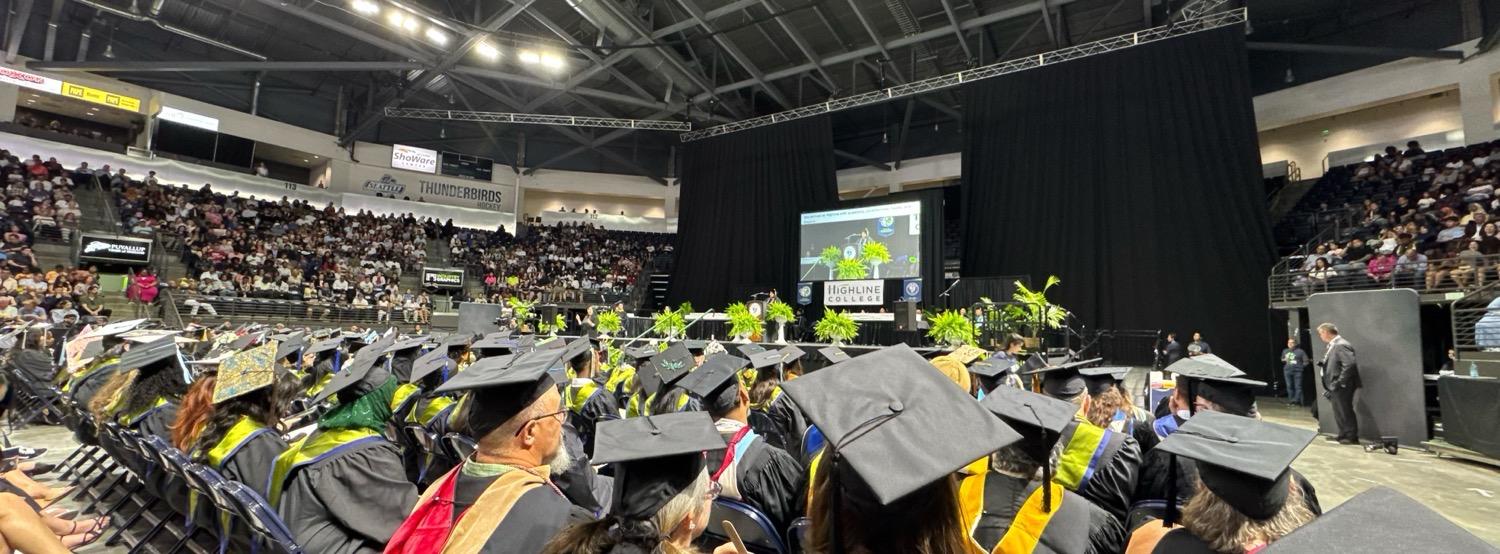
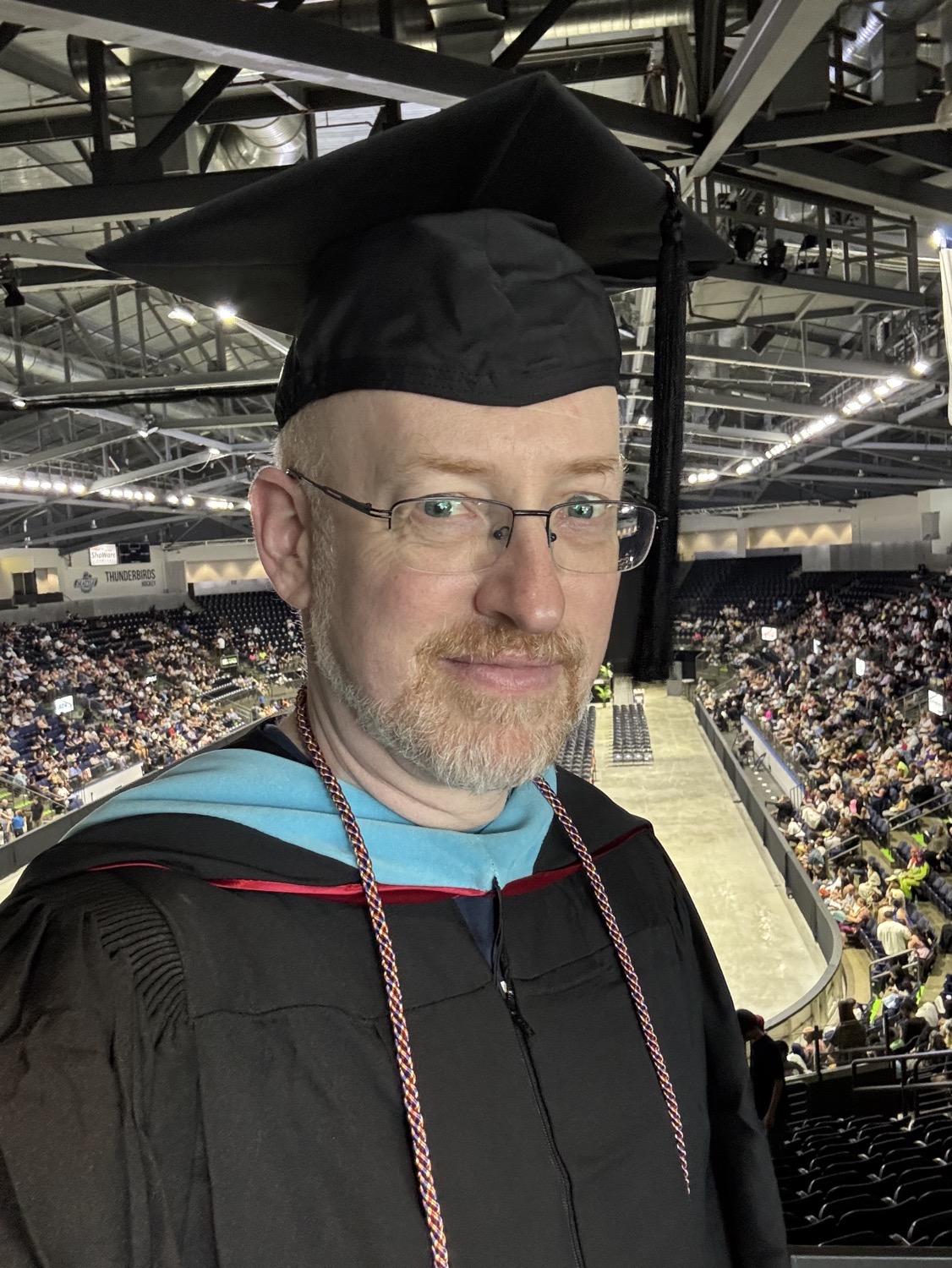
- 🎓 This week was Highline’s graduation week, with the commencement ceremony on Thursday. We had a record number of graduates this year (almost 900 signed up to walk in the ceremony), and still managed to wrap up the ceremony in just slightly under two and a half hours. Not bad!
-
🍾 Happy anniversary to us! Friday was our thirteenth anniversary. Rather than doing anything big, as we just made it through graduation week and have plans coming up next weekend and beyond, we celebrated by having a quiet weekend of naps, reading, and movies here at home.
-
🌞 Happy solstice! Summer is officially here.
📸 Photos
📚 Reading
-
Michael Chabon’s The Yiddish Policemen’s Union, a noir detective mystery in an alternate-present Sitka, Alaska.
-
Meg Elison’s latest, Foundling Fathers, a very funny and sharp bit of sci-fi political satire that I really enjoyed.
📺 Watching
-
Fantasy Island (2020): A horror prequel-of-sorts to the ’70s TV show. It was entertaining enough for a lazy afternoon.
-
TRON: Ares (2025): Looks great, sounds great, no real substance and completely breaks my suspension of disbelief.
🔗 Linking
-
Daniel Beekman at the Seattle Times: Seattle uses AI to help triage, divert 911 medical calls (archive.is mirror of a paywalled original): “For more than two years, a Denmark-based company’s artificial intelligence technology has been listening to Seattle residents’ 911 medical calls without their knowledge. ¶ And the Seattle Fire Department has been using the company’s AI to help dispatchers decide which callers don’t deserve a rapid response.”
-
Catalina Gaitán at the Seattle Times: Judge to decide fate of Seattle’s unofficial nude beach (archive.is mirror of a paywalled original): I’ve never been to this beach, but I know people who have and who would be disappointed if the NIMBYs got their way.
-
James D. Walsh at New York magazine: Everyone Is Cheating Their Way Through College (archive.is mirror of a paywalled original): “In January 2023, just two months after OpenAI launched ChatGPT, a survey of 1,000 college students found that nearly 90 percent of them had used the chatbot to help with homework assignments. In its first year of existence, ChatGPT’s total monthly visits steadily increased month-over-month until June, when schools let out for the summer. (That wasn’t an anomaly: Traffic dipped again over the summer in 2024.) Professors and teaching assistants increasingly found themselves staring at essays filled with clunky, robotic phrasing that, though grammatically flawless, didn’t sound quite like a college student — or even a human. Two and a half years later, students at large state schools, the Ivies, liberal-arts schools in New England, universities abroad, professional schools, and community colleges are relying on AI to ease their way through every facet of their education. Generative-AI chatbots — ChatGPT but also Google’s Gemini, Anthropic’s Claude, Microsoft’s Copilot, and others — take their notes during class, devise their study guides and practice tests, summarize novels and textbooks, and brainstorm, outline, and draft their essays. STEM students are using AI to automate their research and data analyses and to sail through dense coding and debugging assignments. ‘College is just how well I can use ChatGPT at this point,’ a student in Utah recently captioned a video of herself copy-and-pasting a chapter from her Genocide and Mass Atrocity textbook into ChatGPT.”
-
Jake Goldstein-Street at the Washington State Standard: Battle ramps up over WA ballot measure to bar transgender students from girls’ sports: In case you thought Washington was too blue to have to deal with this transphobic crap.
-
Andy Baio: The Wholesale Plagiarism of Obscure Sorrows: “It’s one thing for a fan to share or remix copyrighted material out of love for the source material, with no commercial motive. (‘No copyright intended!’) It’s another for a marketing agency to take an entire living author’s book, replace its art with AI slop, add an AI word generator, monetize the traffic, promote it in their portfolio, and then outrank the official site everywhere.”
-
Maggie Harrison Dupré at Futurism: Google’s AI Overviews Feature Is Telling Users That SCP Horror Fiction Entities Are Real: “As the lore goes, the SCP Foundation is a non-government organization that collects and contains supernatural discoveries. Writers catalogue these fictional phenomena — which range from the terrifying to the downright bizarre — in the form of fake records, studies, research documents, and logs, all of which are indexed in a sprawling archive. ¶ The key word, of course, is ‘fake.’ Google’s AI Overviews, it turns out, has a bad habit of presenting entities from the expansive SCP universe as real items, events, or beings — blatantly confusing those fabricated studies and records as actual evidence of horrifying or otherworldly happenings.”