♿️ Been a very busy couple weeks of work as we’ve been approaching the start of classes for the fall quarter. In addition to the usual preparations and appointments with students, I’ve been part of our Opening Week planning committee. Part of that was helping to make sure that accessibility was kept in mind as we were planning the week’s activities, and part was serving on a subcommittee to come up with a “community engagement” activity.
We tried to come up with a pub quiz-inspired trivia activity (created by people who’d never done pub trivia) that would work both for people there in person and those who were attending via Zoom, with questions drawn from the college’s history. While there were definitely still some bumps, overall I think we did okay; we’ll see what people say as evaluations of the week come in. (A few have come in already, and so far…well, responses are definitely mixed. So it goes!)
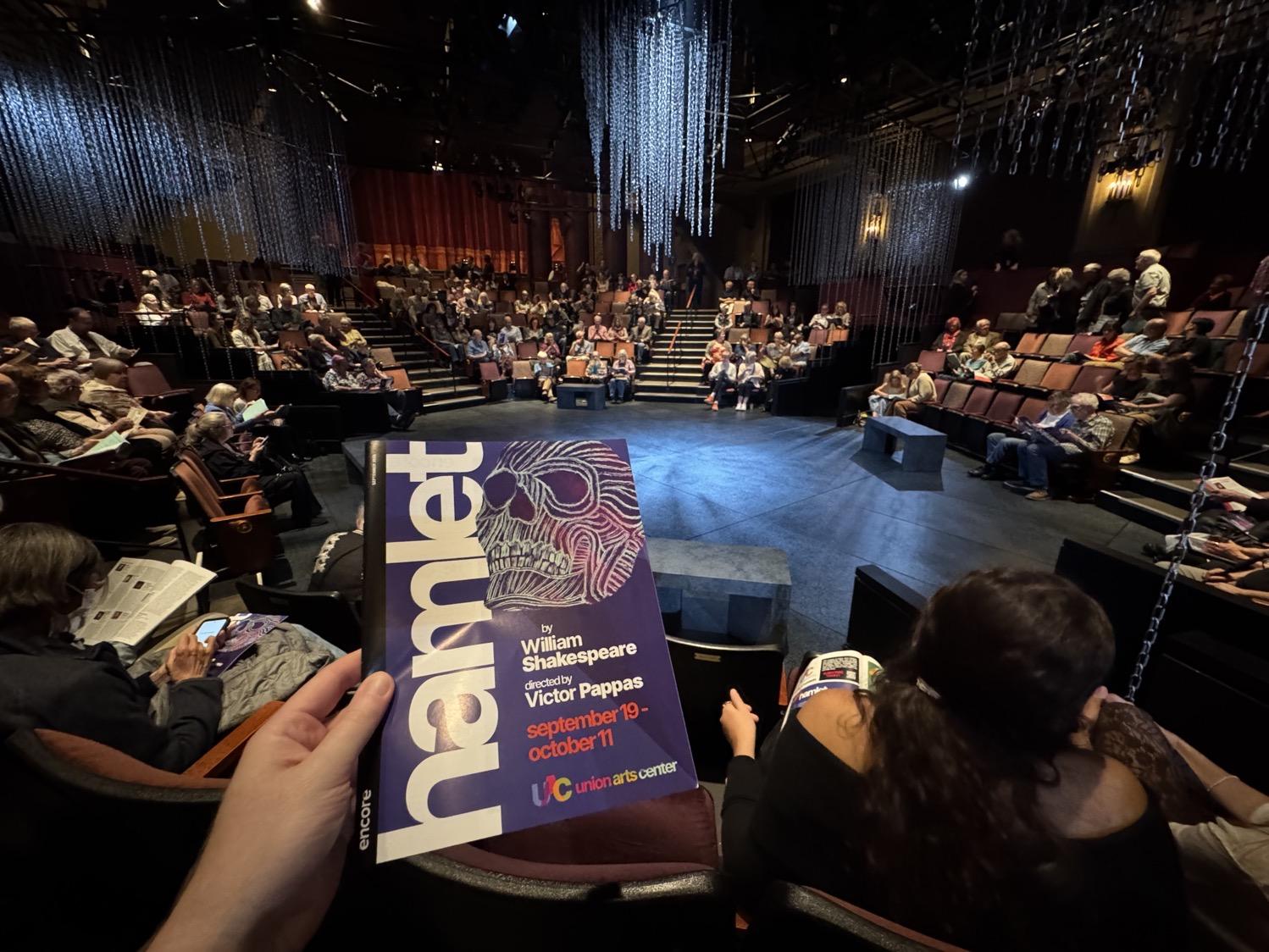
🎭 Last Sunday we went to the Union Arts Center’s production of Hamlet with a friend from work, and really enjoyed it. Done in a nice small theater in the round, with a minimalist set, and some very strong performances. If you’re local to Seattle, it runs through Oct. 11.
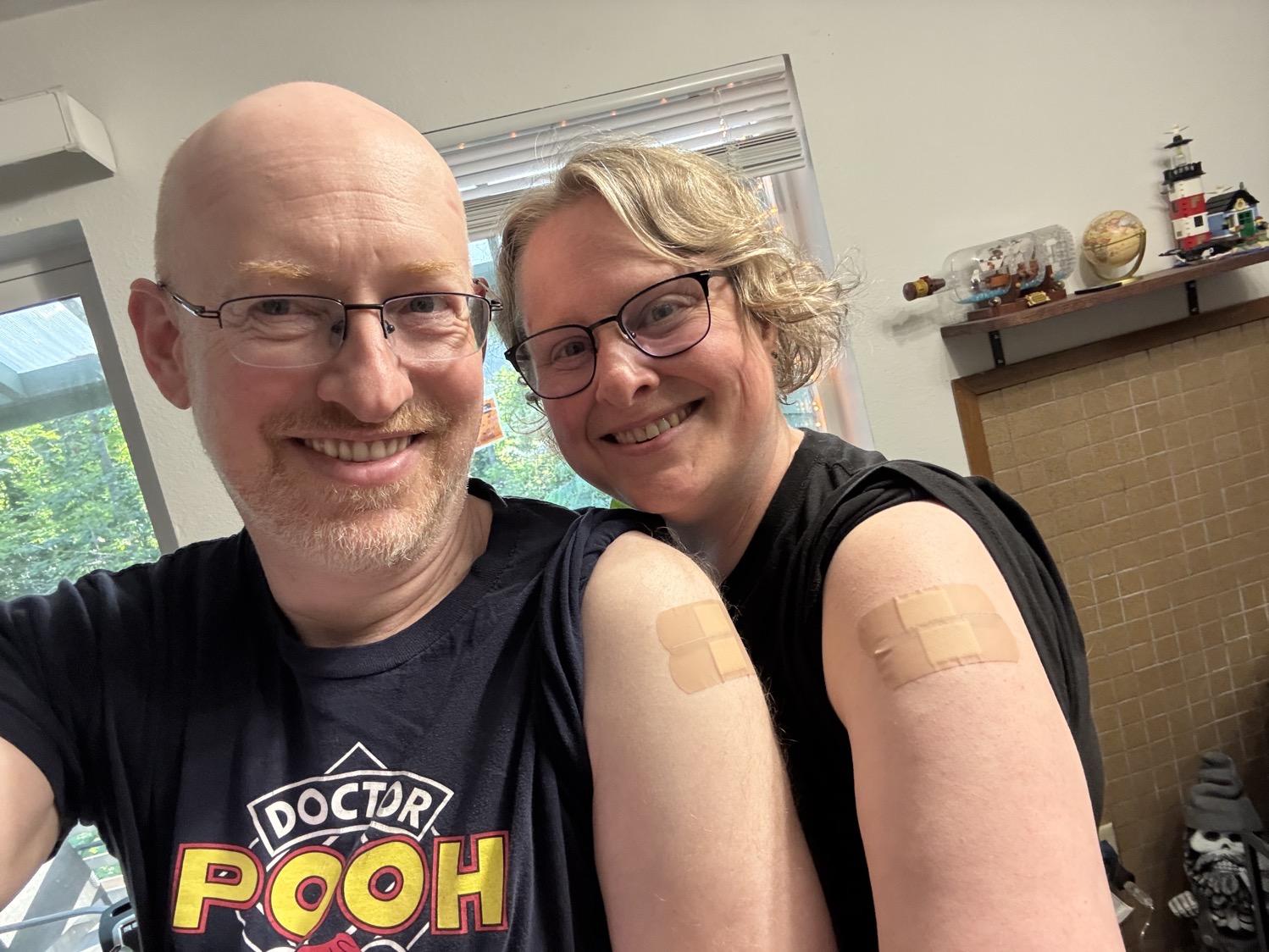
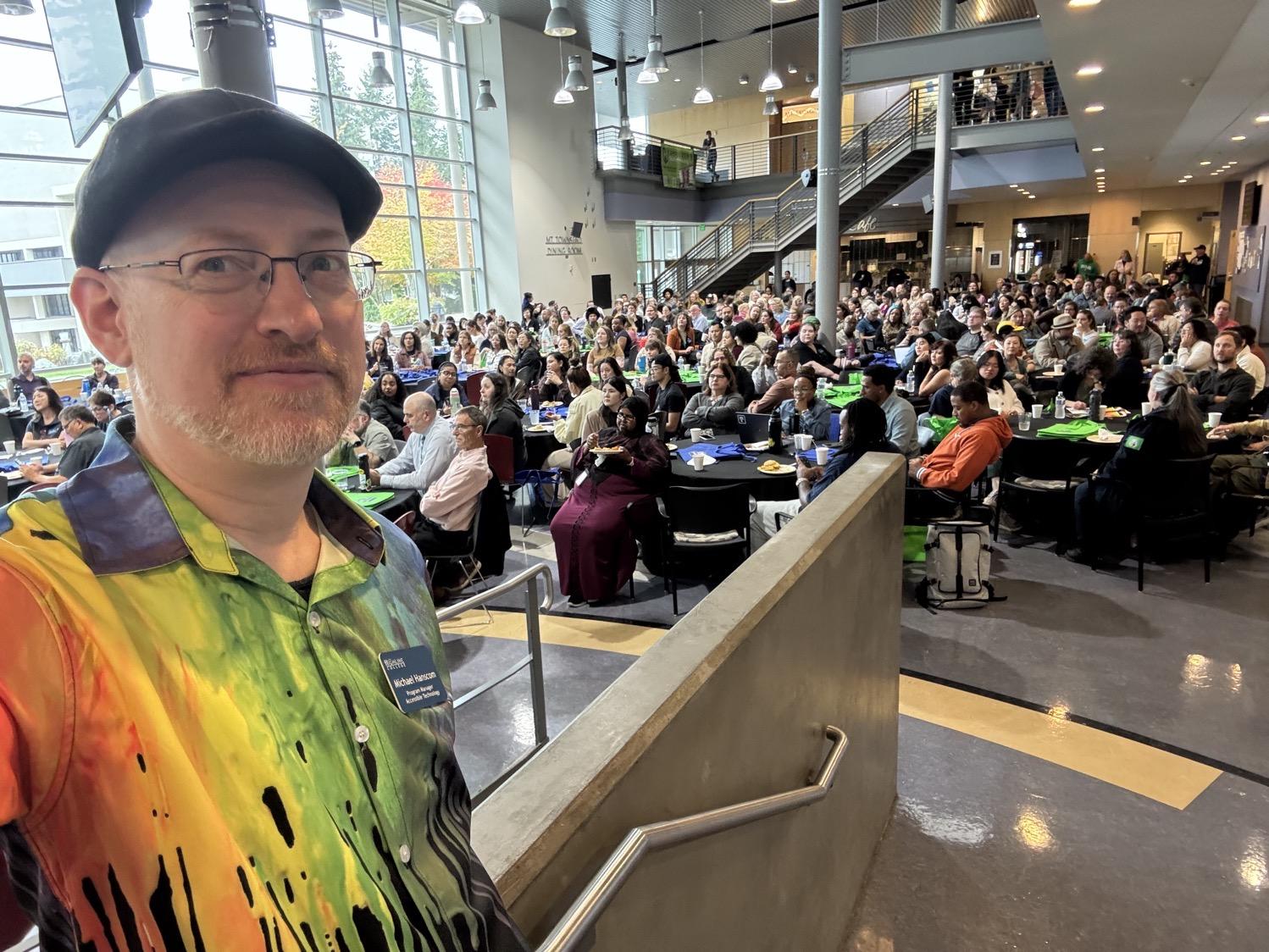
We got our flue and Covid shots. Vaccination for the win!The theater for Hamlet.Standing by the side of the stage before heading up to run the trivia section during our Opening Week festivities.
Project Hail Mary (2026): Good, but didn’t “wow” me as much as it did many, I think. I’m not sure that it needed to be two and a half hours long, and while it’s possible it suffered in translation from page to film, but a lot of the science felt more like magic to me. I did really appreciate Rocky being a practical effect, though.
Stop! That! Train! (2026): Honestly, better and funnier than I expected. Absolutely a ridiculous, low-brow, Drag Race-meets-Airplane disaster movie spoof with virtually non-stop rapid-fire jokes, not all of which land. But there were a lot of jokes that really made me laugh out loud.
🔗 Linking
Alan Siegel at The Ringer: Keep Chasing That Bird: The Oral History of ‘Coyote vs. Acme’: “These days, battles between art and commerce don’t tend to end well for the artists. But every so often, the little guy manages to avoid the anvil—and win.”
Ernie Smith at Tedium: alt.time-capsule.reopened: “I think what stands out to me about Usenet-Rewind is that it more or less captures all of it, warts and all. I did a search for my late ’90s email address, and found numerous entries under my name. I then did a search at my email addresses for the two colleges I went to and found a bunch more posts. And I’m not going to lie, most of those posts were not written with the assumption that they would be a part of the permanent record 25 years later.”
Catalina Gaitán at The Seattle Times: Seattle bans discrimination against polyamorous, nonmonogamous people (archive.is mirror of a paywalled original): “The City Council voted unanimously on Tuesday to pass a law barring discrimination in employment, housing, business licensure, park usage, policing and public accommodation against adults in consensual relationships with more than one partner. ¶ The bill also expands such protections to nonbinary people in general by removing “male or female” from the city’s definition of sexual orientation, and broadens the protected category’s definition to include pansexuality — attraction to people regardless of gender identity — and asexuality — not experiencing sexual attraction while sometimes experiencing romantic or significant connection to other people.”
Mike Masnick and Dave Willner at TechDirt: The Apocalypse Will Not Be Sexy: “For all the talk of “AI Safety” risk these days, the most present real risks remain variations on the theme of “humans doing stupid shit”. Sometimes really smart humans. But stupid actions by humans are a lot less headline grabbing than the shiny sexy apocalypse. A human accidentally causing a radioactive chain reaction by carelessly using a screwdriver to separate things is stupid. Skynet turning everyone into paperclips… is kind of cool and fun. ¶ But, as anyone who works in risk mitigation (including one of the authors of this piece) can tell you, the overwhelming majority of actual disasters aren’t cool and fun. Instead, they’re usually more like the Demon Core: stupid, disappointing, and easily prevented if only a few common sense steps had been taken.”
Ryan Epps at Polygon: Fahrenheit 451’s opening line still burns, 73 years later: “All he needed was six words. That’s all Bradbury required to introduce one of the most famous dystopian novels ever written. The sentence is almost comically straightforward, which makes its meaning all the more horrifying. Bradbury doesn’t begin by explaining why books are forbidden or by introducing the society that outlawed them. Instead, he puts us directly inside the head of the story’s protagonist, Guy Montag, a fireman whose very job is to burn said books. The pleasure isn’t metaphorical. Montag genuinely enjoys watching books of all kinds erupt into flames.”
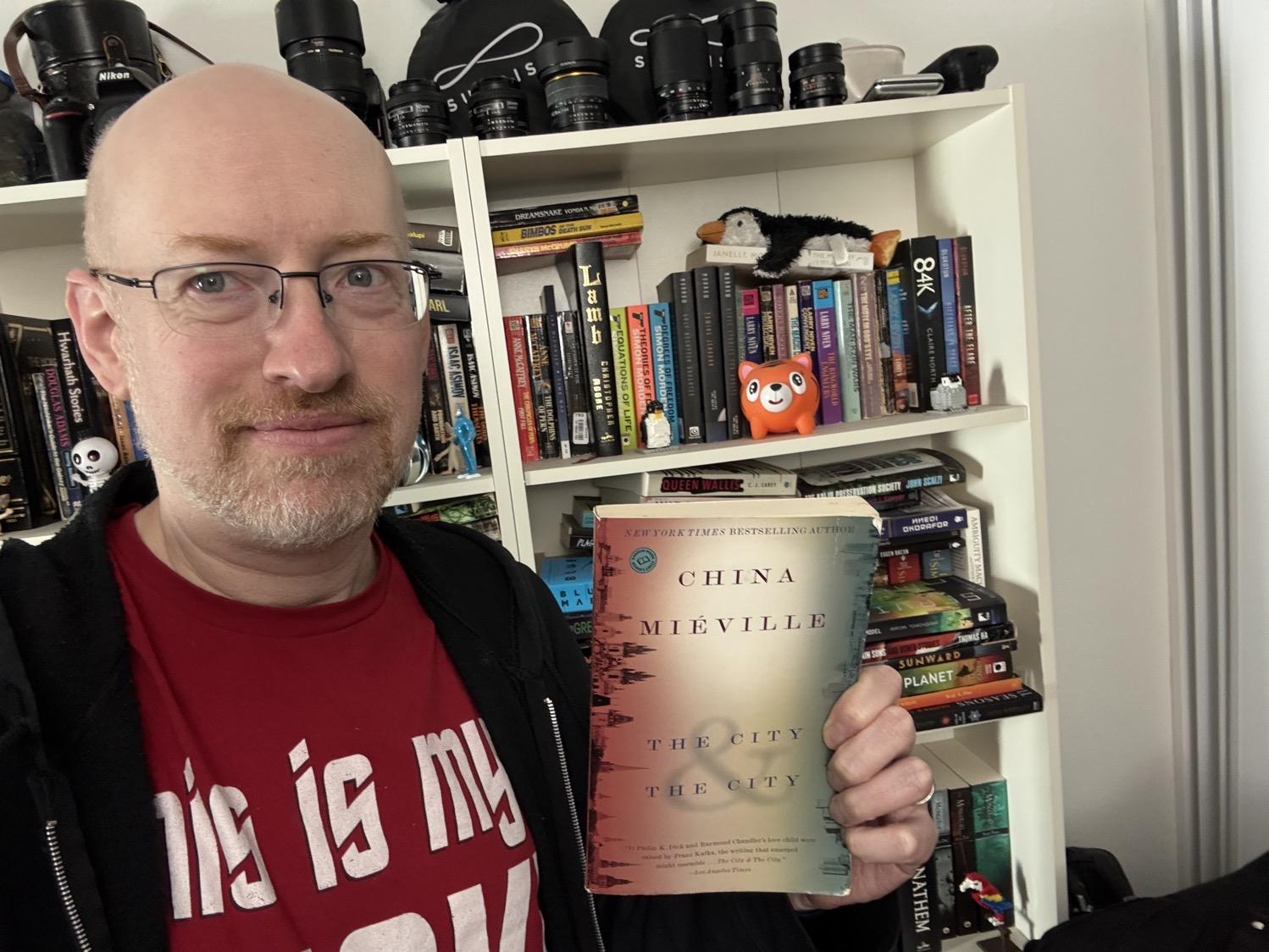
Book 42 of 2026: The City and The City by China Miéville. 2010 Hugo Best Novel winner (tied with Paolo Bacigalupi’s The Windup Girl).
⭐️⭐️⭐️⭐️⭐️: Mostly a crime noir, but set in two cities that share the same physical space but do not interact. The crime novel part is a good mystery; the setting itself is fascinating and has me looking at the spaces I live in differently.
Absolutely baffled that this tied with The Windup Girl, which I gave one star and was sorely tempted not to finish. What was up with the Hugo voters in 2010?
🥱 The big theme for this week was jet lag. 10 hours of time change is a lot to adjust to, and it was only at the end of the week that we really started feeling like we were about back to a regular sleep schedule.
♿️ Since I figured jet lag would be a thing, I took a couple recovery days, and so only came back to work on Thursday. Those two days of work were, unsurprisingly, pretty much dedicated to getting caught up and triaging through the hundreds of emails that were waiting for me after a month away.
🚀 Saturday was the first ConCom planning meeting for Norwescon 49, and it was good to start getting back into the swing of things there. Plus, I came home with a box full of more goodies to scan for the historical archives, which was fun as well.
📸 Photos
I’ve started the process of uploading my photos from the trip. It’ll take a while to get through everything, but San Francisco is up.
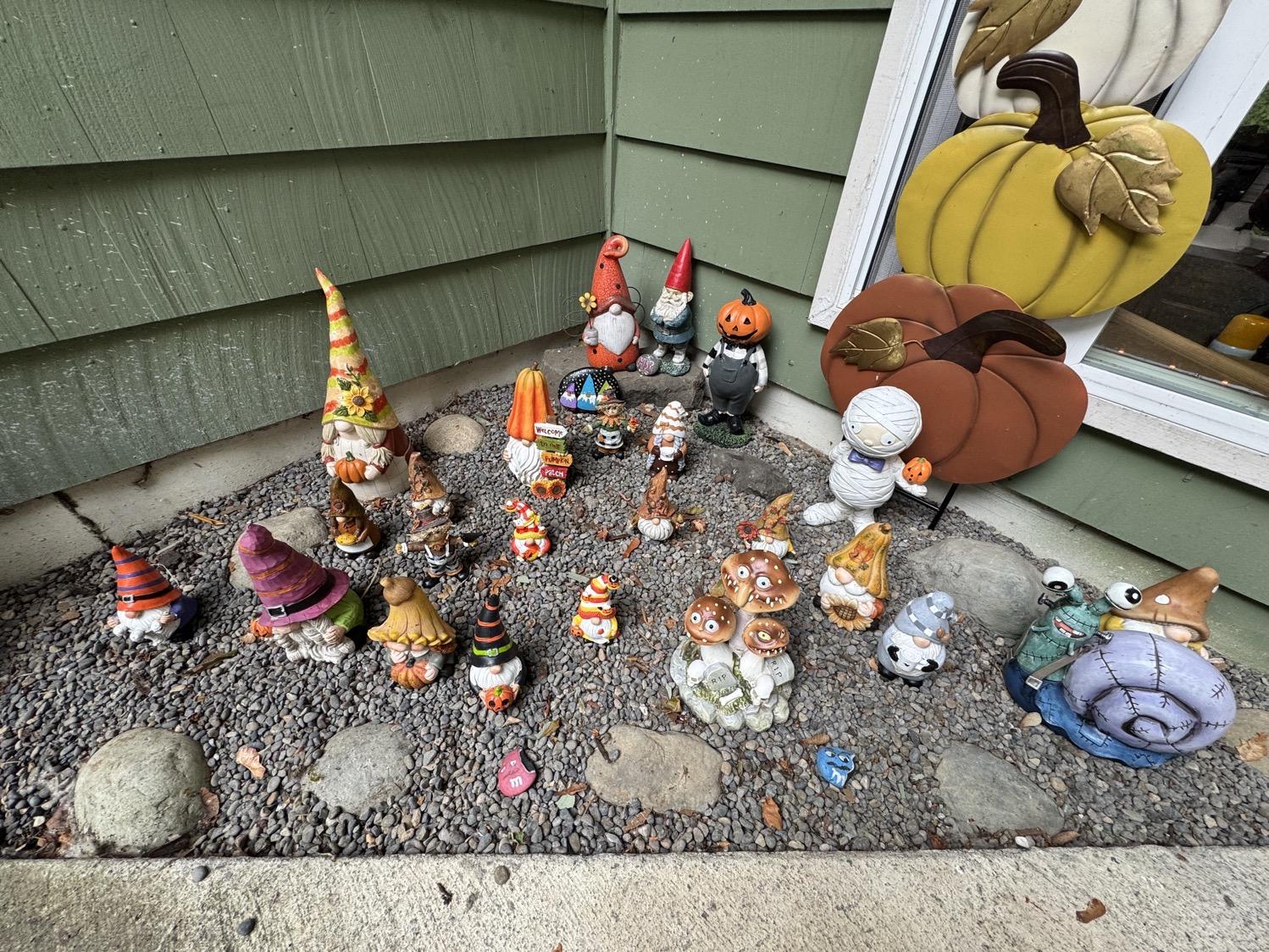
Our little gnome corner is all set for fall and spooky season.
📚 Reading
While traveling, I read Terry Pratchett’s Discworld novels Reaper Man and Witches Abroad, and finished the next one, Small Gods, and a Star Trek novel I’d started just before we left, John Peel’s The Death of Princes, over the course of the week.
📺 Watching
I didn’t get through all of it, but I watched all of the first season and a couple episodes of the second season of the classic ’80s cyberpunk series Max Headroom while on the flights to and from Europe, and it’s a lot of fun. Dated in many ways, sure, but a lot of the themes that are in the storylines actually hold up pretty well today. Definitely need to find time to finish the rest of the second season.
🎧 Listening
I’ve been enjoying listening to the CDs I picked up while traveling:
Some of these links got saved while I was traveling, so they may not all be super current.
Sophie McBain at The Guardian: Art Spiegelman: ‘The US needs a counter-revolution’: “More than four decades after his Holocaust story Maus transformed the graphic novel genre, Art Spiegelman discusses Trump, the shadow of 9/11 and the rise of fascism in America”
Jessamyn West at Librarian.net: How to disable or avoid intrusive AI: “One of the biggest questions I get at Drop-In Time at the library (besides “what is taking up all my cloud storage?”) is how to disable or avoid intrusive AI that shows up where people don’t want it. This is a guide for people who would like less intrusive AI in their tech environment.”
Stephannie Stokes at The Seattle Times: A one-of-a-kind partnership gets community college students housed (archive.is mirror of a paywalled original): “Since 2020, Highline College has paired students facing homelessness with housing vouchers provided by the King County Housing Authority, covering their rent for up to four and a half years or until six months after they graduate.” Neat article about a very cool program at Highline College.
Rui Carmo at The Tao of Mac: Apple Papercuts: “This isn’t about Liquid Glass or grand design failures–those are well documented elsewhere. This is about the small stuff. The papercuts that, individually, you learn to live with, and collectively make you wonder whether anyone at Apple actually uses their software.”
Angela Lim at The Seattle Times: Old 7-Eleven in downtown Seattle becomes ‘Inconvenience Store’ exhibit (archive.is mirror of a paywalled original): “The shop, stationed in a building that formerly housed a downtown 7-Eleven, includes a hot bar, checkout counter and refrigerator. But rather than offering quick grab-and-go options, this one sells beeswax egg votive candles, shoulder bags made out of Cheetos and Lays wrappers, Nerds Gummy Clusters keychains and a pretangled USB cord.”
Ian Sample at The Guardian: Rich people more likely to steal children’s sweets, finds Ig Nobel prize-winning study: “Piff and his colleagues found that upper-class drivers were more likely to cut other cars off at junctions and ignore pedestrians at crossings. Wealthier people also appeared more willing to lie at work. In one experiment, volunteers were left alone with a jar of sweets ostensibly meant for children. When the researchers returned, upper-class people had snaffled nearly twice as many candies as lower-class people.”
Jewel Bright at NPR: The U.N. backs a new world map showing Africa in its true relative size: “The ‘Correct the Map’ resolution, introduced by the West African country of Togo on behalf of the African Group (the 54 African member states at the U.N.) and supported by the African Union, was adopted on Friday by a vote of 164 to one, with six countries abstaining. ¶ The United States was the only country to vote against it.”
Angelina Chapin at The Guardian (in 2016, but I just came across it): WD-40 and microwaved tampons: secrets of food photography revealed: “Behind most professional food photos is a stylist who tricks the viewer. These deceits range from a touch of lipstick to redden a strawberry, to ‘milkshakes’ made from mashed potatoes. It’s not that food stylists are liars and cheats. They’re simply in the business of improvisation.”
Robert Hart at The Verge: Why AI food looks like that (archive.today mirror of a paywalled original): “There is a torrent of unappetizing slop coming from restaurants, cafes, and brands that are increasingly turning to AI to generate images promoting their food. The resulting horror show includes donut shrimp, Reubens from the deep, wormlike noodles, and noodle-like pastries and stringy chicken. There’s also construction material masquerading as ice cream, ice cream masquerading as brains, and other masonry-adjacent cuisine. I don’t even know how to begin describing this monstrous attempt of a burger, and the less said about the trypophobic burrito from hell, grubs and all, the better. There are lumps. And holes. So many holes.”
Jake Goldstein-Street at the Washington State Standard: Coming in November: A big election for WA’s Supreme Court: “The five elections are, in a way, statewide proxy battles between conservatives and liberals, with four challengers endorsed by the state Republican Party against candidates favored by Democratic leaders, including two new appointees of Gov. Bob Ferguson.”
Eddy Frankel at The Guardian: A constipated baby and a kid that looks like Boris Johnson: why would anyone bother stealing a Renoir?: “Pierre-Auguste Renoir was one of impressionism’s head honchos, a leading figure in one of 19th-century art’s most important movements. But time hasn’t been too kind to poor old Pierre. Where his contemporaries like Monet, Cézanne and Degas have been heralded as modernist revolutionaries, artists who shaped the future of western painting and helped set the path that all of their successors would soon follow, in recent years Renoir has been denigrated, mocked, protested and hashtagged.”
Judd Legum at Popular Information: The hidden dangers of Musk’s votesafe.org: “The slick voter registration website, currently being promoted to millions of people, is a digital surveillance machine.”
Melissa Santos at Axios Seattle: Seattle’s civil rights laws could soon cover polyamory: “The measure would make people who engage in consensual nonmonogamy, including polyamory, a protected class that can’t be discriminated against in areas such as housing or employment.” This would be a boon to a lot of people I know.
Meredith Blake at The Contrarian: The Rise of the Infinite Cable News Ticker (archive.is mirror of a Substack original): “The news ticker was not exactly an unknown concept in 2001. The iconic Motograph News Bulletin in Times Square — a.k.a. “The Zipper” — had been flashing headlines from around the world for more than 70 years. But before September 11, the feature was used sparingly on TV, usually to display stock prices during financial news programs or share storm warnings in specific regions. ¶ By December 2001, however, constantly scrolling headlines became a permanent fixture on TV.”
Michael Cragg at The Guardian: ‘You start to worry you’ll never listen to anything else’: 25 years of Can’t Get You Out of My Head, the song that saw the future of pop: “Can’t Get You Out of My Head wasn’t just ‘good, for a pop song’, as joyless people were wont to say, keen to use the caveat in case their muso credentials be tarnished. As pop began to absorb the outre production styles of R&B experimentalists such as the Neptunes and Timbaland – Britney’s career-restructuring I’m a Slave 4 U, produced by the former, would arrive in the same month as Can’t Get You Out of My Head – audiences were becoming more attuned to pop that was looking to push the boundaries. This felt like dance-pop beamed in from the future, where the first time you hear it you’re like, ‘Huh?’ then the second you’re like, ‘Wait!’ and then the 35th time you start to worry you may never listen to anything else.”
⭐️⭐️⭐️⭐️⭐️: Pratchett takes on religion, belief, godhood, corruption, holy wars, goodness, and compassion, and does it all with style, humor, and heart. The Turtle moves.
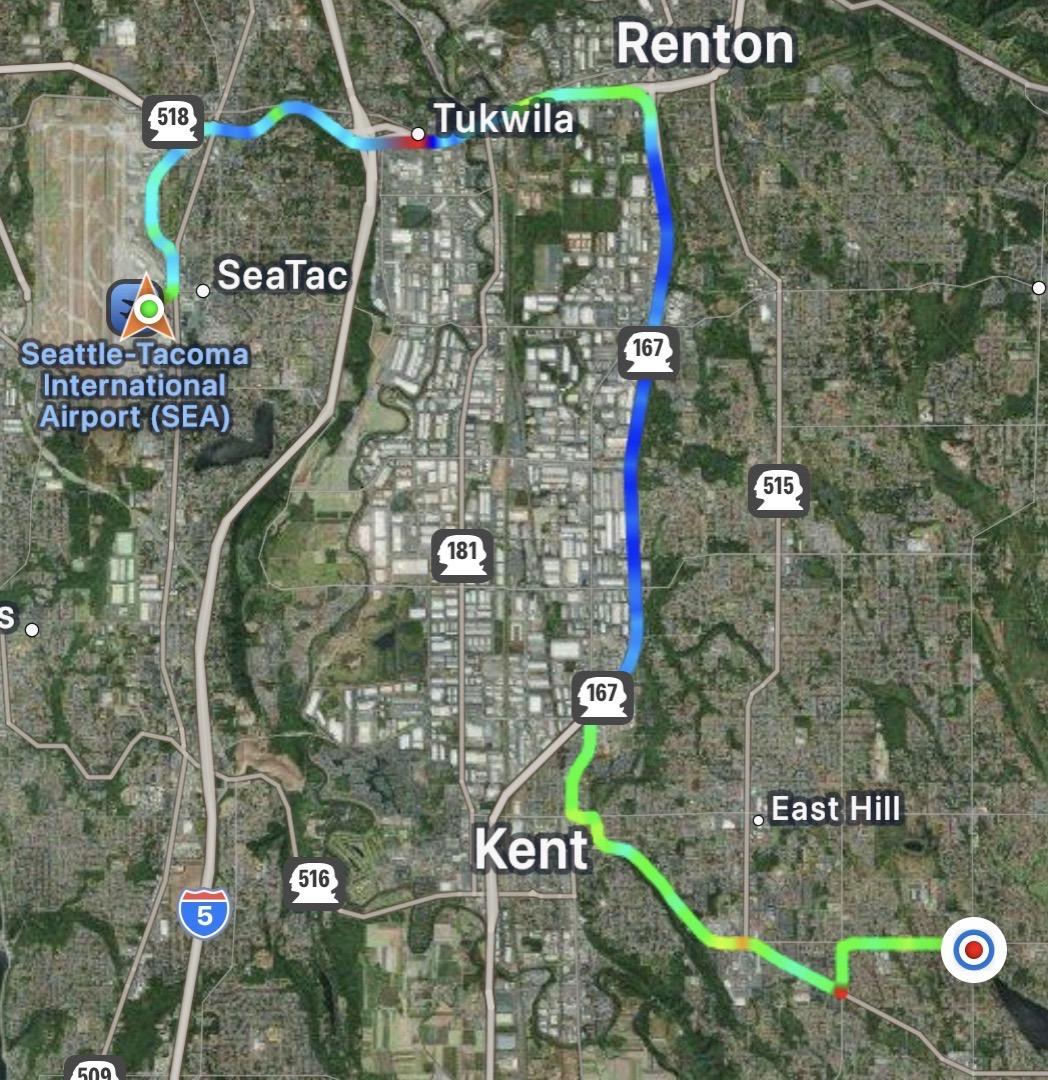
We’re back in Seattle! (Well, Kent. It’s close to Seattle. Greater Seattle metropolitan area.)
Day 24 (part 2): London to Seattle
Finally, we’re at the end. We flew out of Heathrow airport, flying home via British Airways in their Premium Economy class. It’s really nice! Not business/first class nice, of course, but a definite step up from coach. Shorter domestic flights well likely stick with standard coach class, but for anything long-haul, it’s worth the extra money.
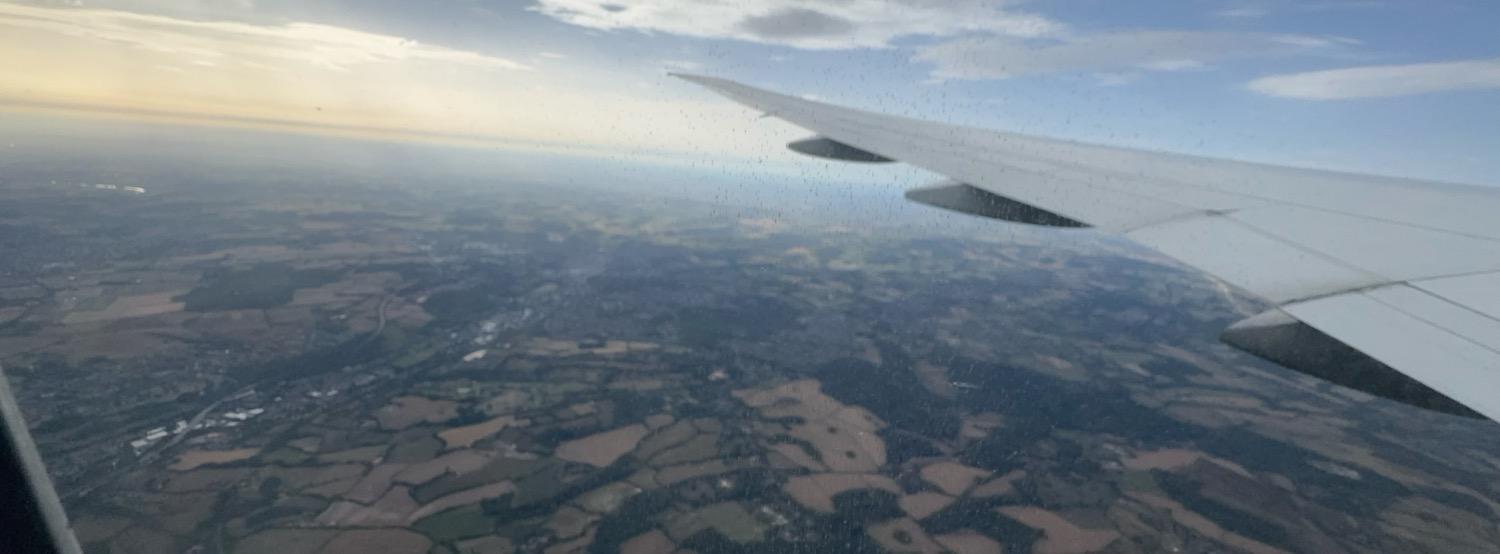
The English countryside is really pretty.
Unfortunately, even with the extra leg room and all, I still can’t actually sleep on planes, so it was a long ten hours. Watched The Mandalorean and Grogu, which was a perfectly serviceable extra-long episode of the series, but I’m glad I wasn’t tempted to pay to see it in the theater. I don’t feel like I lost anything by watching it on the back of an airline seat. Also watched Ready Player One, which was entertaining fluff; even having read the book and knowing how pop-culture dependent it is, mostly I was impressed at how many characters, items, and visuals they got permission to include, and I’m sure I only caught a small fraction, as I was watching a fairly highly compressed version (judging by how muddy it got during quick action scenes) on an airplane seat console. And I read some more of the Discworld book I’m currently reading, Small Gods.
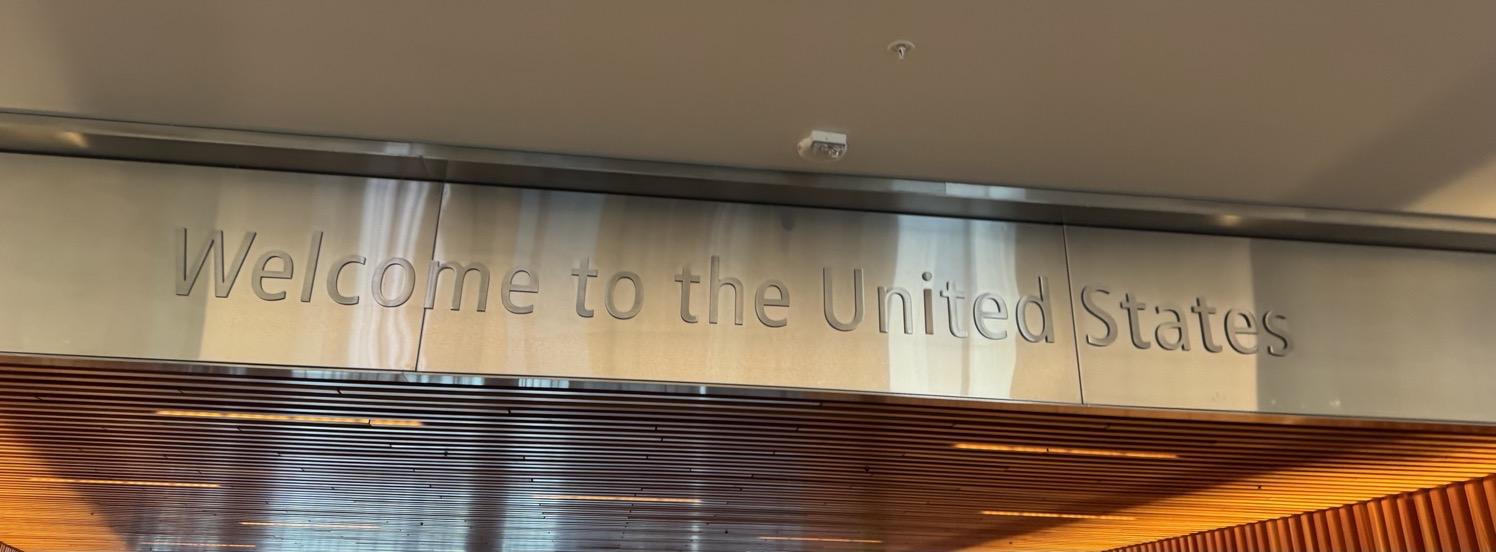
Perhaps a little ominous these days, but still, it’s good to be back.
Eventually, the plane landed, we breezed through incoming customs, caught a Lyft, and we are home again! It’s been a great trip, but after three and a half weeks, we’re so happy to be sleeping in our own beds again.
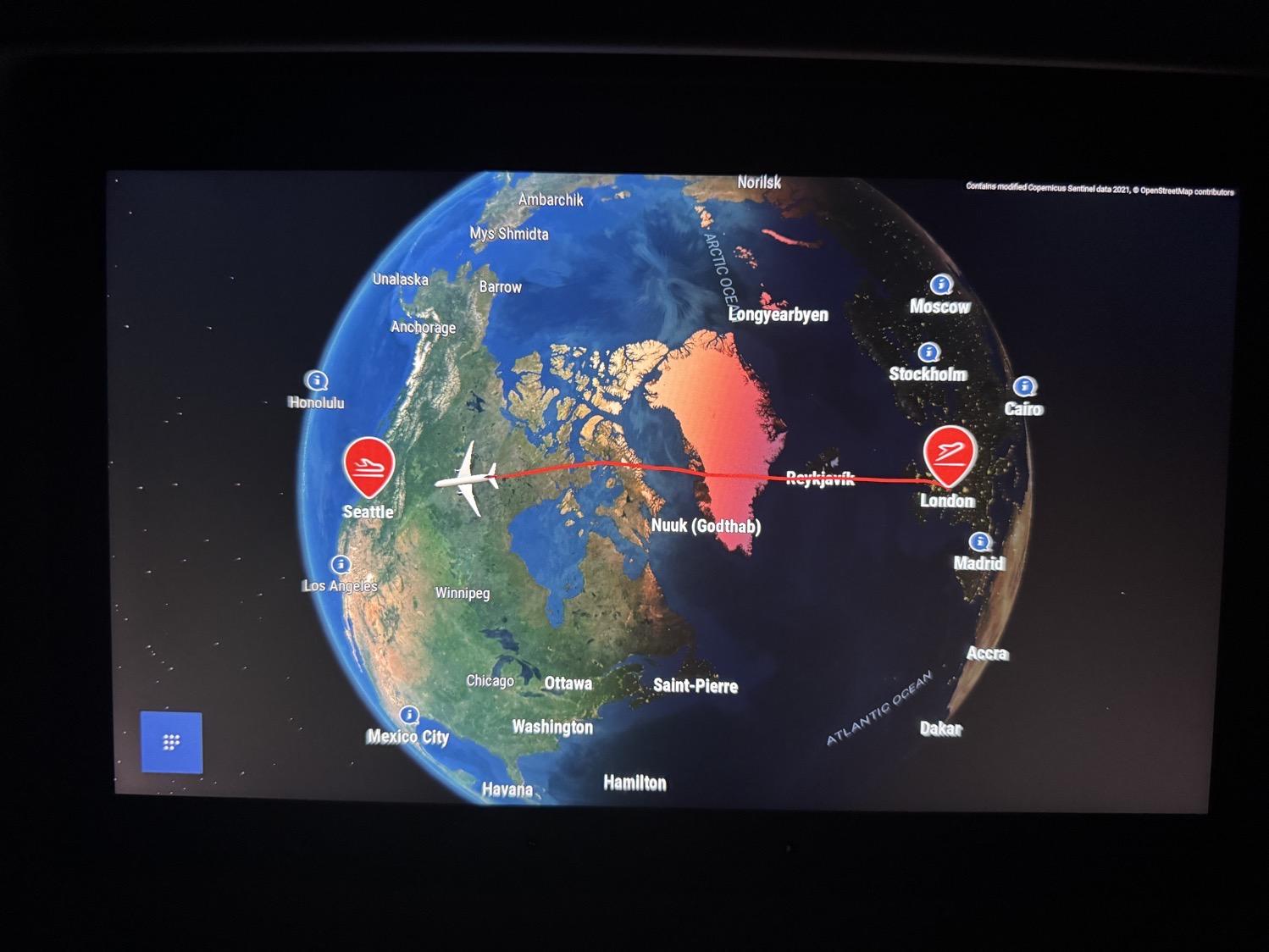
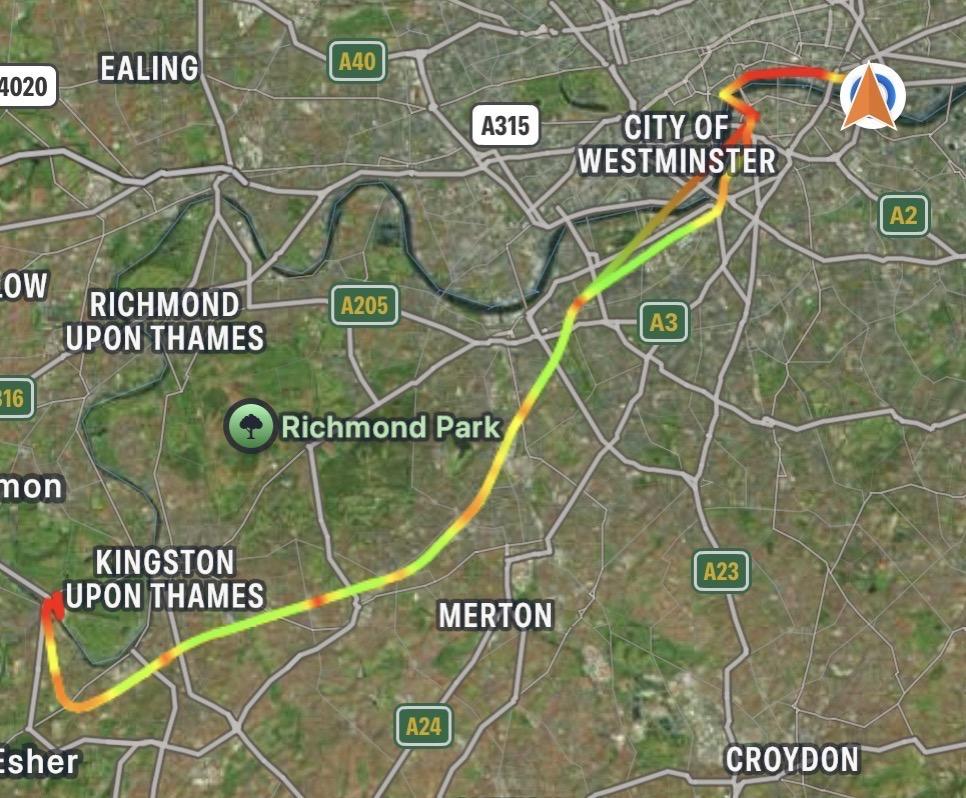
The last of the GPS track log maps for this trip!
Many more photos to come over the coming weeks (or months) as I get through processing them all!
Random Travel Thoughts
And finally, a few random thoughts and comments that have come up while we’ve been traveling but didn’t make it into the earlier posts:
Euro convenience food is better than ours, with more variety and much better quality. This may well be a side effect of so much of Europe’s grocery/shopping norms operating on a “shop regularly for a day to a few days at a time” cadence rather than the U.S.-ian “shop every week or two unless you do monthly/semi-monthly Costco runs” cadence; even their “convenience” stores are closer to just being small grocery stores, with a wider range of choices. It made grabbing easy in-hotel dinners and breakfasts very easy, and was much more affordable than if we’d gone to restaurants for every meal.
Without planning it this way, we travelled in inverse likelihood of encountering cigarette smoke. Germany (Frankfurt and Berlin) was smoke everywhere (walking through the Berlin zoo, with ashtrays on all the garbage cans, parents calmly puffing on cigarettes while shepherding children around, and some smaller semi-enclosed viewing areas that we simply couldn’t go into because of the stench was a truly bizarre experience), Amsterdam almost as bad, Brussels a bit less. Paris was much less smokey than we expected; it was almost at US/UK levels. The UK is more like the US, where cigarettes are around on the streets and in some public areas, but generally briefly and/or can be avoided in most cases, and many large public spaces and parks are designated no-smoking areas.
Pot smoke was nonexistent in Germany, which was nice. Some in Amsterdam, which was expected, it wasn’t as prevalent as we thought it might be. I don’t remember encountering any in Paris or Berlin, and I’m not sure about Brussels. (As with cigarettes, I don’t particularly care if people smoke pot or otherwise use marijuana, I just really don’t like the smell of the smoke and prefer it when people don’t force me to unwillingly participate in their indulgences.)
US tow trucks assume enough space to maneuver the car and tow truck around to tow or winch the car up onto a flatbed. Euro tow trucks assume they’ll need a crane to hoist the car onto the flatbed.
There have been so few pickups, SUVs and the like, etc. Virtually nonexistent for most of the trip; all vehicles were small, reasonable cars or work vans. Have spotted a few in London, but they’re still in the minority. It’s been so nice to spend three weeks without giant SUVs and status-symbol pickup trucks dominating the roads. And while we did see Teslas, they weren’t as numerous as they are in Seattle (or were in San Francisco), and thanks to the EU/UK’s stricter safety regulations, not a single Cybertruck!
Germany and London had the best train/tram transit. Amsterdam’s trams are good but they need more cars; the trams were always overcrowded (but we did like the rear-of-train secondary person).
Though the UK is a walk-on-the-left country, London has so many tourists from walk-on-the-right countries that the end result is that all pedestrian spaces are effectively a chaotic free for all, with enough inability to predict where anyone will be, is going to be, or which direction they’ll be coming from at any moment to make Heisenberg himself giddy. Escalators, on the other hand, are a no-nonsense hard line: stand to the right, walk on the left, violators will be shoved.
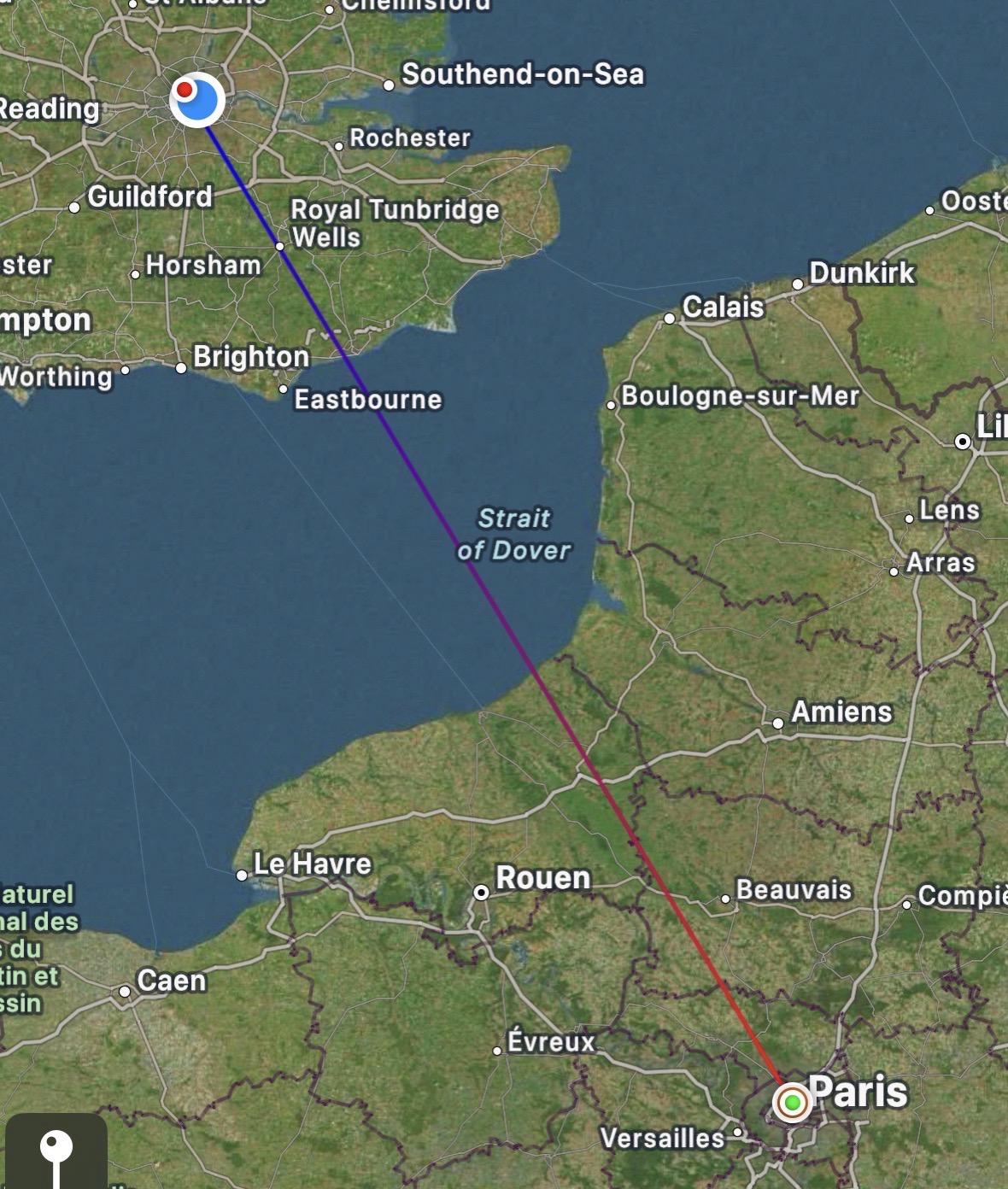
When we hopped on a train in Paris, we headed out of the EU and through the Chunnel to London. The border crossing in the terminal was a little hectic and unpleasant, as there were few clear instructions until you did something a little wrong, when you got firmly corrected, and at first we didn’t understand why we had to do the whole passport scan and biometric photo check twice in a row, ten feet apart. It made sense after the fact — the first time was leaving the EU, the second time was entering the UK — but as a first-timer, the system really feels designed by and for people who do it regularly and can breeze through, rather than newbies. Still, we didn’t make any major errors, got through, and got on the train without any real major hassle.
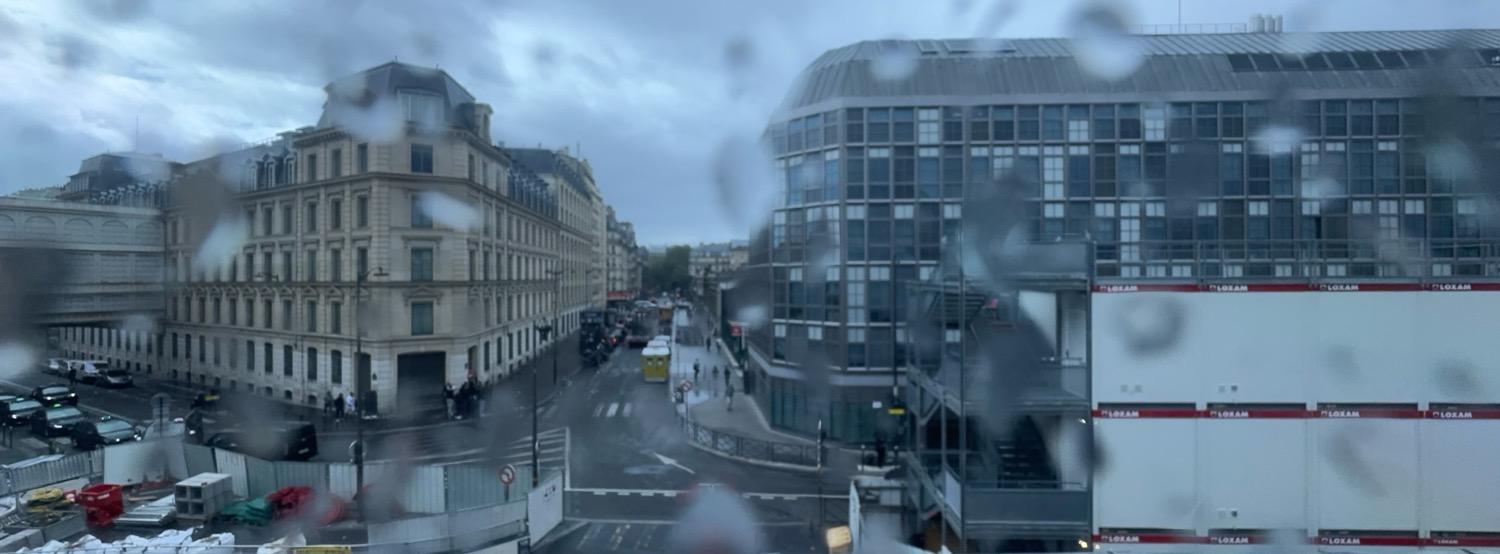
Our last look at Paris from the train station.
The train ride was as pleasant as any have been, with pretty views of the French and English countryside as we went. The Chunnel, of course, isn’t much for scenery, but it’s fun to have done that.
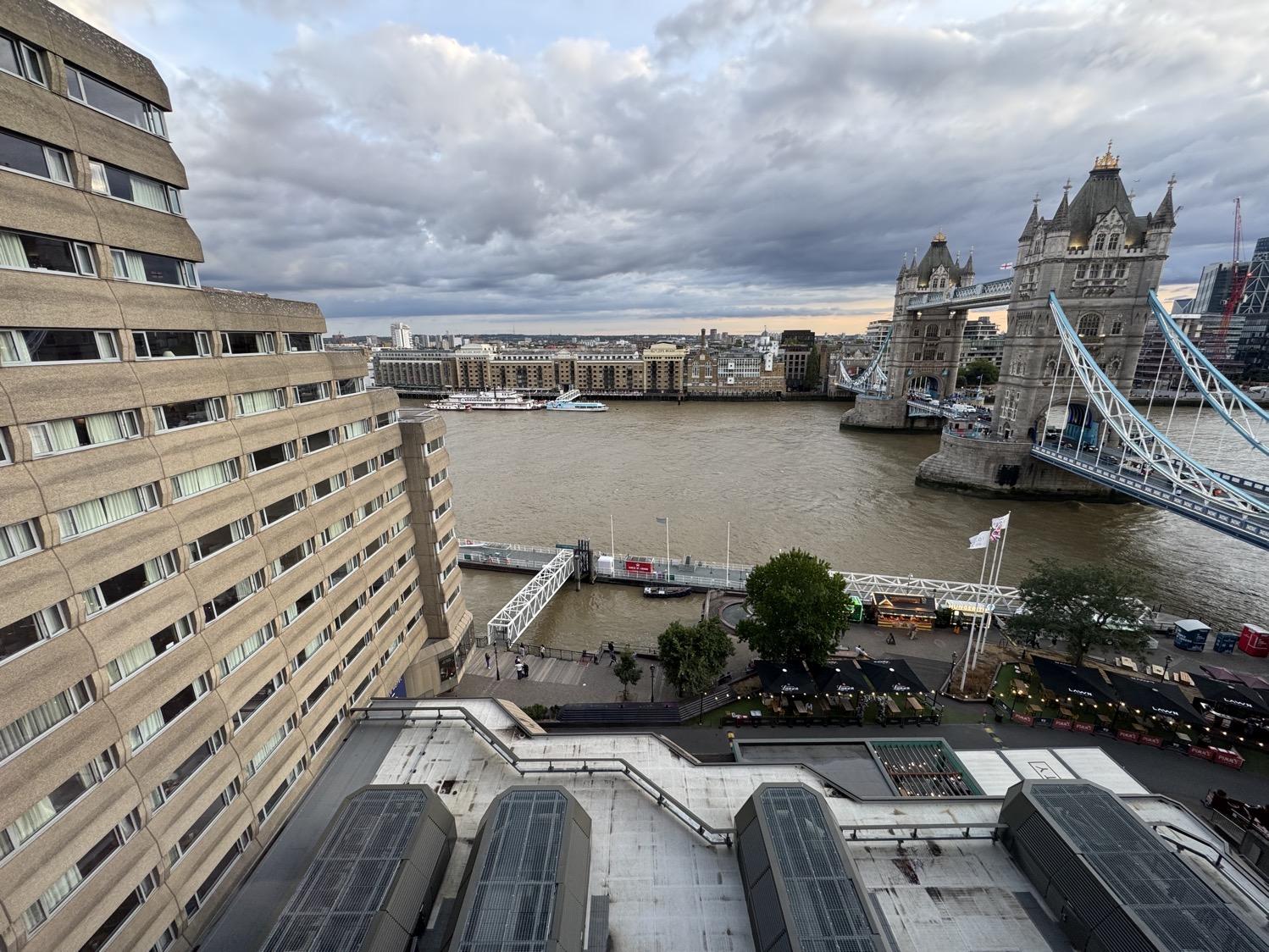
The train ends at St. Pancras, part of a complex with King’s Cross, so it was relatively easy to find our way to the correct Underground platform and make our way to the Tower Hill station. From there, it’s just a couple blocks around the Tower of London to the Tower Hotel where we’re staying. This is the same hotel we stayed at last time we were here; it’s a funky old brutalist exterior (according to Wikipedia, “voted the second most hated building in London in a 2006 BBC poll”) with very ’70s British interior and gorgeous views of Tower Bridge, and we like it a lot. We got settled in and called it a night.
Cheers, London! Never going to get tired of that view.
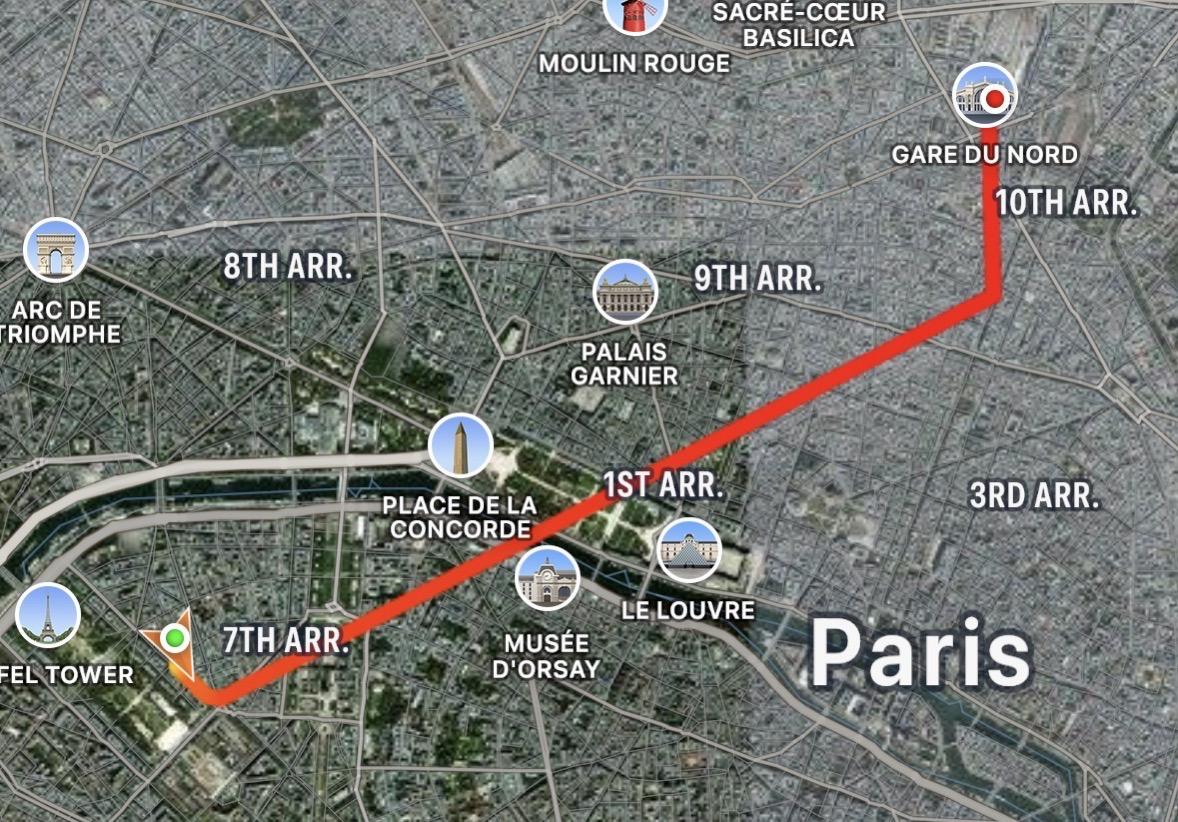
Much of our Paris to London journey wasn’t quite as ‘as the crow flies’ as these track log maps make them look, but the GPS tracking app occasionally glitches out.
Day 19: London
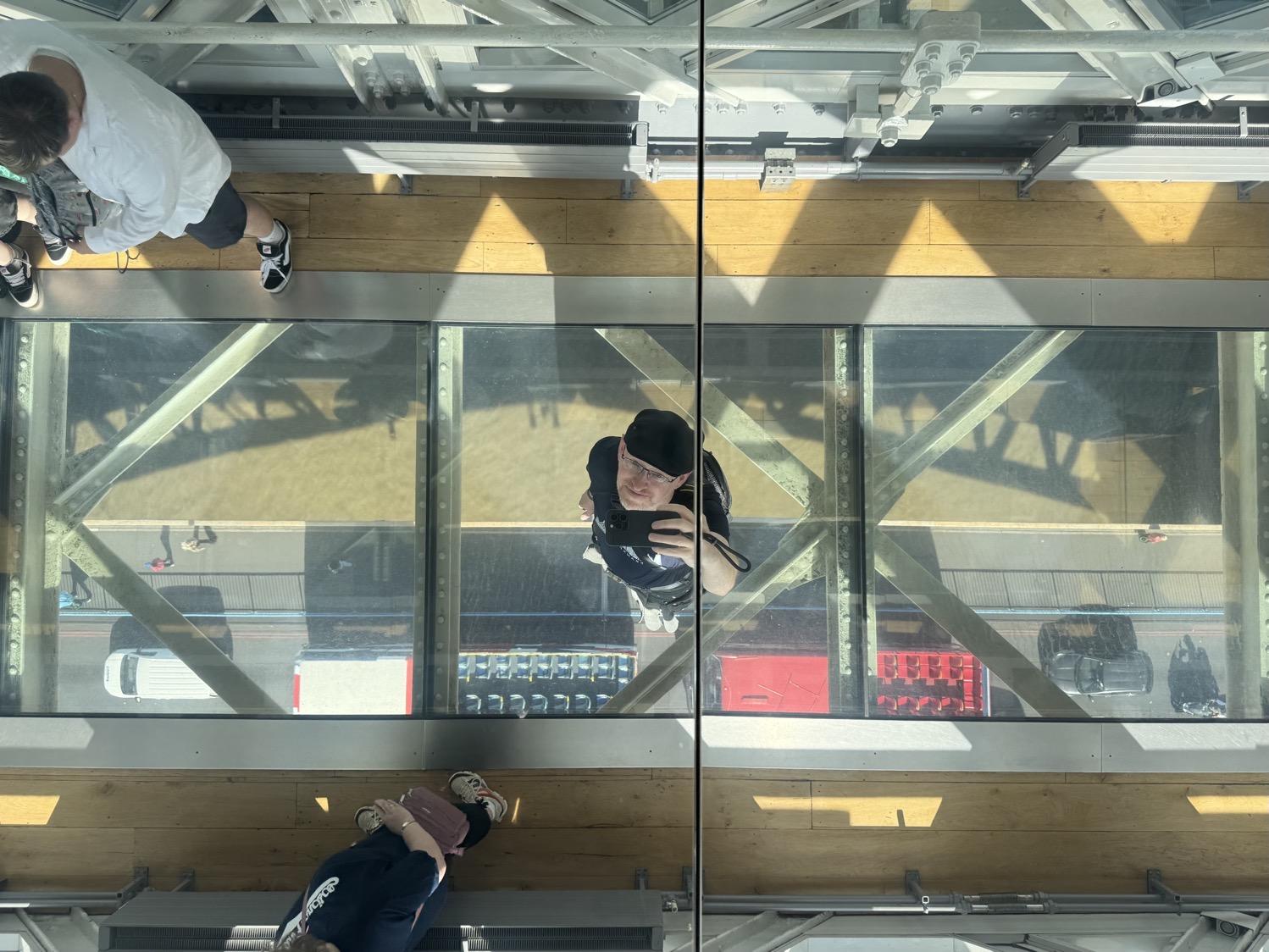
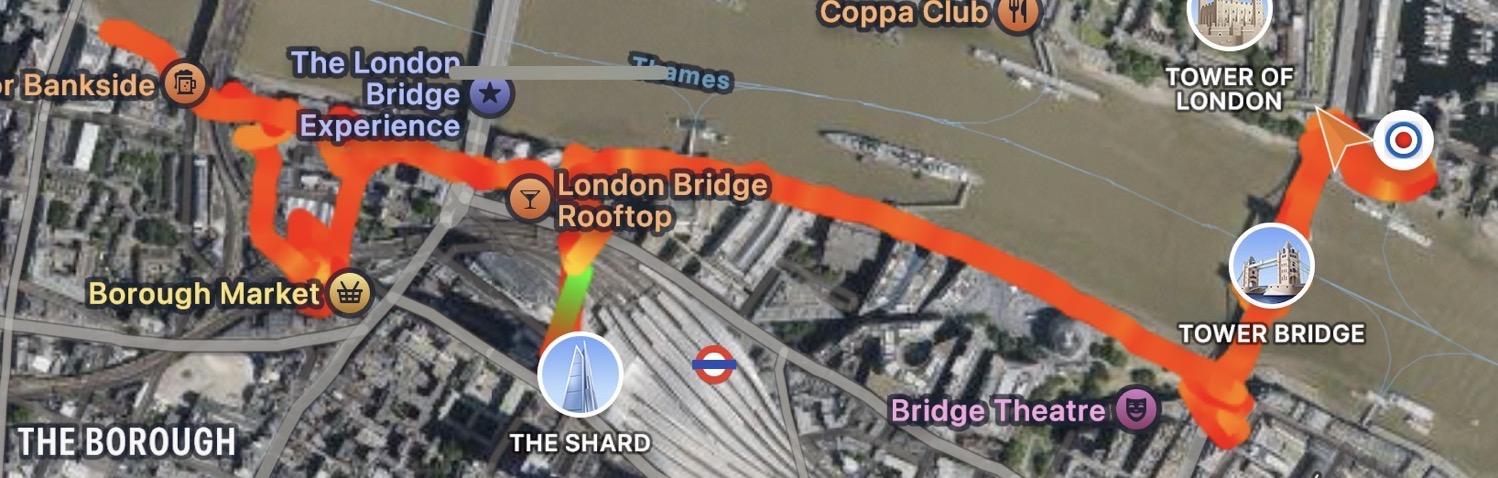
For our first full day in London, we didn’t have anything planned until the evening, so we decided to start our day with wandering around and exploring the local sights on foot. Since there’s a particularly notable sight right outside our hotel window, we decided to do something we’d skipped on our last visit, and do the Tower Bridge tour. Seeing a bit of the inside was neat — Victorians weren’t exactly minimalists, and even the interior spaces are impressively crafted. The tour goes up one of the towers, across the upper walkways (which now have glass floor sections), then down again, and then down into the old steam engine rooms (not used anymore). Fun start to the day!
A little disconcerting, sure, but fun to do.
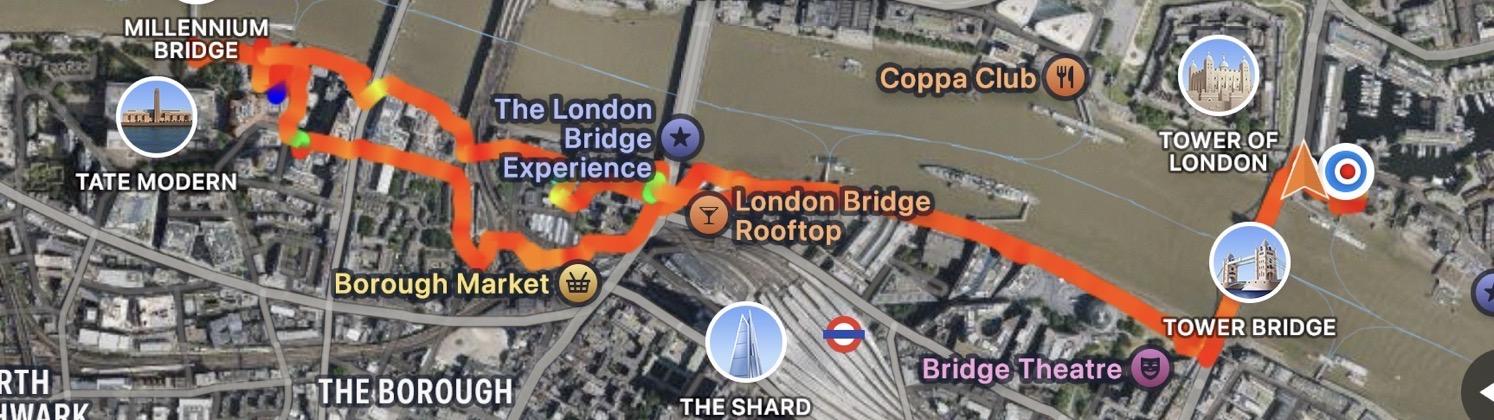
From there we wandered up the Queen’s Walk along the Thames, wandered through the Borough Market and sampled a few different goodies for lunch, found the Golden Hinde and explored that, then went through the Clink prison museum, and then went back to the hotel for a bit to give our feet a rest.
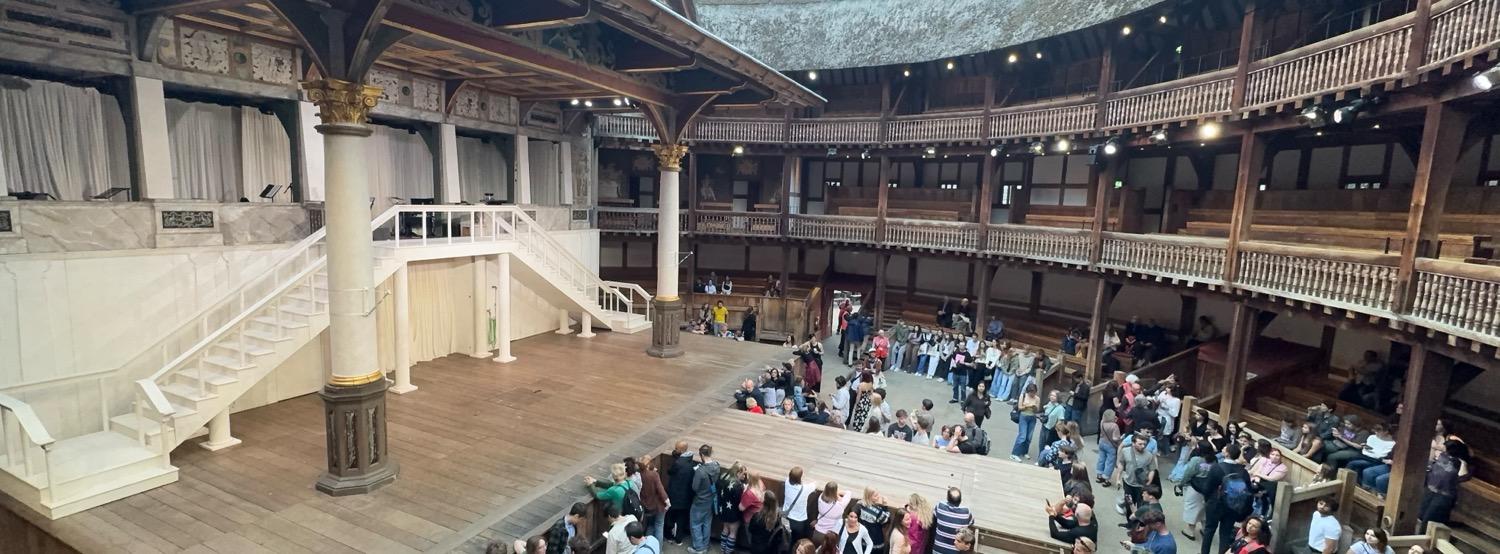
For our evening adventure, we walked back up the Queen’s Walk to Shakespeare’s Globe to see Much Ado About Nothing. Their production was wonderful, as expected, and seeing a long-time favorite play at the Globe was a real treat. A nice nighttime walk back to the hotel afterwards, and off to bed.
‘Groundling’ tickets are just £5. We opted for seats, and paid a few pounds extra for cushions.
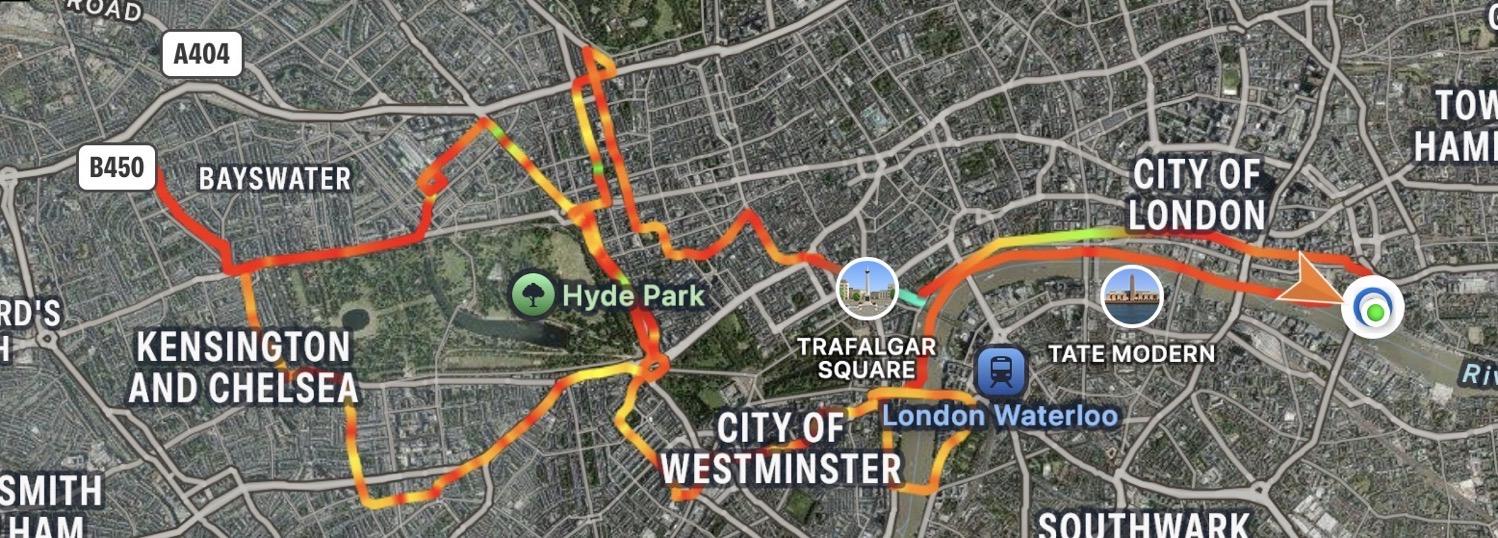
Two very similar walks for this day’s outings.
Day 20: London
This day had originally been entirely unplanned, but then last night we were browsing the London theater options before Much Ado started, and we’d made an impulse decision to add another performance to our itinerary.
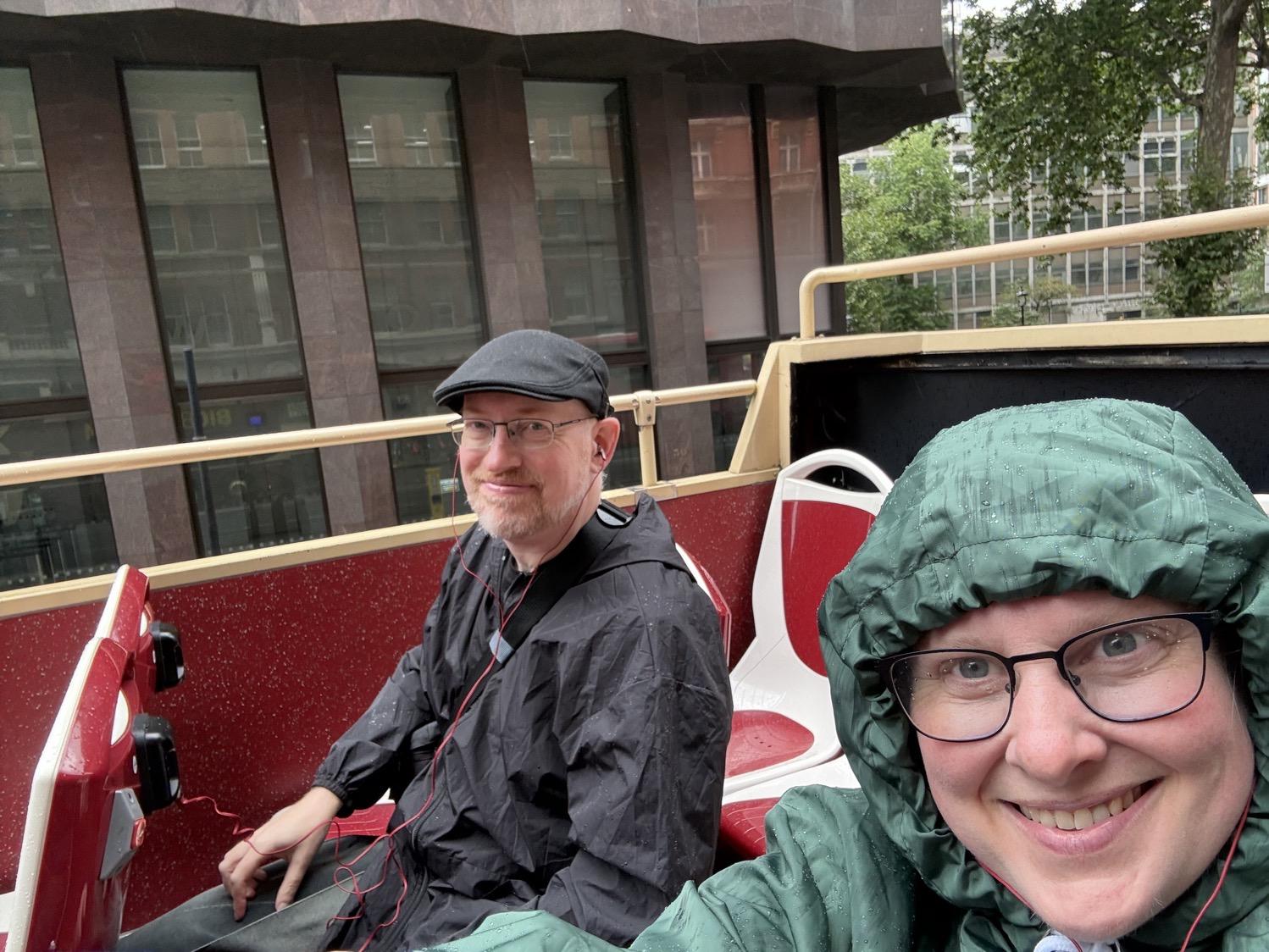
But that wasn’t until the evening, so we started our day by being very touristy and hopping onto one of the “hop on hop off” open-top city tour buses that constantly run around d the city. We figured this would be a good way to get a peek at areas of London we wouldn’t otherwise see, and maybe help us find ideas for more things to explore during other unplanned times. It was a grey and lightly rainy day, so while we were comfortable sitting on the open top deck for a while, eventually it got to be raining hard enough that we came down to the lower enclosed deck. Not long after that, the bus suddenly filled with other people who decided to use it as a good way to get out of the rain. We stayed on just long enough for the rain to slack off a bit, and then hopped off at Notting Hill.
We stuck it out as long as we could, but even Seattleites eventually get tired of rain. Photo by my wife.
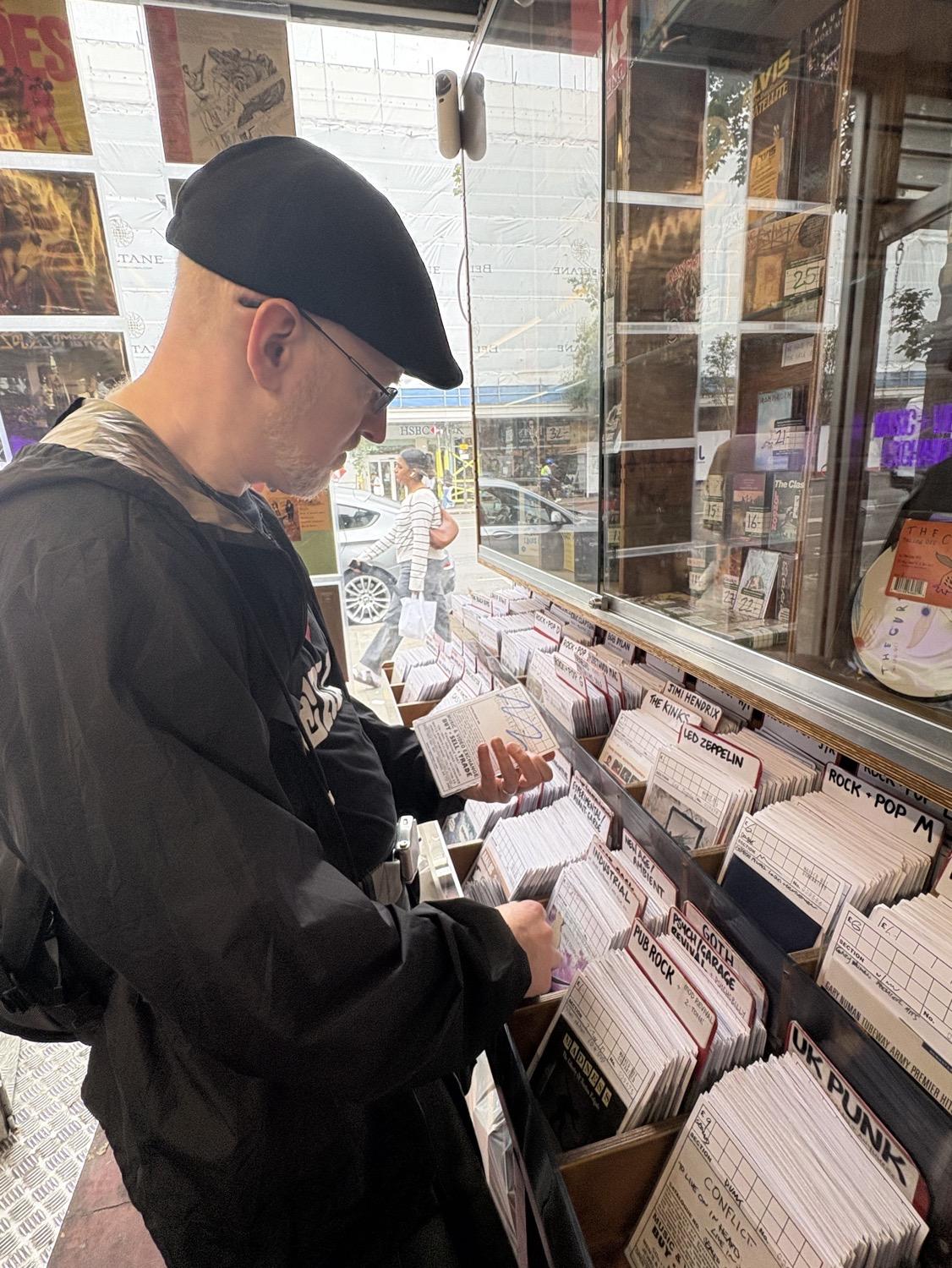
We took a slow wander up Notting Hill (even spotting the storefront used for the film) to Portobello Road, poking in little shops along the way. We found me a new hat and a few more CDs, got lunch, and wandered back to the bus stop.
I found three volumes of the Dependence: Next Level Ectronics sampler series; the first two (2004 and 2007) and a later one from 2015. Each was filed in a different section of the store. Photo by my wife.
We hopped back on the bus, intending to ride it the rest of the way around the loop to where we started. Unfortunately, for some reason, it seemed this driver had other plans, and we ended up literally going in circles. We went around one block twice, then passed the Marble Arch at least four times, and eventually ended up going entirely rogue, heading down a street not on the published bus route. Eventually it got back on route, but by then it had taken much longer to get there than it should have and we no longer trusted the driver, so we hopped off at the next stop and took the tube back to the hotel.
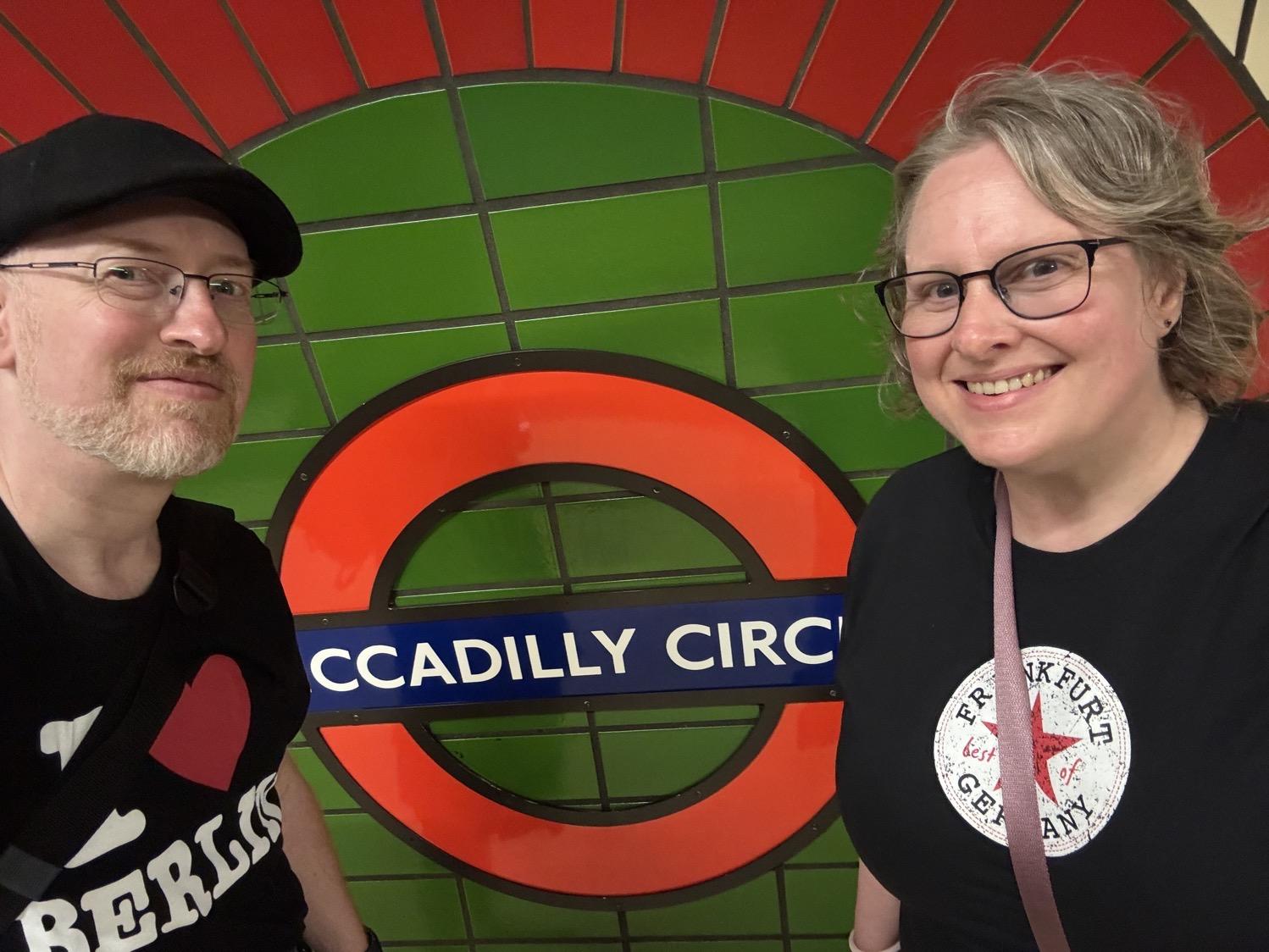
This did mean that we ended up at the Piccadilly Circus tube station.
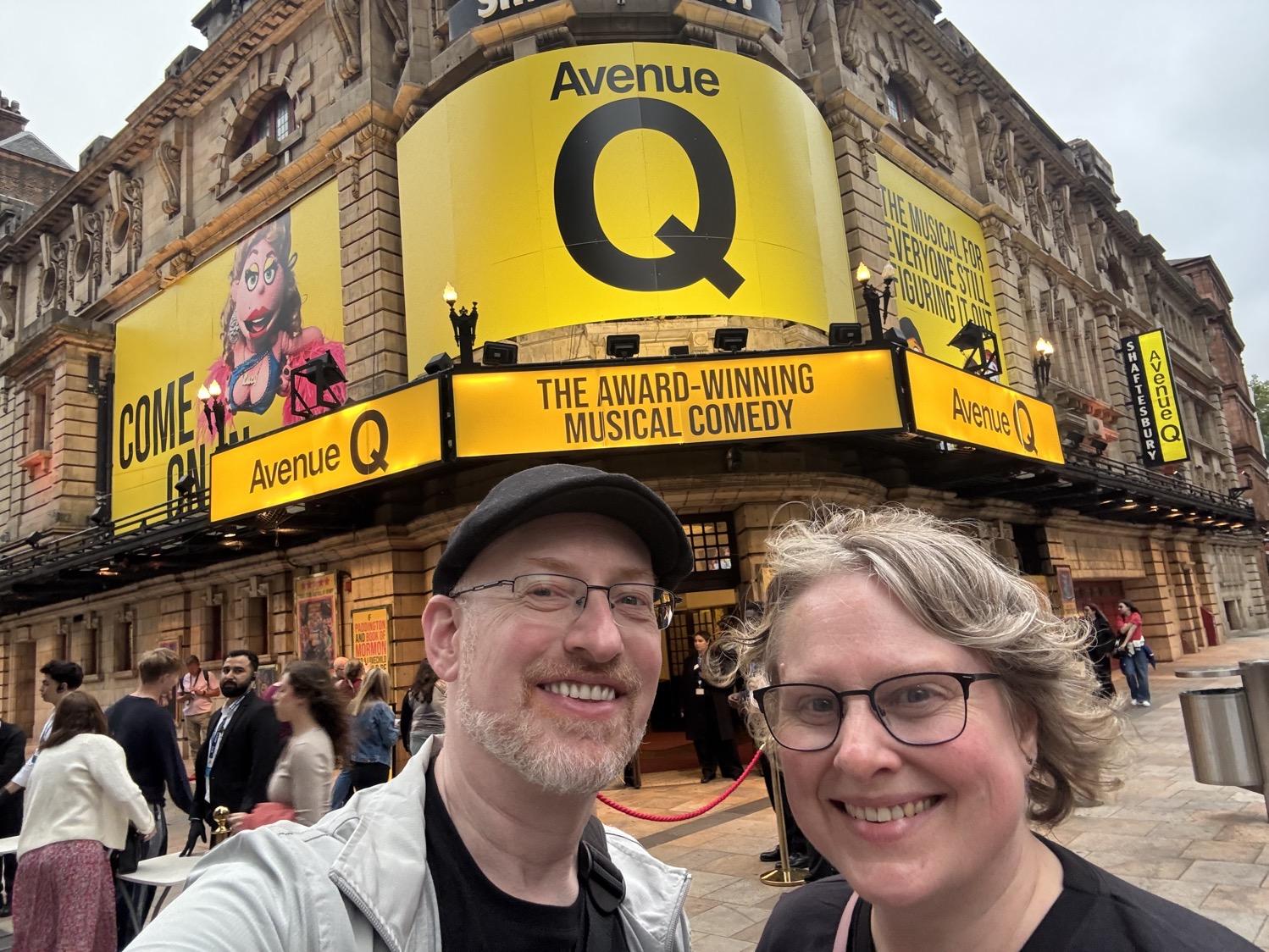
We had about a hour or so to rest, and then it was back on the tube and out to the theatre district to see our impulse purchase show, Avenue Q. We’d both heard about it for years and had had it on our “want to see” lists, and it did not disappoint. Funny, raunchy, and sweet, and absolutely fascinating to watch, as the performers handled their puppets. After the show, another tube ride back to the hotel and off to bed.
Weird route and rain and all, that bus did take us around parts of London we wouldn’t have otherwise seen.
Day 21: London
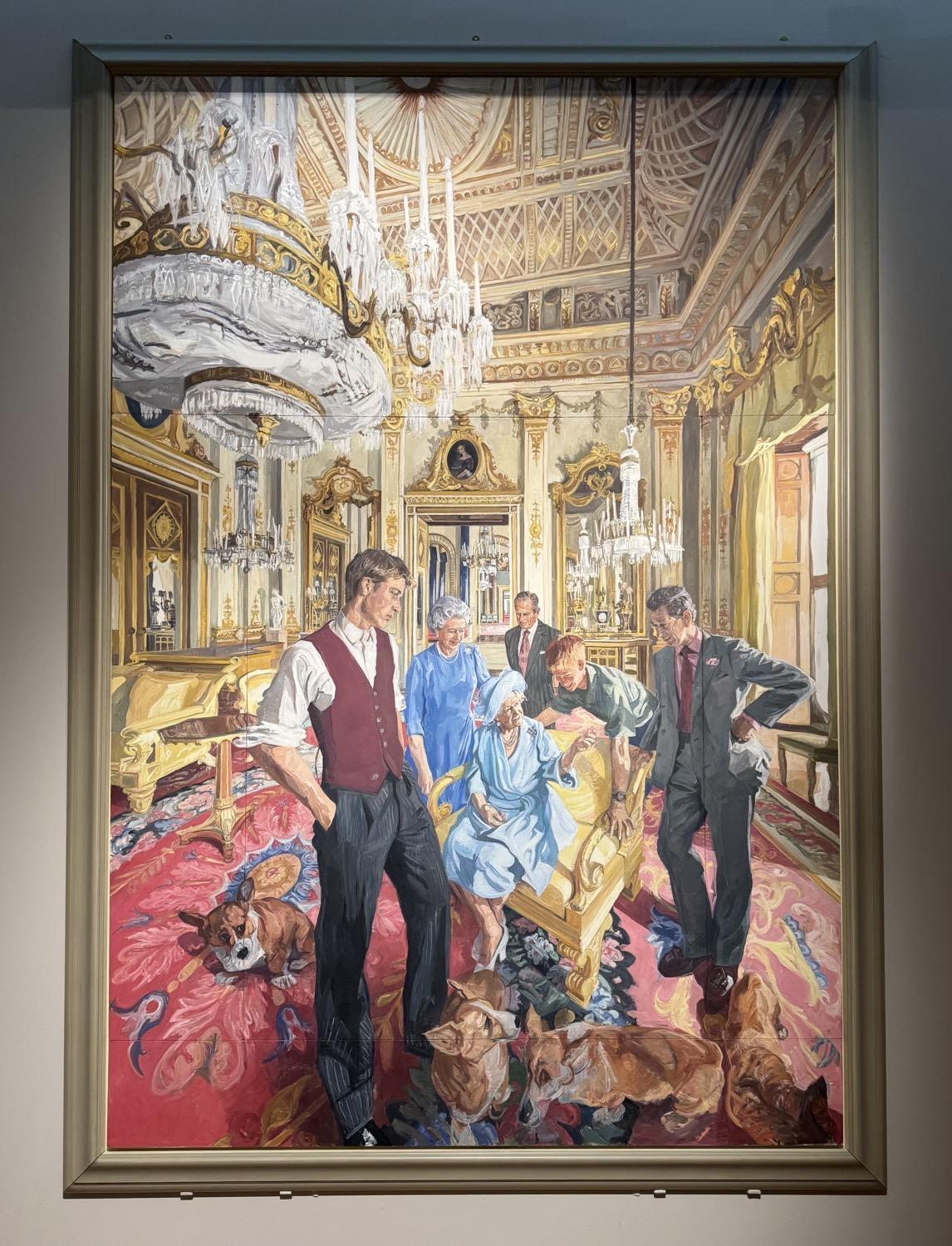
Having had two pretty full days, we gave ourselves a slow morning and didn’t leave hotel until after noon. Once we did, we took the Underground up to Trafalgar Square. We started with a couple hours in the National Portrait Gallery, then went on to the National Gallery, giving us a nice afternoon of gorgeous and historic art.
The Royal Family: A Centenary Portrait (2000) by John Wonnacott. I though the wide-angle, almost fisheye-lens distortion of the painting was really neat.
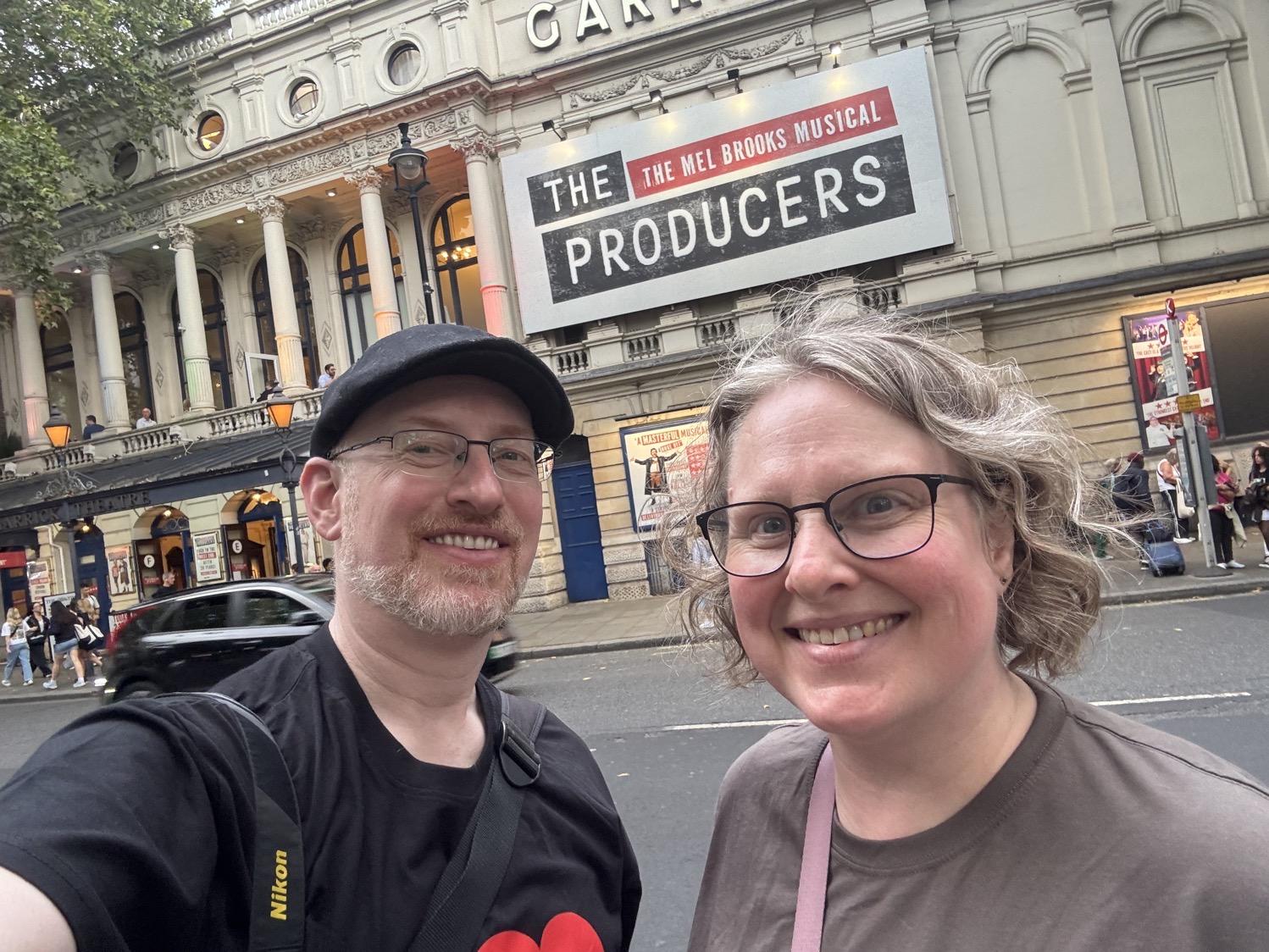
We found dinner, then went to our third show in three nights and saw The Producers. While we’re both very familiar with the film version of the musical, this was our first time seeing it on stage, and it was hilarious…and, honestly, at times a little unsettling. I mean, it’s one thing seeing “Springtime for Hitler” on your TV screen, it’s quite another, no matter how hilarious, to be sitting in a theater with giant red, white, and black swastika banners dominating the stage. Mel Brooks knows, though: Always mock fascists.
If you’ve got it, flaunt it!
After the show, another tube ride back to hotel, and another late collapse into bed.
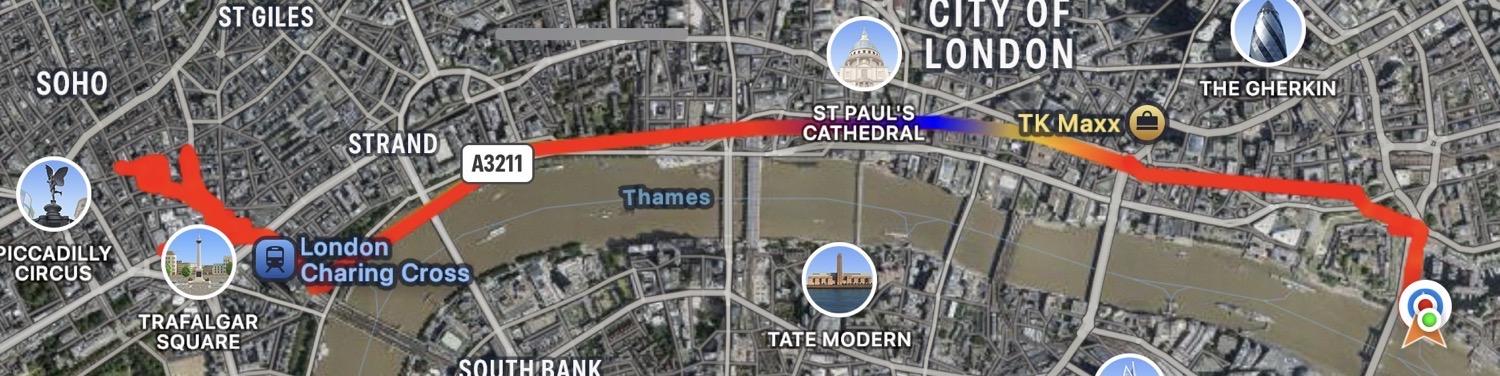
We were definitely getting more and more familiar with these particular sections of London and the District, Circle, and Northern tube lines.
Day 22: London
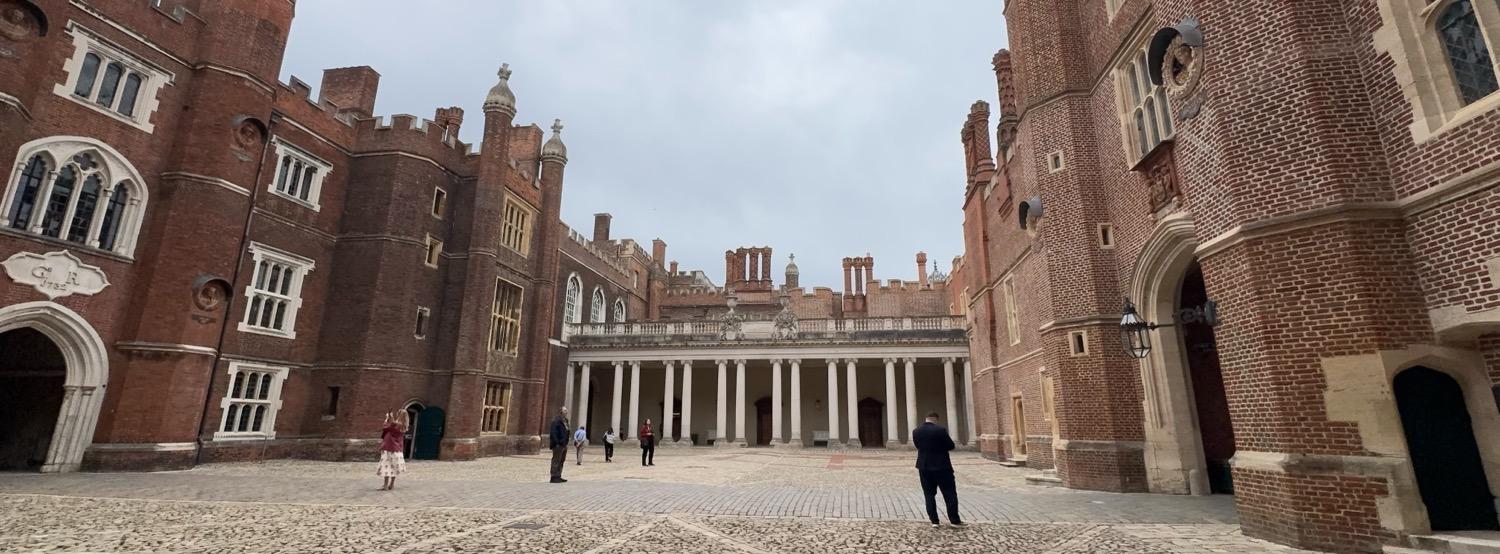
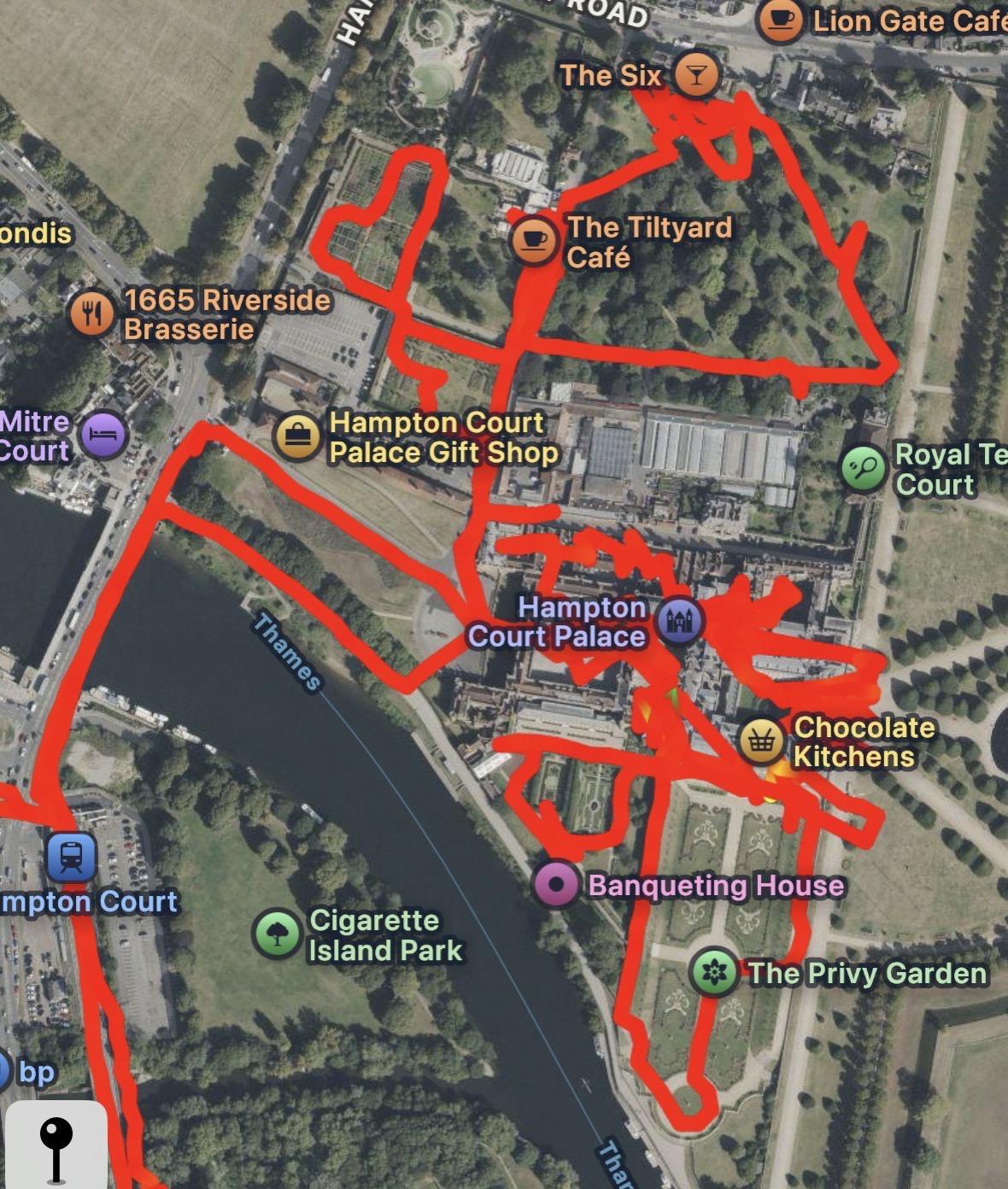
Another more planned day today. We got up a bit earlier in the morning and headed out, taking the tube to Waterloo station, then hopping on the NRS South Western Railway out to Hampton Court. We then spent our day slowly wandering through Hampton Court, letting my Tudor-era Anglophile wife soak up the history. We did have some disappointment in that a large part of the formal gardens was taken over by an upscale car show (which we had no interest in paying £112 to see), but there were other gardens still accessible, and aside from that unfortunate bit of timing, we very much enjoyed the day. We came back to the hotel in the afternoon, and had a quiet hotel evening.
Inside the courtyard of Hampton Court.
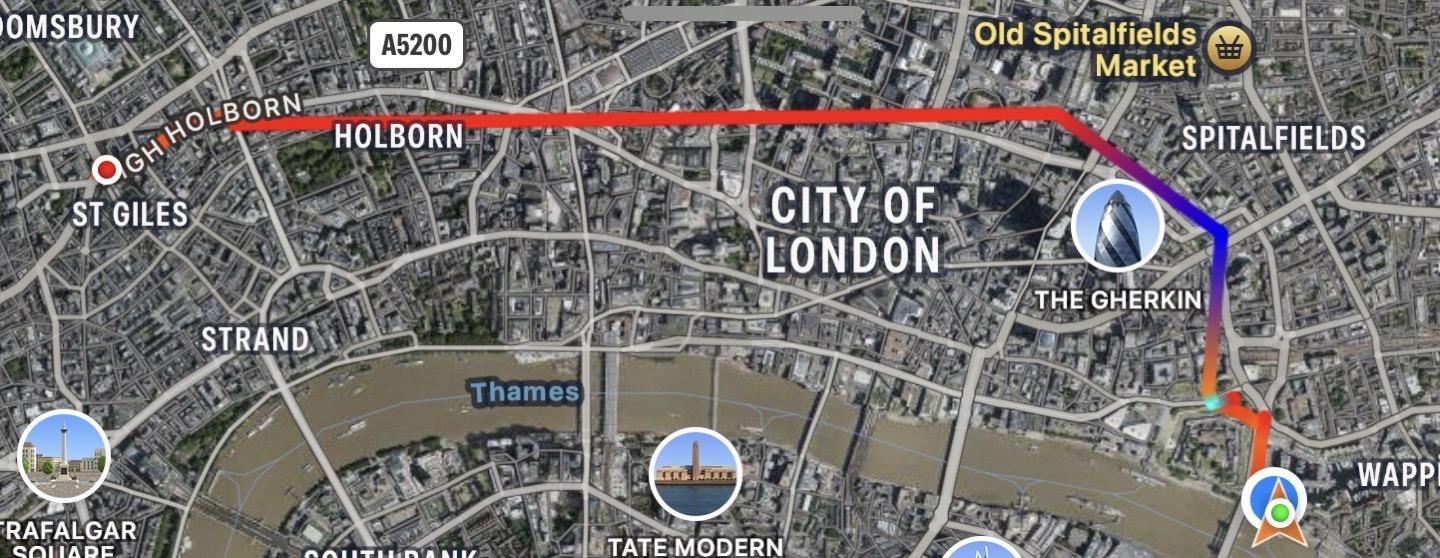
The part of the gardens we weren’t able to get to because of the car show is to the right side of the second of these maps.
Day 23: London
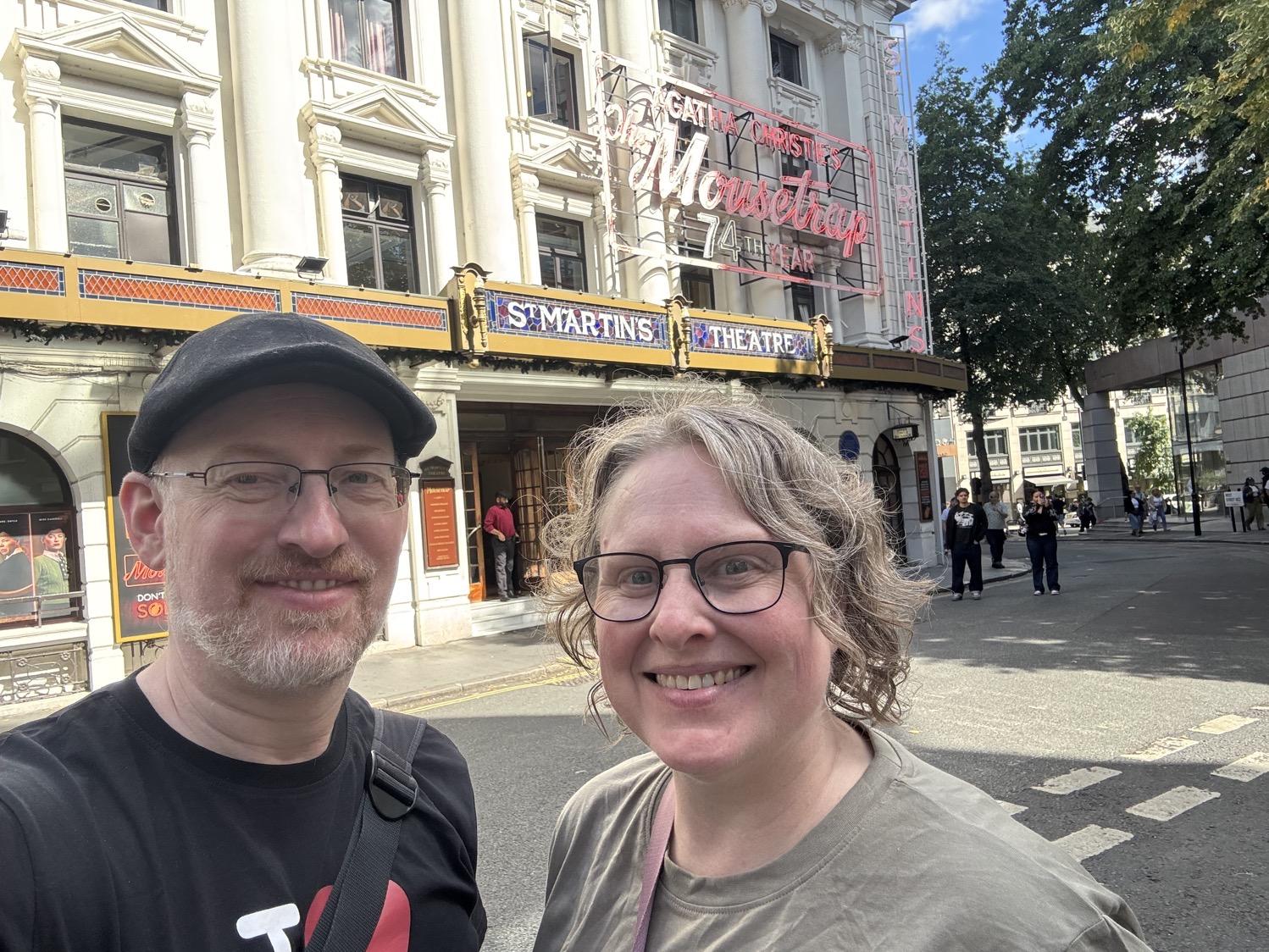
Took it somewhat slower again, with another day where we didn’t leave the hotel until after noon. (At over three weeks into this trip, we’re definitely flagging a bit.) Once we headed out, we started with some souvenir shopping, then went back out to the theater district. Wandered there for a bit, then saw The Mousetrap (notable both for being a fun Agatha Christie mystery, and for being the world’s longest continuously running play, now in its 74th year).
Now, if it was in its 74th year with the same cast, that would be really impressive.
After the play ended, we started to come back to the hotel and saw that the tube line we wanted from the closest station was delayed with massive crowds in the station, so we bailed out and walked to the next closest station that would have the final line we needed to get to the hotel. Got back, had dinner, and relaxed in the room. Just before crashing out, we got to watch Tower Bridge open and close for a cruise ship passing through.
The people on the cruise ship sure got a nice twilight view of London and the Tower Bridge as they went along.
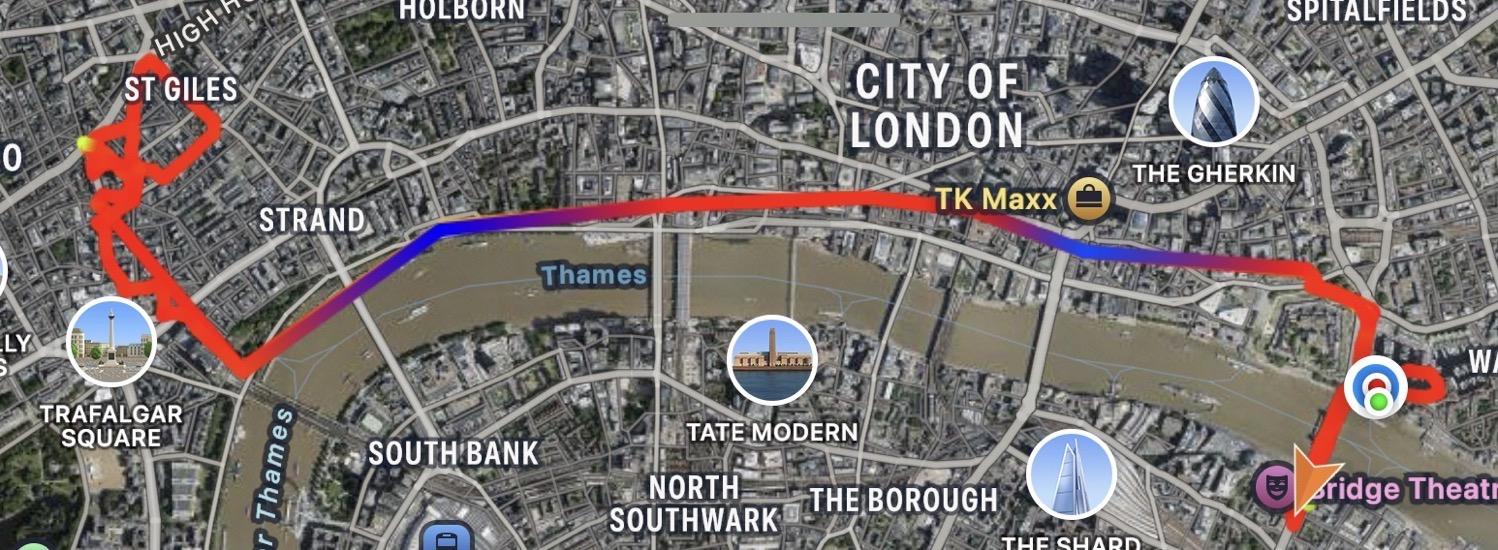
A bit more walking on this route that we’d originally planned, but certainly nothing we couldn’t manage.
Day 24 (part 1): London to…?
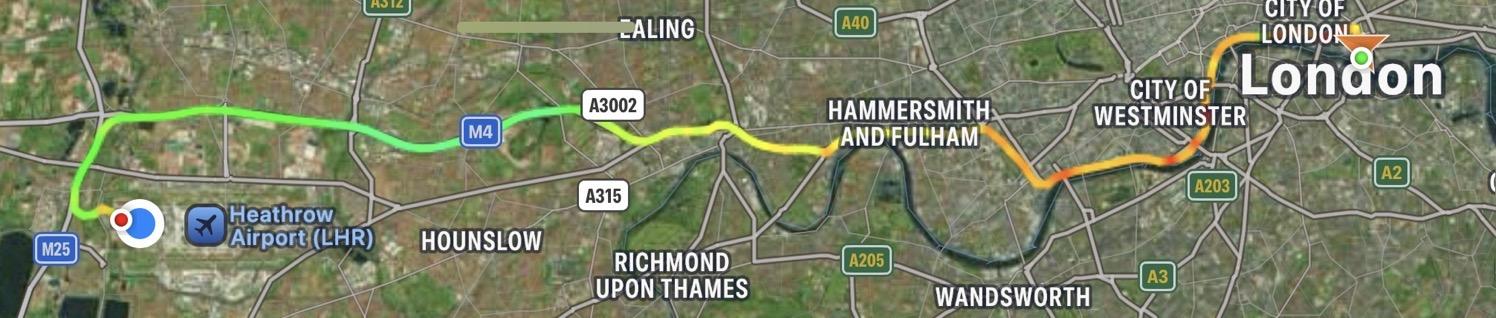
Travel day! The usual routine: Pack up, check out, and head off towards our next destination! Heading out was a little more trouble some than expected. Turns out today was the day for the London Big Half half-marathon, which attracts some 16,000 runners and starts by going over the Tower Bridge. This was pretty cool to discover when we were getting ready this morning, and we’d take regular breaks from packing to watch runners cross the bridge. But when it was time to go, this was the day we’d planned to give ourselves a bit of a break and take a traditional London Black Cab to our departure point, and we suddenly discovered that the number of roads closed around the Tower Bridge meant that cabs couldn’t get to our hotel. We checked with the concierge, and they just told us that the next closest taxi stand was near the Tower Hill Underground station, which gave us a vague direction to go, but wasn’t exactly clear directions. Apple Maps found us a taxi stand, though, and just a few minutes later a taxi pulled up to drop someone off, and we were able to hop on. And now we’re settled in and waiting to depart for our next stop.
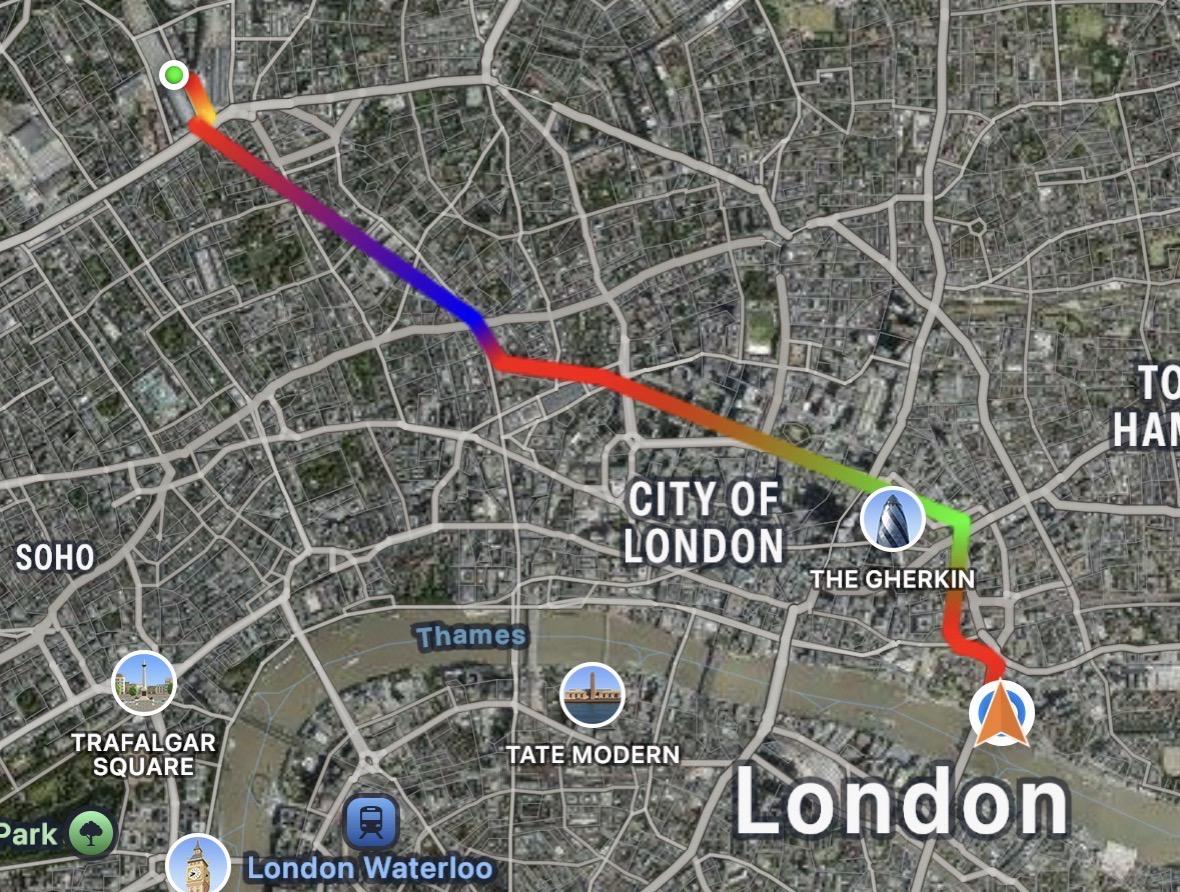
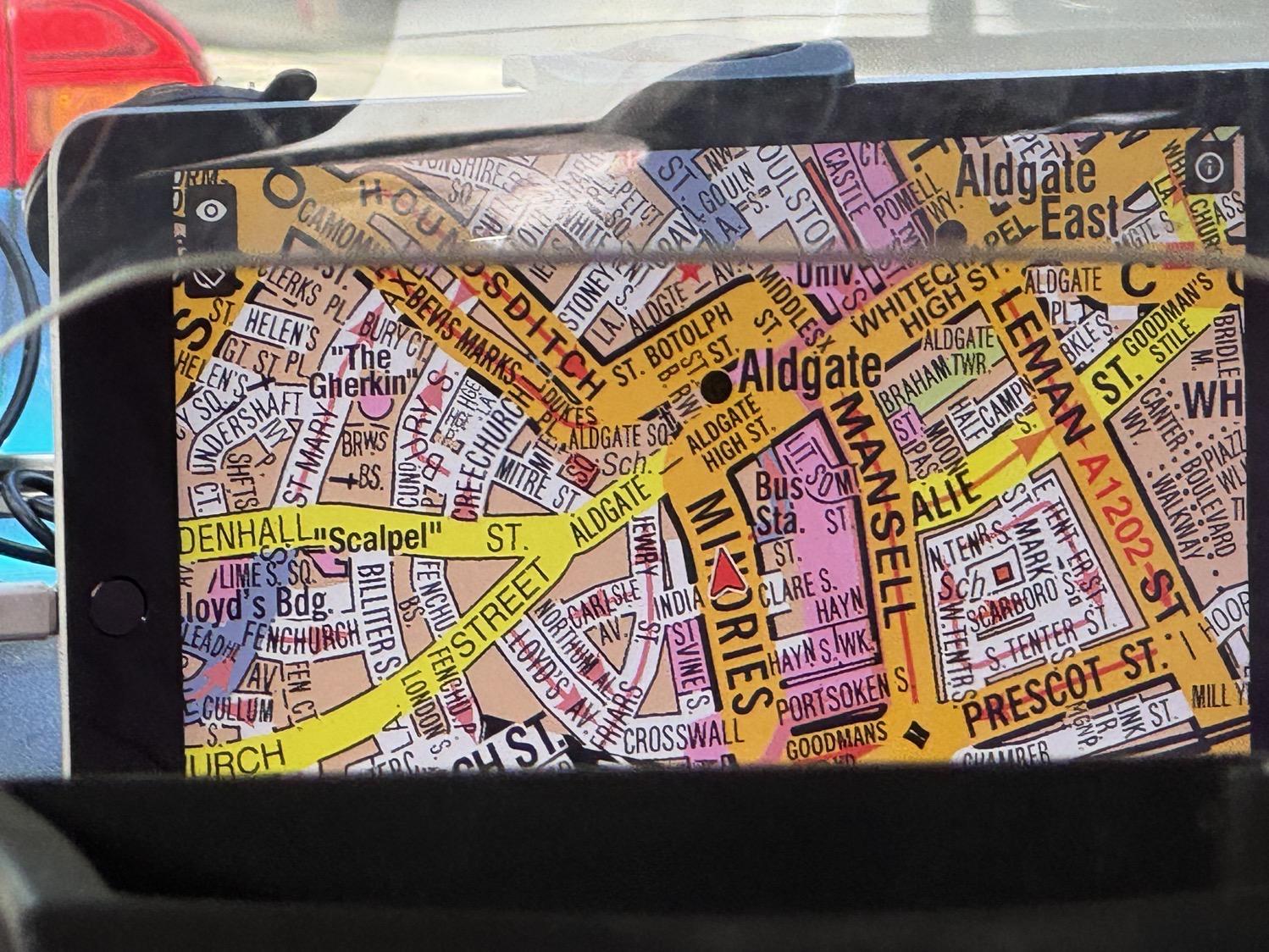
I was fascinated by the street map display style of the GPS app the black cab driver was using.Oh, dear, the destination on this track log does kind of hint at where our next destination might be, doesn’t it?
Well, that was a long travel day. After the four hours sitting in the Brussels Midi station and getting on our train, things looked fine, with the most interesting piece being checking the weather report for Paris and seeing thunderstorm warnings. Well, we’re from Seattle and brought lightweight raincoats, so we didn’t think much of it, and ended up missing all of the rain anyway.
We got to the first train station on the outskirts of Paris, and transferred to one of the local B-line trains to go into the city — almost missed it, but just squeaked in the doors with the help of a man on the train. We chatted with him until he got off, and then we rode a few more stops to where we had to switch to our next in-city C-line train. And waited…
…and waited…
…and eventually figured out (along with everyone around us) that the storm had downed some trees on a track somewhere and the C trains were entirely disrupted. So we decided to go up to street level and see what we could figure out, hoping it wouldn’t have to be on foot, since we were about an hour’s walk away from our hotel. We got up to the street level, and were immediately distracted with a gorgeous view of Notre Dame at dusk. Once we got over that, we walked a little ways up the street until we found a bus stop and taxi stand. At that point, it was after 9 p.m. we were tired, and it was time to admit that sometimes, a taxi is worth it. Fifteen minutes later we were at the hotel.
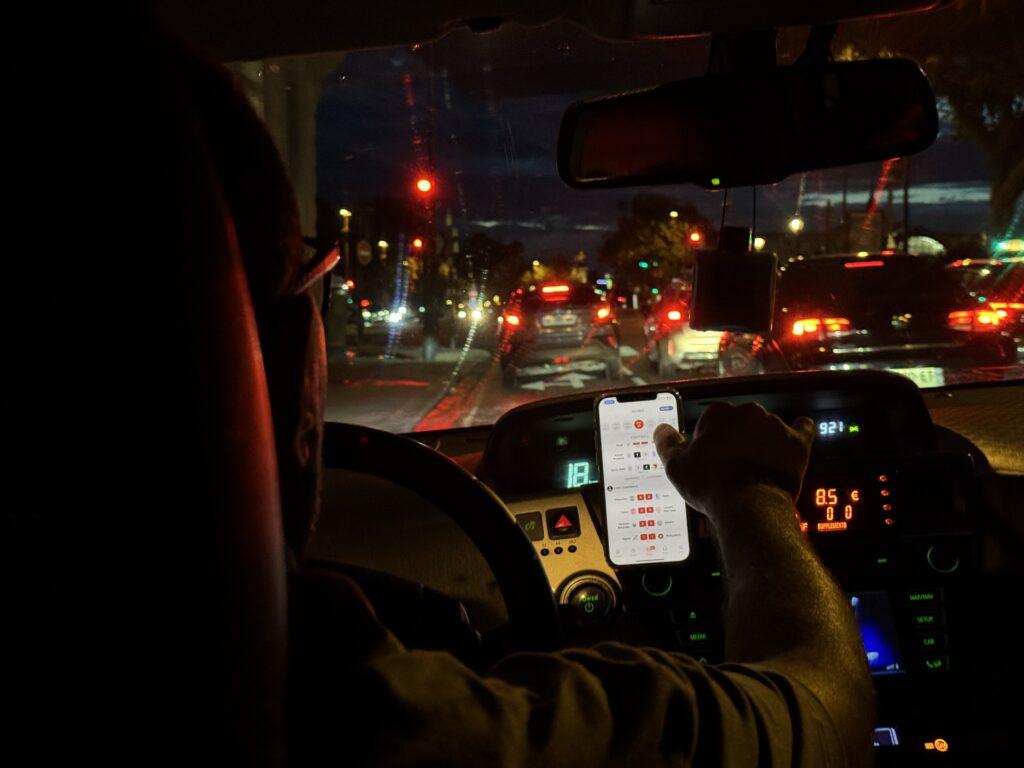
Yes, that’s our cabbie scrolling through sports scores on his phone with one hand as he drives us through busy Paris traffic to our hotel. Welcome to Paris?
The hotel is very cute, all built around an inner courtyard, with an elevator we had to take one at a time, tiny walkways, and a tiny room, and it’s great. We’re here, the beds are comfy, and that’s it for the day.
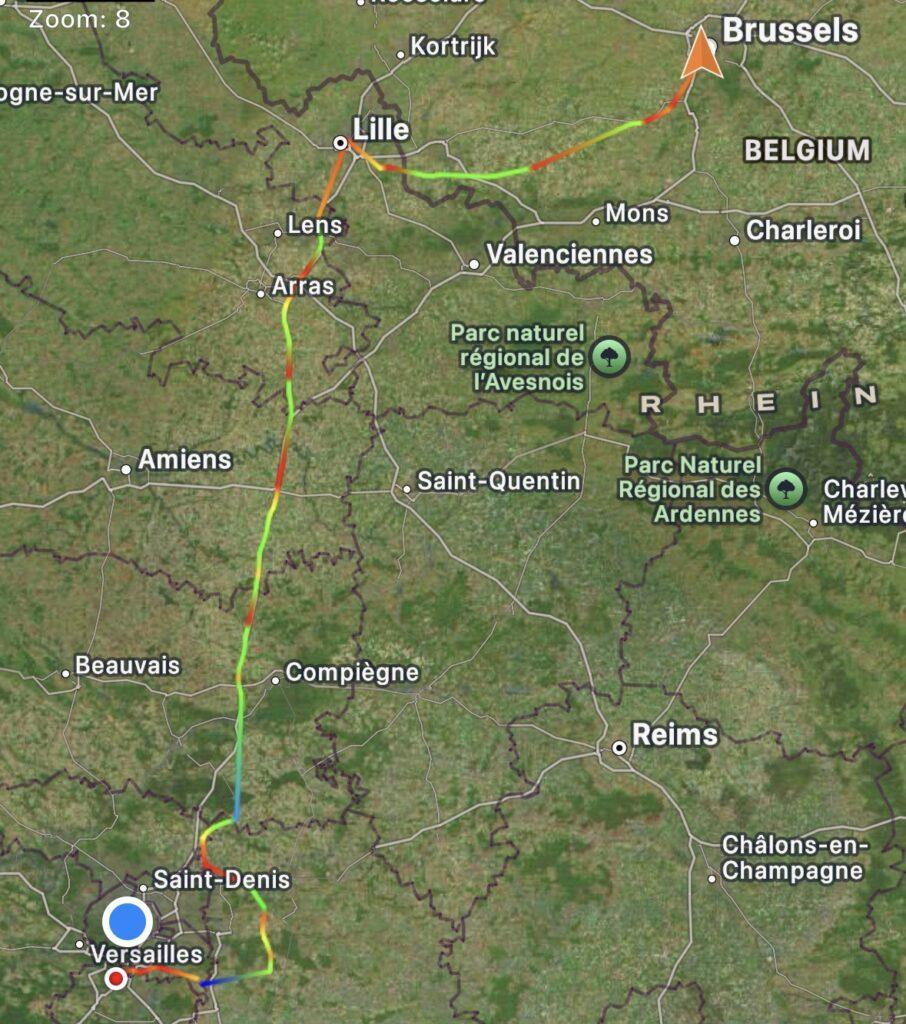
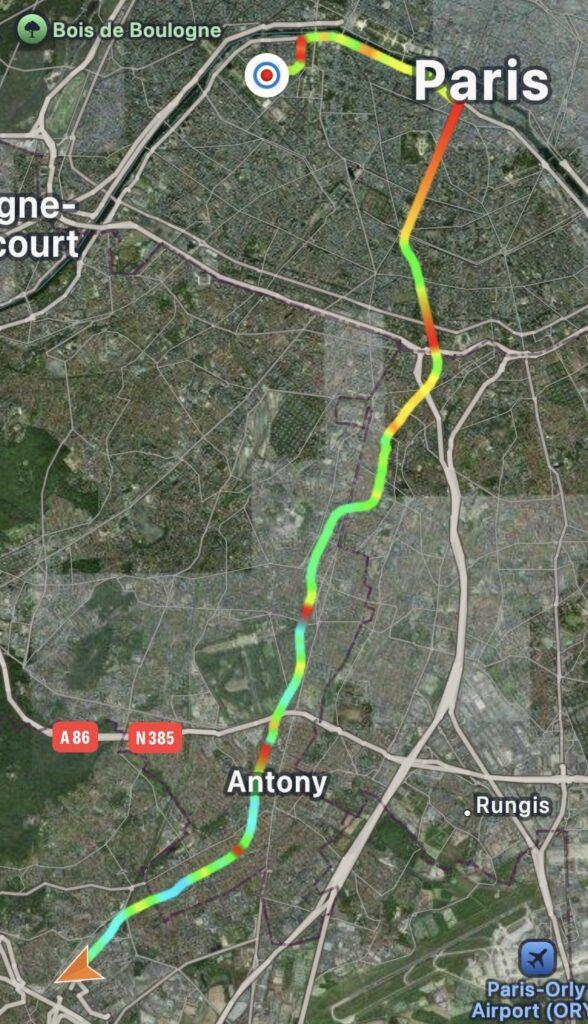
Our Interrail journey from Brussels to Paris.From the southern end up to the left turn just at the ‘a’ in ‘Paris’ was the train, the final leg was by cab.
Day 15: Paris
Big day for exploring Paris and seeing all sorts of pretty things!
We started by getting up nice and early in the morning and walking from our hotel to the Louvre (just over two miles, which is entirely doable after a night’s sleep and when you’re not carrying backpacks). Made it to the Louvre with about half an hour before our 9 a.m. entrance time (when the museum opens), stood in line at the entrance closest to the Mona Lisa…and then right at nine, a museum staff person came up to tell everyone who was lined up there that that entrance wouldn’t actually open until 10, and to follow them. Of course, by this time there was already a huge line at the main entrance, so we were a little concerned that we’d just get dumped into the end of that line, but instead, we all got marched over to the group entrance and let in there. No biggie, as it turned out.
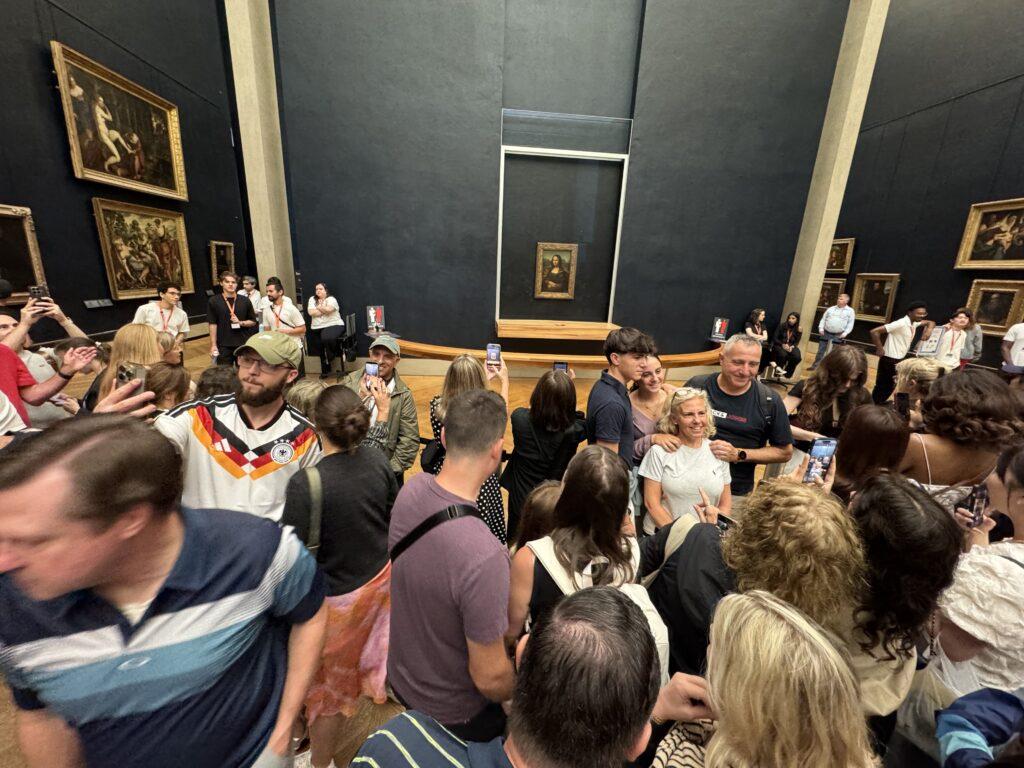
Once in, we beelined for the Mona Lisa…along with nearly everyone else. This really is one of those things you do to be able to say “I’ve seen the Mona Lisa in person”, not to actually, you know, stand there, look at it, and see the painting. The scrum wasn’t as bad as trying to see the Rosetta Stone at the British Museum, and we were able to get to the front and get our 15 seconds of photo and selfie time in, so we called it a success and went off to investigate these rumors that the Louvre has one or two things worth seeing other than the headliner. We then had a very pleasant few hours wandering the museum and finding all sorts of things to gawk at.
Yes, it’s a bit crazy, but I can now say that I’ve seen the Mona Lisa in person. Some people will be very impressed, others will understand that it’s about the experience, not the art.
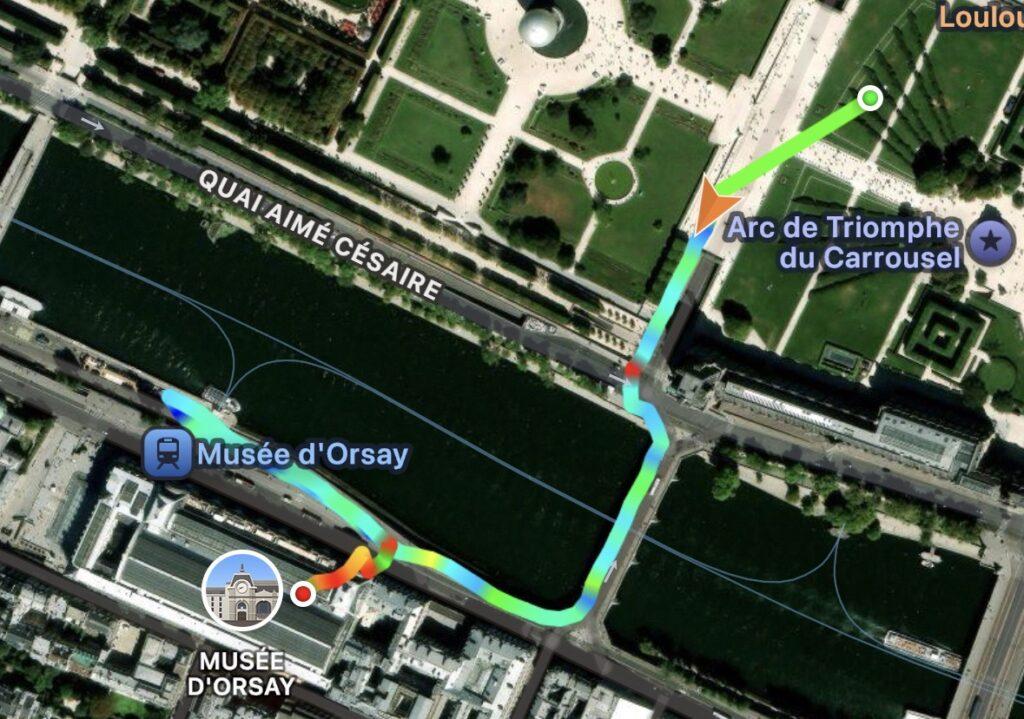
When lunchtime rolled around we grabbed a bite at the Louvre’s cafe (it was close, quick, and convenient), went out and wandered the grounds for a little bit, and then went across the street to the Musée d’Orsay for the afternoon. What they say (whomever “they” are and wherever they say it) is true: you go to the Louvre to say you’ve been to the Louvre, you go to the Orsay to be able to see the art. Another incredible collection, but not (quite) as crowded (save for the Van Gogh rooms on the top floor, but having just been to the Van Gogh museum in Amsterdam, we were okay with skimming those rooms), and much easier to be able to find something you like and be able to hang out and really appreciate it.
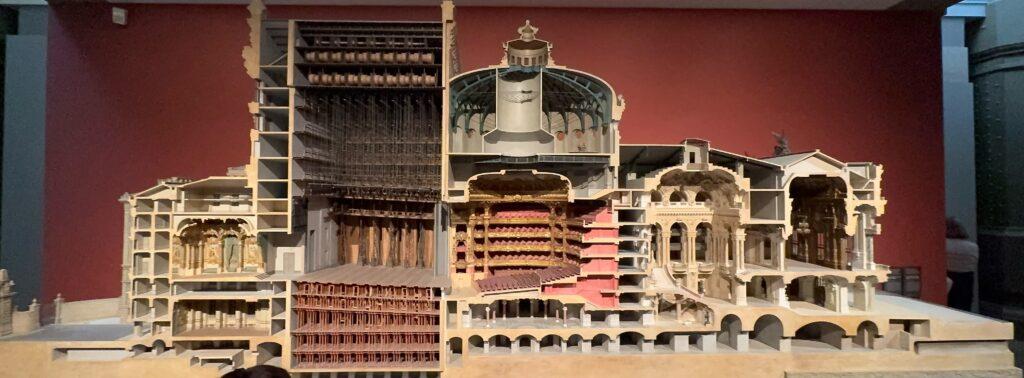
The Orsay has this incredible model of the Paris Opera; if we)d had more time, I could have spent a lot of it just staring at this (and hoping to spot the Phantom…).
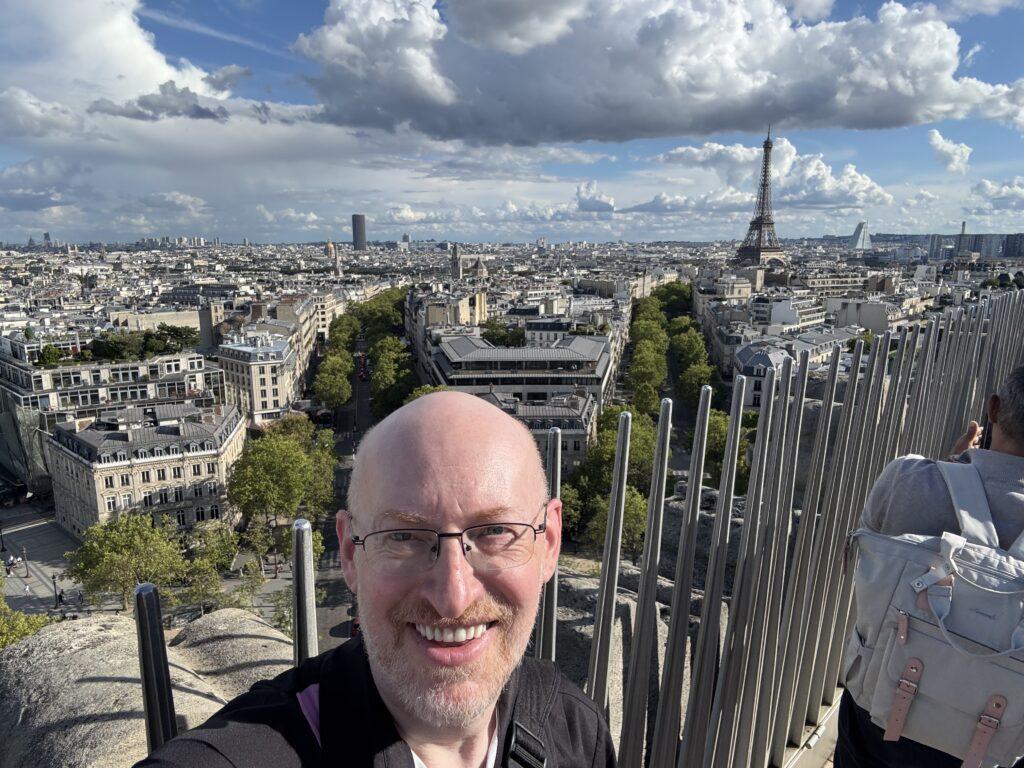
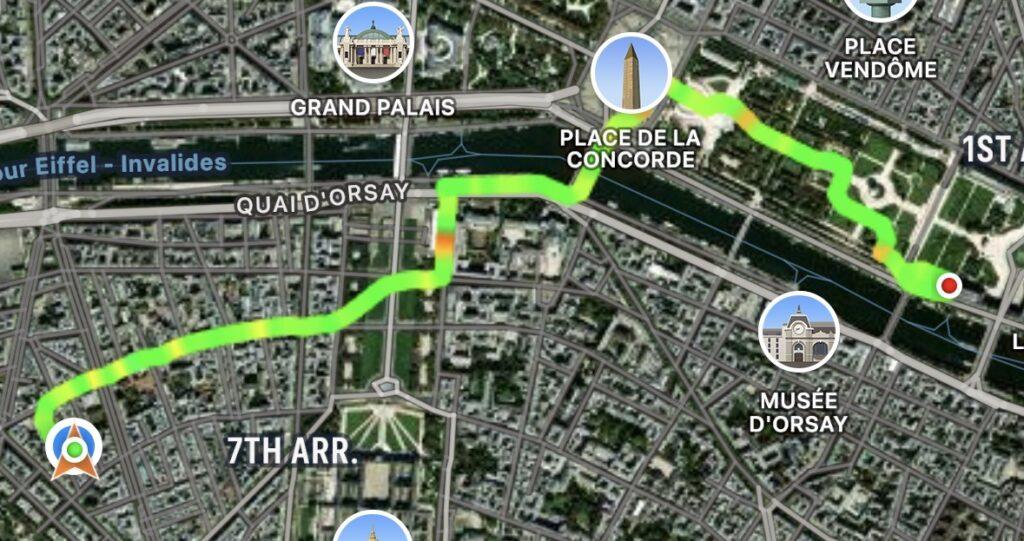
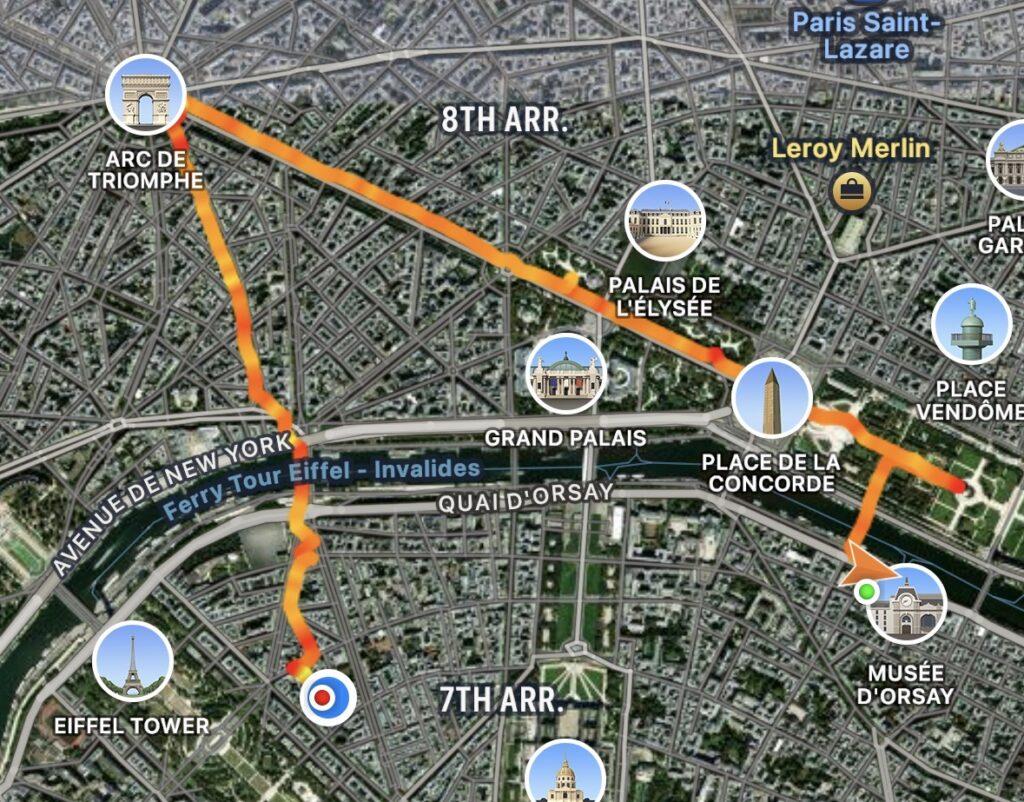
Once we were all art-ed out for the day, we crossed back over the Seine to the Jardin des Tuileries, and then proceeded to walk the entirety of the Avenue de Champs-Élisée, all the way to the Arc de Triomphe. Once there, my wife found a bench to rest on while I climbed the 280 steps to the terrace at the top for some gorgeous views of Paris. When I made it back down to ground level, we walked from the Arc back to our hotel.
At the top of the Arc de Triomphe.
The Orsay-to-Arc-to-hotel leg of the day’s walk was about 4.7 miles. All together, my watch tells me today ended up with 23,705 steps and 10.58 miles — a record for this trip so far! (We’re not really trying to set these records, we just want to see All The Things, and then whine when we get back to the hotel about walking too much and swear we’re going to take it easier the next day. Then the next day comes along….)
That was a lot of walking, but it was well worth every step.
Day 16: Versailles
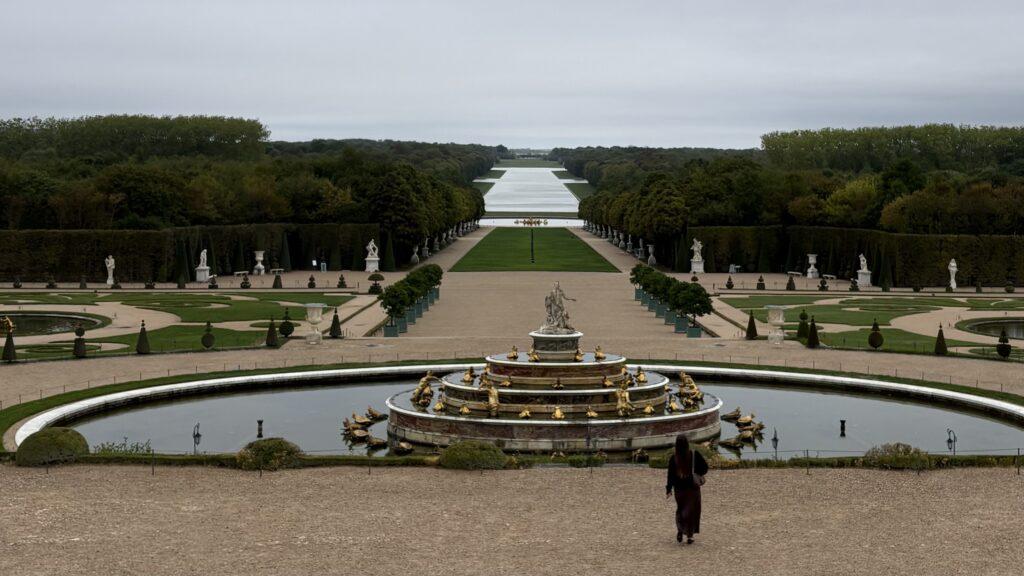
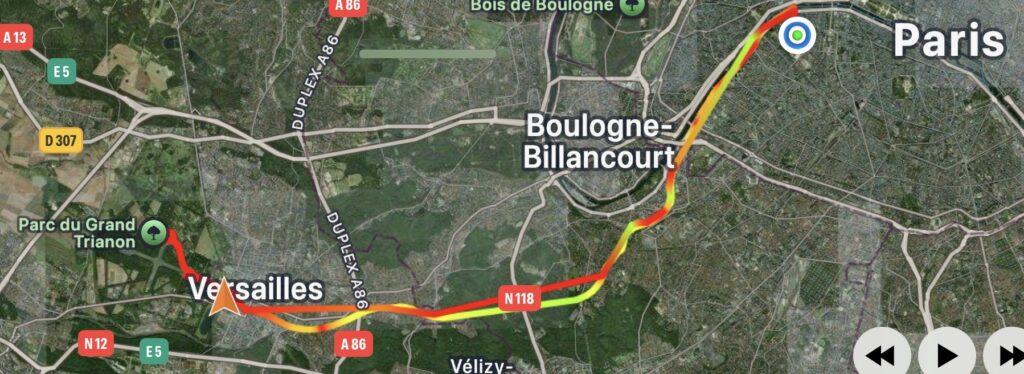
Today’s adventure was an excursion out to Versailles. We got up really early, had a quick in-room breakfast, and headed out. Hopped on a local train, rode ten stops, and a short walk later were at the gates. We had the earliest entry tickets we could get (9:30 a.m.), and had made sure to get there nice and early, so we had time to start our day with a short walk through the gardens. Being able to do this first thing in the morning was really neat — hardly anyone else was there (a few visitors early for their entrance time like us, and locals out for their morning run…y’know, like you do, when you live close enough), so we had the entire space nearly to ourselves. We did that for about half an hour, then went back up to stand in line for our entrance.
It bugs me to no end that this fountain is just slightly off center from the rest of the gardens.
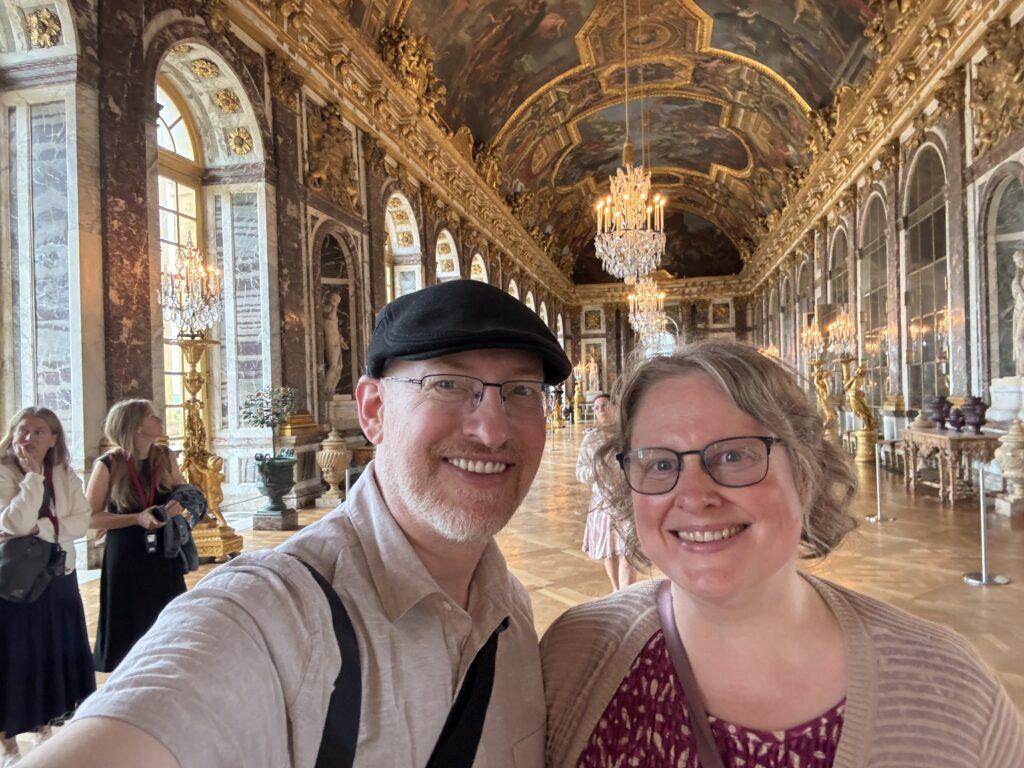
Once in, we kind of skimmed through the first half of the palace (lots of pretty paintings, but having just done a number of museums, we were okay with doing a quick breeze through while keeping an eye out for any we really wanted to stop at) so that we could get to the Hall of Mirrors before it got too crowded. While not empty when we got there (there were 9 a.m. entry people before us), it wasn’t super crowded, and so that was where we really slowed down to take things in, and enjoyed moseying our way through the rest of the palace.
What I admire the most about Louis XIV is his understated and subtle design sensibilities.
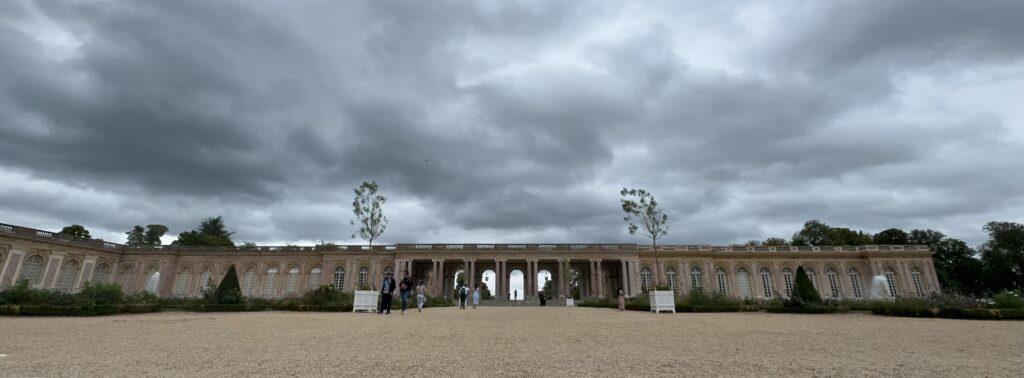
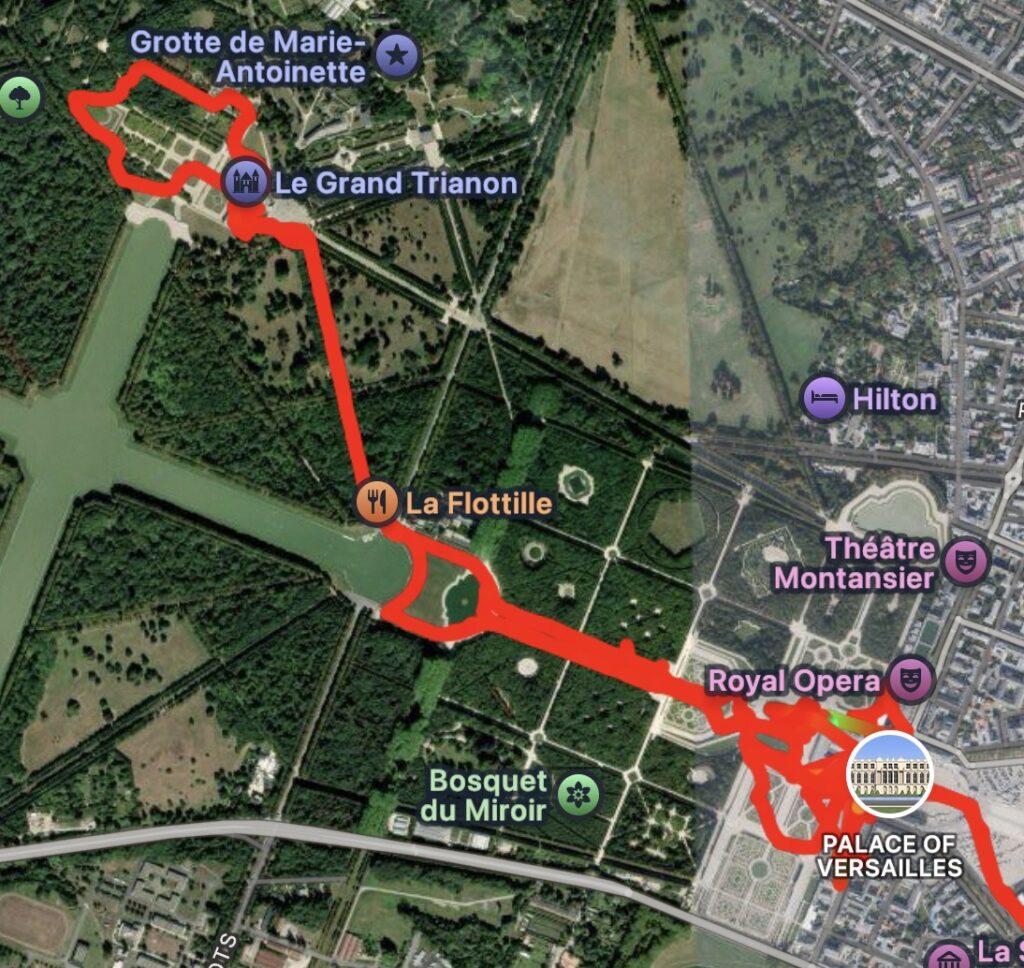
From there we went back out to the gardens, which while much busier, had the advantages of having the fountains running (which hadn’t been turned on yet earlier) and more dramatic skies (instead of the morning’s flat grey). We went down along the main walk towards the Grand Canal, then headed off toward the Grand Trianon. We weren’t sure if we’d be able to go in or just wander the outside, but it turns out our tickets were good for that too, so we got to wander through the inside of that smaller palace as well.
Those skies were really staring to look ominous….
After the Grand Trianon we went out and explored the Trianon’s gardens and fountains for a bit. This was a nice treat as well, as fewer people make the trek out to the Trianons, so it was a much quieter stroll than in the main gardens.
Eventually we could see the skies getting even more dramatic, so we decided that it was time to head back (not an easy decision when we realized we’d missed Marie Antoinette’s Petit Trianon, but there’s only so much time…). We got back to the main gardens just in time for a heavy rain storm to start, which lasted our entire walk back up the gardens, out of Versailles, and the few blocks down the street to the Paris Metro station where we got on our train. We were absolutely soaked, but still having a good time. We got back into town and to our hotel, hung our clothes up to dry, and crashed out for an afternoon nap.
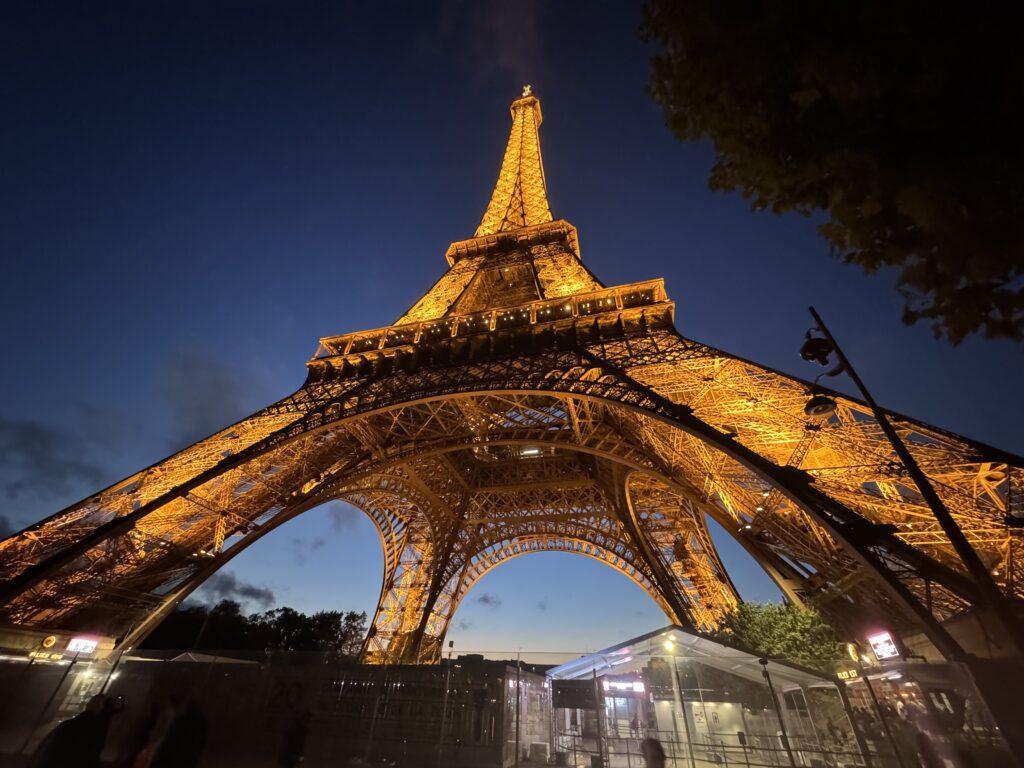
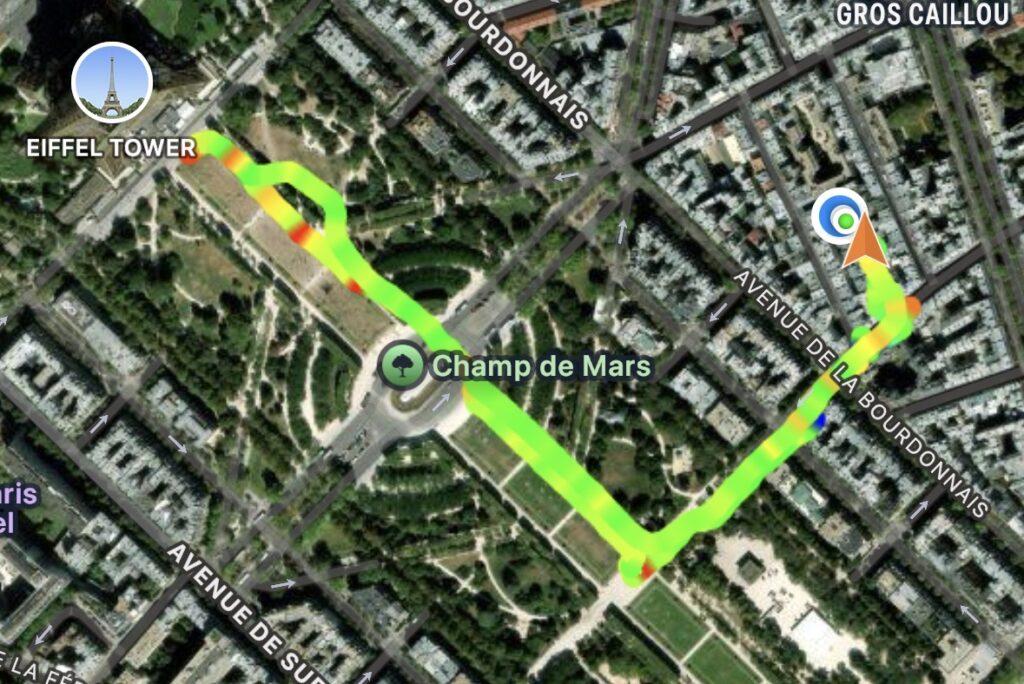
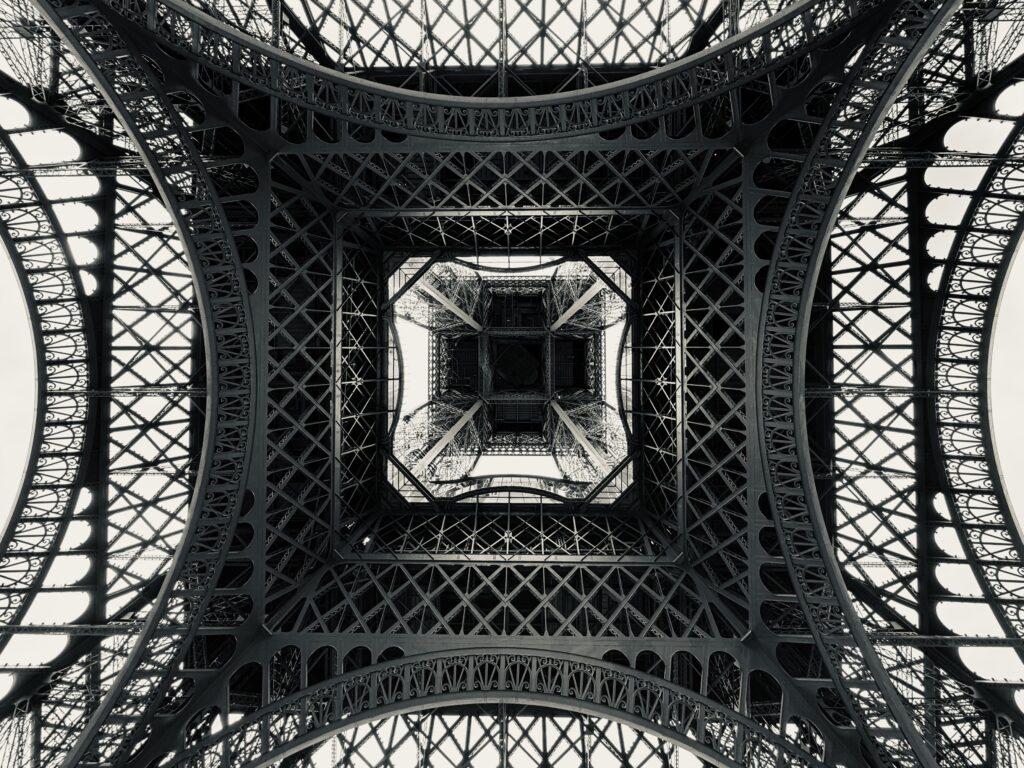
After a couple hours to rest, we were hungry and ready for dinner, so we headed out and walked down the block to a really cute little Italian place just at the end of the street from our hotel. Had a good dinner there, then walked two more blocks to the Champ de Mars, and stood and watched the Eiffel Tower slowly light up as the sun set, then as it put on its sparkly light show shortly after sundown. We then walked up through the park to near the base of the tower — and as keeps happening on this trip, knowing about something on a theoretical level doesn’t really prepare you at all for the reality of standing underneath this colossal structure. It’s really an incredible thing.
It’s huge.
After enjoying the view for a while, we decided that it was time to call it a day and headed back to the hotel.
After having seen Versailles in films and TV shows for years, actually being there was kind of surreal.
Day 17: Paris
Today we made another attempt at taking things a bit slower, with…mixed results, unsurprisingly. We slept in as late as we could, and had a nice slow morning, with breakfast in the room and no rush to get out and about.
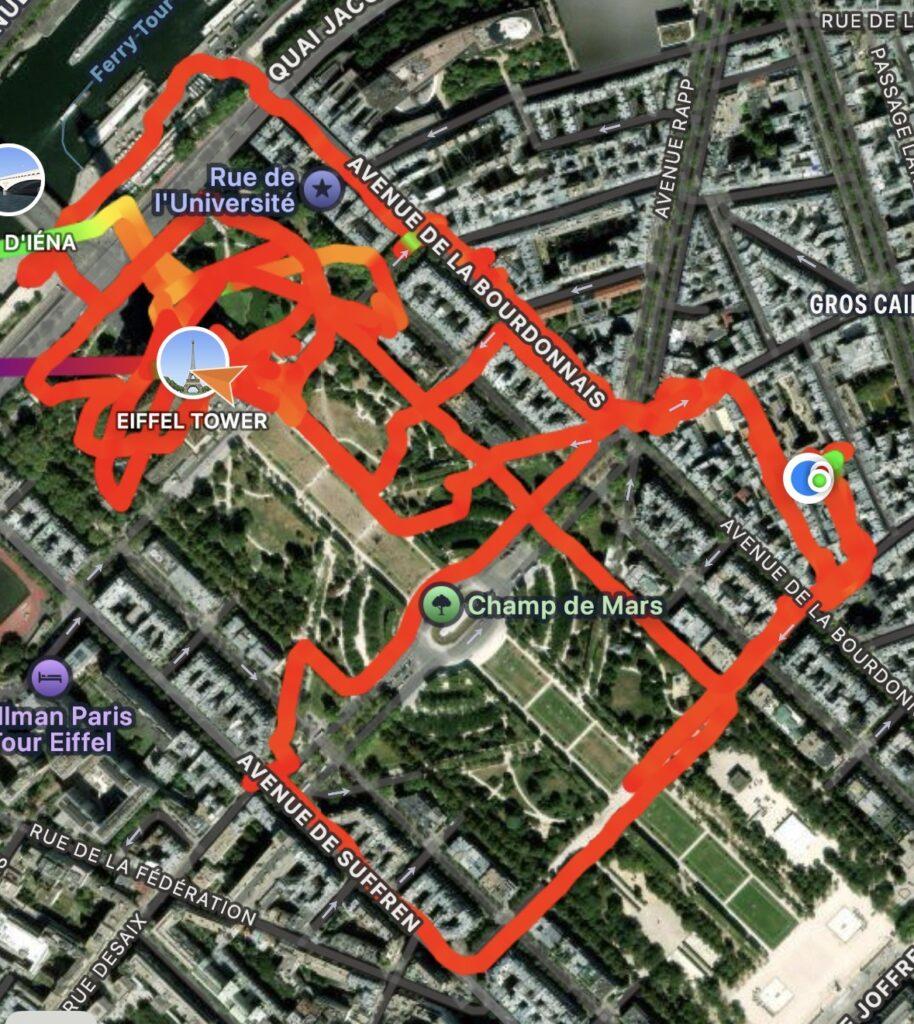
When we did venture out, we started off by getting a bag full of pastries from a local patisserie, and walked up to the Champ de Mars to eat them while sitting in the park in the (figurative, due to the time of day) shadow of the Eiffel Tower. Then we strolled around the park and the base of the tower for a bit before making a brief stop back by the hotel room to make sure we were prepped for our afternoon adventure.
Enough people want to do this kind of shot that there’s a very convenient plaque on the ground telling you where to stand. Well, I never claim to be original….
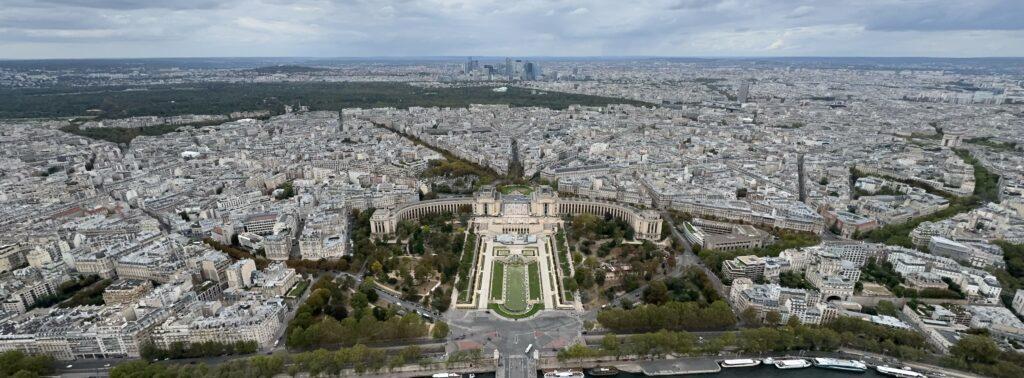
Heading out again, we started by crossing over to the other side of the Champ de Mars and finding a cute French restaurant for lunch (we had to get actual French food at least once while we were here, of course). When that was done, it was back to the Eiffel Tower, where up to the top we went! We took the easy way up in the elevators, which is a two-stop process: one elevator up to the second level, and then a second elevator (and then a short flight of stairs) up to the top.
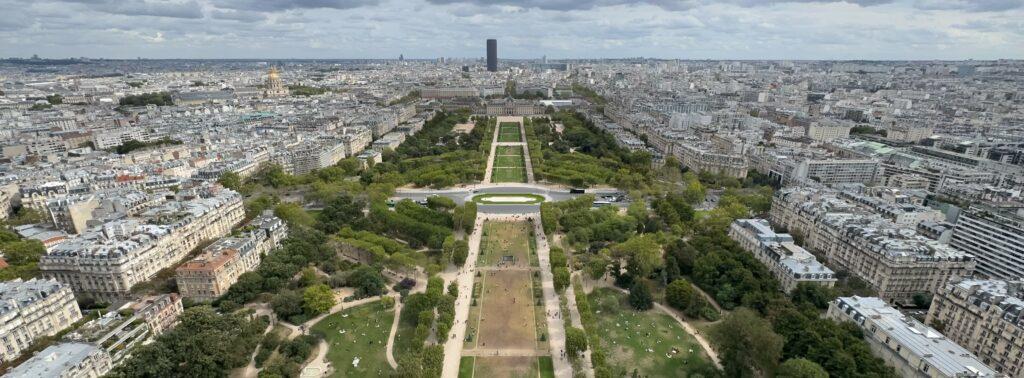
And here I thought the view from the Arc de Triomphe was impressive!
As can be guessed, the view was incredible. We went all the way around the top, me taking photos and my wife (who is somewhat afraid of heights, but was determined to do this, and handled herself quite well) stayed nearer to the inner wall. After our circuit, we started heading back down again. We took the elevator down from the top to the second level (the only option), but then, having spent our time in line for the elevator sandwiched between one family who didn’t bother to rein in their rambunctious 7-year old at all and another family who were remarkably pushy and kept trying to go around (or through) us even though there was no space to either get around or to get to, we decided to just skip the next elevator and take the stairs down. All 674 of them!
It’s a lot of stairs, but easier to do going down than up, and though it took longer, it was a much more pleasant experience than being crammed into one of those elevators again. About 15 minutes or so later, we were back on the ground (to my wife’s great relief). We took a little time to recuperate, and then headed back to the hotel to get back into a quiet space and away from people…and once there, though we’d considered some other evening jaunts, we decided we were fine with calling it a day. A short venture out to the local grocery for dinner sandwiches, and then we tucked ourselves away for the evening.
Having a hotel two blocks off of the Champ de Mars was incredible.
Day 18 (part 1): Paris to…?
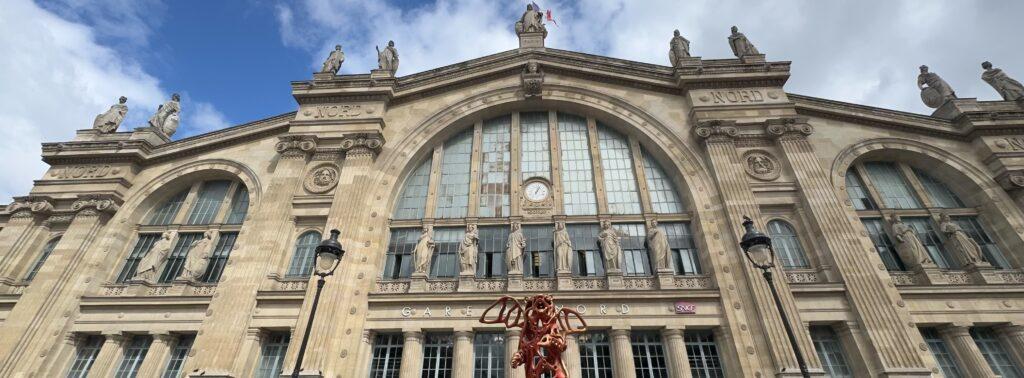
It’s another travel day! So, the usual routine: sleep as late as possible (today that meant we got about 11 hours of sleep…we may be getting a bit tired at this point in the trip), pack everything up, and head out. We walked to the closest metro station, took two metro trains, and made it to the Gare du Nord with several hours to kill before our next train. Camped out on the floor, found some lunch, waited, and eventually made our way to the right platform, boarded our train, and are now watching the French countryside roll by on our way to….
⭐️⭐️⭐️⭐️: A Discworld look at stories, fairy tales, and what happens when someone is a little too intent on making sure they go just the way they should.
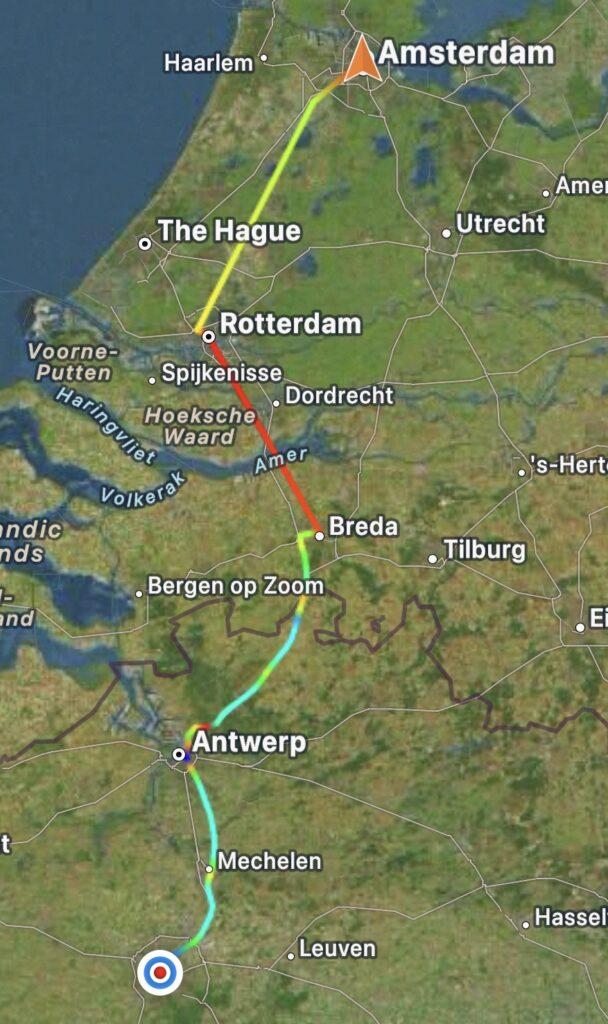
And now for Belgium (my apologies for using such rude language)!
Day 12 (part 2): Amsterdam to Brussels
Before we left for this trip, while researching so that we’d be prepared, we’d read that trains in Germany were the most unreliable. We’d also read about some of the most common behaviors to avoid to make sure we didn’t stick out as stereotypical rude Americans: Talking unnecessarily loudly, having loud phone conversations or playing music without headphones, placing our bags on seats so that we took up multiple spots, and so on.
Well, bad behavior is universal. Europeans are just as bad about all of those as we were warned not to be (and we’re not much for that kind of behavior anyway), and so far, the German trains were rarely more than a few minutes late if at all and they regularly apologized when it happened, while every Dutch train on our Amsterdam to Brussels leg has been late by at least 15-20 minutes. One time that just meant we had to change our connecting train, but then later they decided that the train we were on was late enough that it was better to pull it out of the schedule entirely, made the next stop the final stop, kicked us all off, and we had to find another train to get us the rest of the way into Brussels.
It’s nothing we haven’t been able to cope with, and all part of traveling like this, of course, but it has definitely been a bit of a shift from our expectations.
Delays and train swaps and all, it was a really pretty trip.
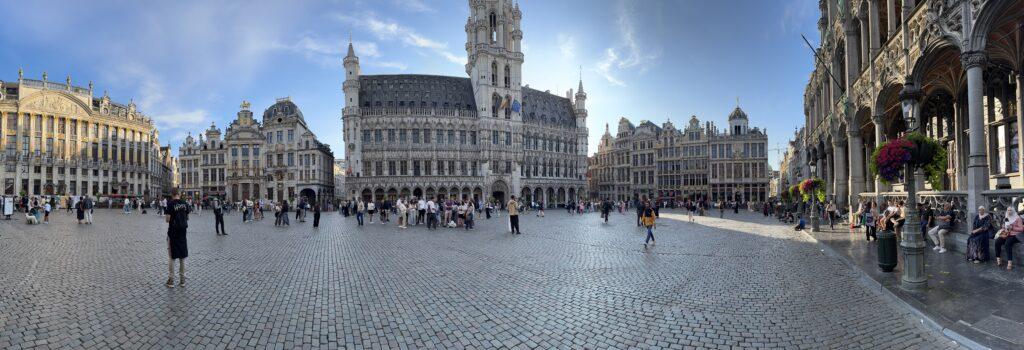
Minor grumbling aside, we did make it to Brussels without any major complications. The mentioned minor ones, but no major ones, ending up at our hotel just about two hours after we thought we’d be here. That was still early enough (about 5 p.m.) for us to get our room and then head out for a bit of a wander, finding dinner and then getting fancy dessert Belgian waffles and sitting in the gorgeous Grand Place as we ate them. Not a bad evening at all! Then back to the hotel to wind down and get to bed.
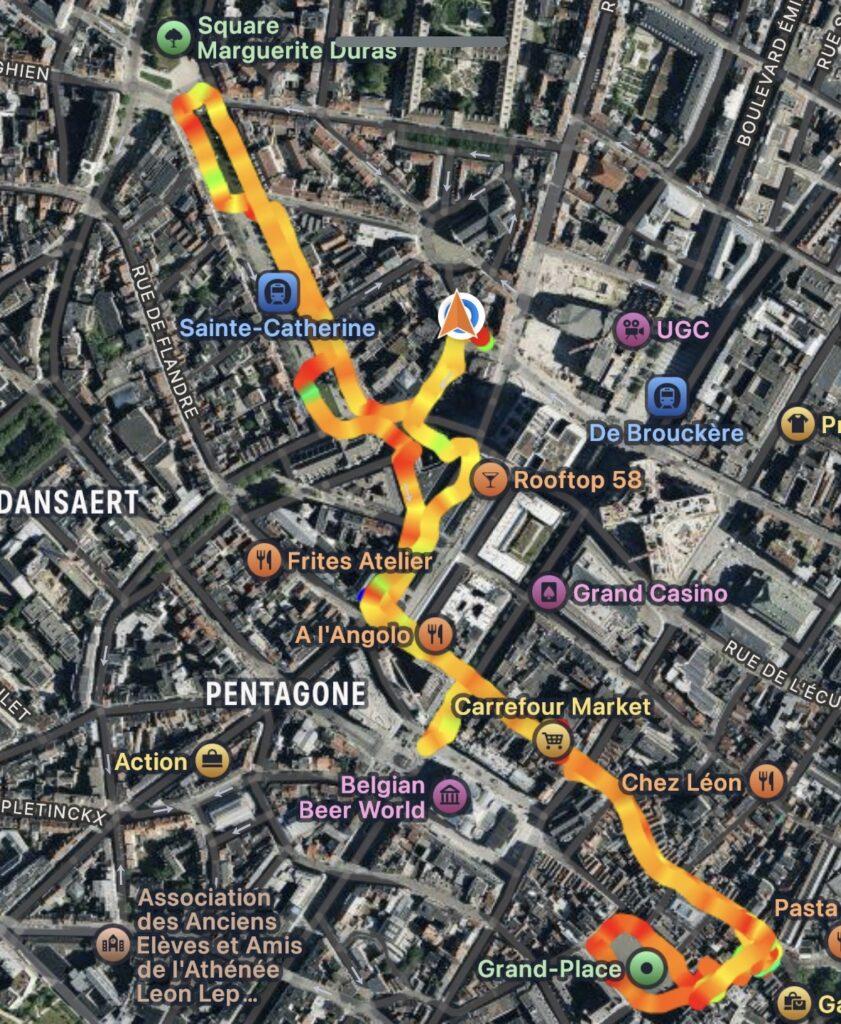
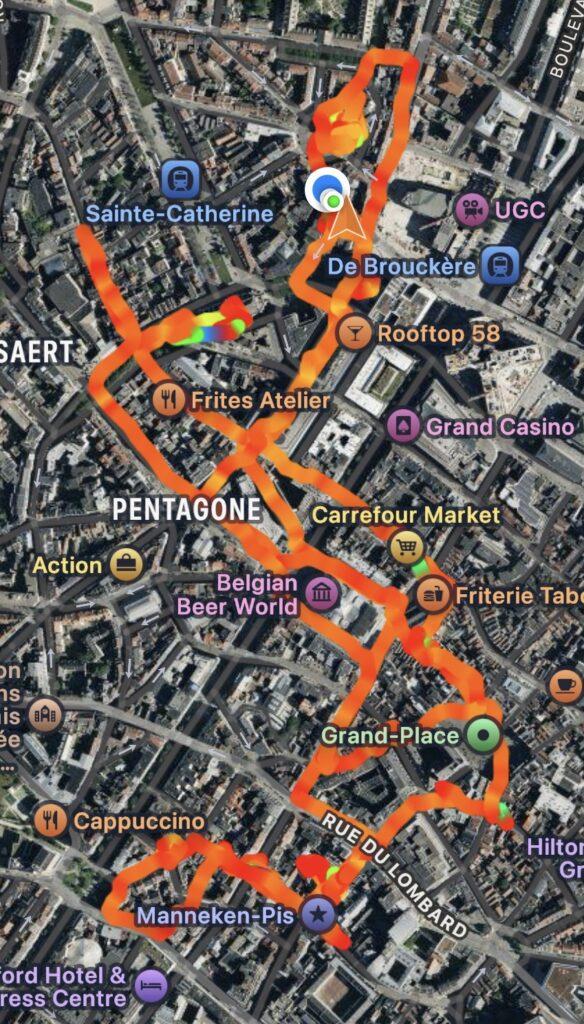
Brussels’ Grand Place, the central square of the city, was just about a ten minute walk from our hotel.For two people tired after a long day of travel, we didn’t do too well at staying put once we arrived.
Day 13: Brussels
Today we had just one thing planned: a morning tour of Choco-Story Brussels, a really cute little museum all about the history of chocolate. It’s a self-guided walkthrough of displays tracing chocolate from its initial cultivation through its being brought to Europe, and ends with a demonstration from a chocolatier making pralines (which you then get to sample). It was fun, and quite tasty!
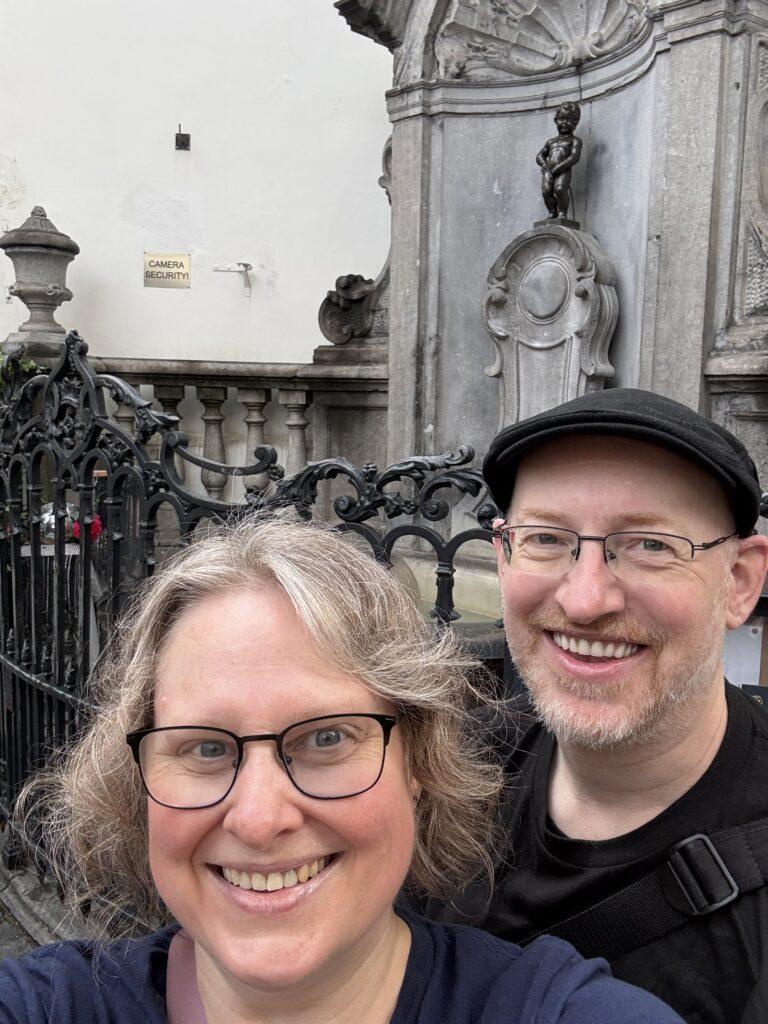
Just before entering the museum, since we’d shown up a bit early, we were walking up and down the block and peeking at what was on nearby streets, when we realized that we were standing right next to Manneken Pis, a famous fountain of a small boy peeing. One more Brussels landmark seen (in a city full of them; Brussels really is gorgeous).
This funny little fountain is a huge part of the Brussels culture. Images of it are everywhere.
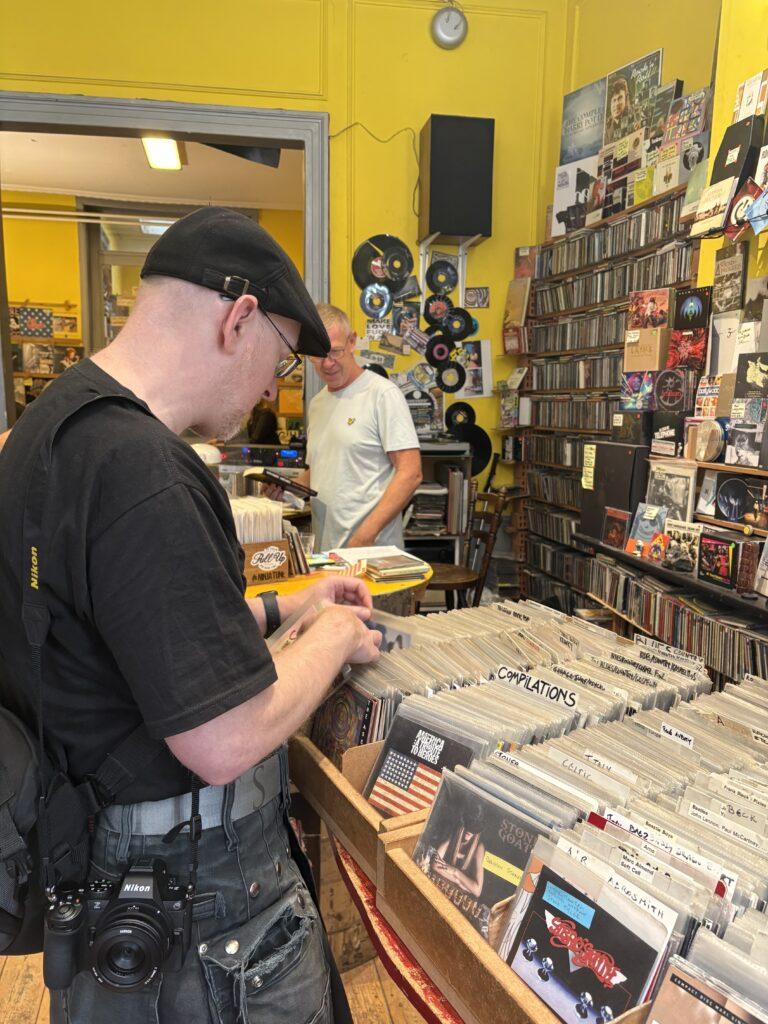
After the museum we took the rest of the day for a slow wander, starting with browsing through a music store we’d spotted just a half-block away from the fountain. The store had a nice mix of vinyl and used CDs, and I had fun browsing through and picking some up as Brussels souvenirs. Then, as we walked on, we found two more vinyl shops in the next two blocks! Considering how just a few days ago I was bemoaning the modern dearth of record stores, this was a fun part of the day; apparently Brussels has a good physical media scene!
Ended up coming out with a Hooverphonic album from the early 2000s, a techno/industrial sampler from 1993 called Blood and Computers (I have Vol. 2 already, so it was fun to find Vol. 1), an album from a band whose name I don’t remember right now but who was described as New Wave/Buggles/OMD-inspired because I wanted to get at least one thing I was totally clueless about…and the old Songs in the Key of Springfield Simpsons soundtrack album at my wife’s request.
From there it was just a day of poking around the streets of Brussels, peeking into cute shops and fancy cathedrals, and just seeing where we ended up going. We were nice enough to ourselves to take a few hours of mid-afternoon downtime instead of pushing through the full day again, which was a good idea. Then sandwiches for dinner, ice cream while watching people at the Grand Place, and back to the hotel again for the evening.
Even with a few hours of midday rest, we definitely still got our steps in.
Day 14 (part 1): Brussels to…?
This is a long travel day. Our train out of Brussels doesn’t leave until 16:52, and checkout time at the hotel was noon. So we checked out just a bit before noon, walked to the local station, hopped a short train to our departure station…and then spent the next four hours camped out in the Brussels Midi station until it was time to board. Not exactly the most exciting hours of the trip, but sometimes that’s how it goes. We’re on our next train now, headed for….
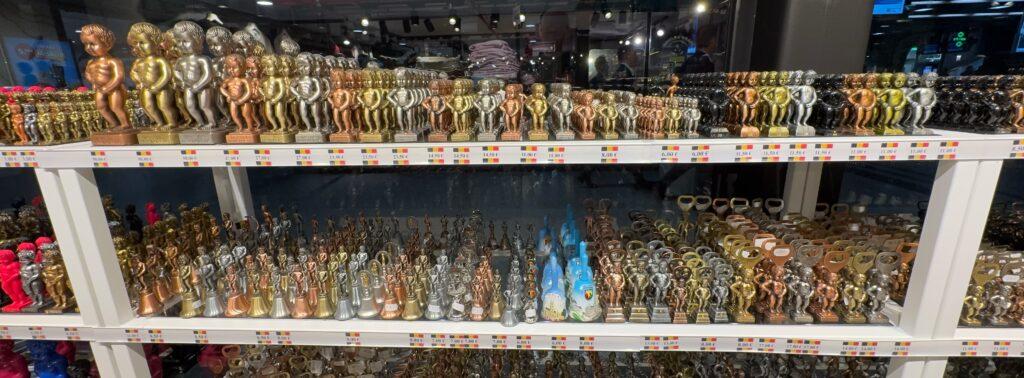
Just one small section of one tourist shop in the train station. If you’re ever in a sudden need for a small figure of a urinating boy, Brussels is the place to be.