The Edge of Space-Time by Chanda Prescod-Weinstein

Book 27 of 2026: The Edge of Space-Time: Particles, Poetry, and the Cosmic Dream Boogie by Chanda Prescod-Weinstein.

⭐️⭐️⭐️⭐️: A neat exploration of quantum physics and the nature of the universe through lenses of Black perspectives, queer theory, and pop culture. Mostly really good, but for me, with one significant flaw. While I will happily accept the author’s expertise in physics, there is one specific sentence that is simply, surprisingly, and significantly wrong.

Lewis Carroll’s “Alice” books are referenced multiple times, and on page 232, the poem “Jabberwocky” is mentioned: “It’s a poem that doesn’t make any sense, composed primarily with words that Lewis Carroll made up.” I’m baffled by the claim that “Jabberwocky” “doesn’t make sense” — yes, many of the words are invented nonsense words, but that’s precisely the beauty and brilliance of the poem, because it absolutely makes sense! The reader knows what is going on; the words may be unfamiliar, but where and how they are used, along with the fun-to-read onomatopoeic nature of them, conveys a very clear story. Honestly, it’s good that this claim showed up a little over two-thirds of the way into the book, due to how severely it threw me out of the book and shook my trust in the author. Any earlier and I might have struggled to keep going.

Still, all in all, a very good book — except for that one sentence.

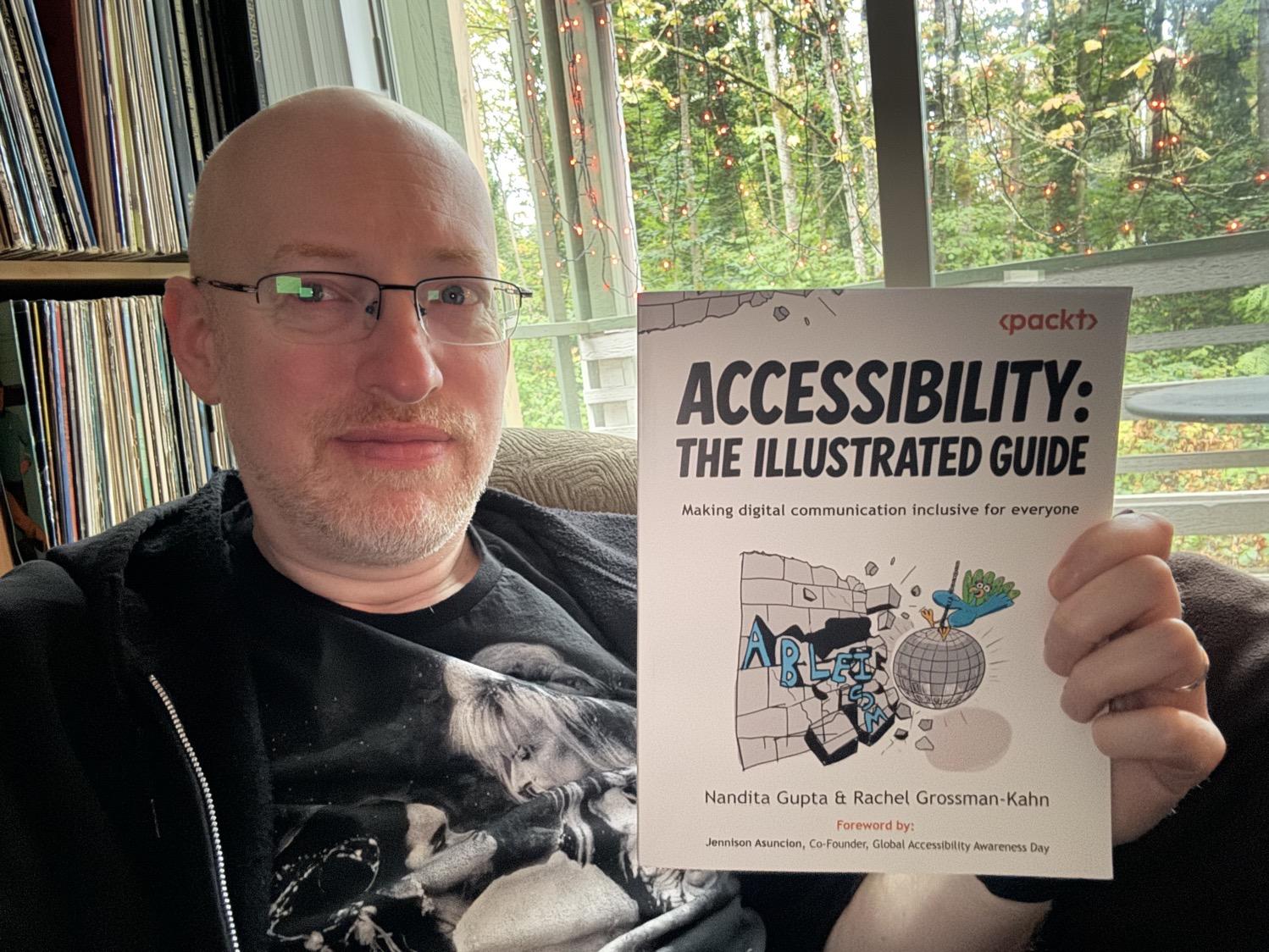
Me holding The Edge of Space-Time.

The AI Compass

This “AI Compass” test was interesting. As with most such tests, it’s not perfect, and I have some quibbles with some of the questions and answers, particularly some where I think it falls into the usual trap of using “AI” for everything, and not adequately distinguishing between genAI and machine learning (ML), but still, not bad.

My result:

Four-quadrant scatter plot. The vertical axis is good / bad, the horizontal axis is overhyped / transformative. My result is a point slightly on the "overhyped" side of the horizaontal axis and about two-thirds of the way towards the "bad" extreme of the vertical axis.
I’m the glowy orange dot. Looks like I’m right on the border, almost ending up classified as “The Skeptic” (full description below). (Side note: Pity about the poor and very inaccessible color design.)

YOU ARE…
The Union Organizer
patron saint: Cory Doctorow.
AI is a real tool being used to extract real labor value from real people without paying them. You don’t care about the singularity — you care about the artists, writers, and workers getting strip-mined by capital. You’re not anti-technology. You’re anti-theft.

Looking at the full list of possible outcomes, I’d self-identify as one of the following. I think it’s my hedging slightly on some of the answers because of the genAI/ML confusion that pushed me into the result I got. They’re all in the same general “don’t like it, don’t trust it, don’t want it” quadrant, though.

The Luddite (Affectionate)
patron saint: Emily Bender
It doesn’t work the way they claim, it’s making everything worse, and you’d like your internet back, please. You can explain in precise technical detail why it’s a stochastic parrot, and you will, whether or not anyone asked. You’re funnier about this than people give you credit for.

The Digital Hermit
patron saint: Jaron Lanier
You’ve been saying the framing is wrong since before most people had heard of any of this. AI is less a technology than a story Silicon Valley tells to consolidate power, and the story is bad. You read physical books and you don’t need a language model to tell you what they mean.

The Skeptic
patron saint: Ed Zitron
It’s oversold, it’s losing staggering amounts of money, and the harms are arriving faster than the value. You’ve done the math on the unit economics and it doesn’t close. You are loud about this, prolific about this, and you suspect history will vindicate you.

Infiltrator by W.R. Thompson

Book 27 of 2026: Infiltrator by W.R. Thompson.

⭐️⭐️⭐️⭐️: Descendants of Khan and his compatriots face off against the Federation. I found this one to be above average, with much of it being something of an early take on the same issues explored by Strange New Worlds with Number One’s status as an Illyrian in hiding, expanded to explore how a society of genetically engineered humans might deal with how they’d be perceived by the Federation. As often happens with any eugenics storyline, it would be improved if the Federation was more honest and introspective about how initial fear and caution has developed into long-standing systemic bigotry, but as Star Trek has yet to really tackle that aspect of the universe, I wouldn’t really have expected it from a thirty-year-old novel.

Me holding Infiltrator.

Weekly Notes: June 15–21, 2026

  • 🎓 This week was Highline’s graduation week, with the commencement ceremony on Thursday. We had a record number of graduates this year (almost 900 signed up to walk in the ceremony), and still managed to wrap up the ceremony in just slightly under two and a half hours. Not bad!

  • 🍾 Happy anniversary to us! Friday was our thirteenth anniversary. Rather than doing anything big, as we just made it through graduation week and have plans coming up next weekend and beyond, we celebrated by having a quiet weekend of naps, reading, and movies here at home.

  • 🌞 Happy solstice! Summer is officially here.

📸 Photos

Panoramic shot from the floor of the stadium mid-ceremony, with faculty and graduates in their robes seated in front of a stage with a large video screen showing the current speaker.
Improvements made this year that I was involved with included adding the on-stage video screen (in the past, the video was only sent to the arena jumbotron, which is directly above all the graduates, so they couldn’t see anything presented on screen) and moving the live captions from small displays on the sides of the stage to being included on the main video feed. A few glitches here and there, but we know what to work on for next year.
Me wearing the traditional black robe, black mortarboard cap, master's hood with blue and red trim, and a rainbow honors cord, with a stadium full of people in the stands visible behind me.
All fancied up for the commencement ceremony! I wasn’t graduating, just participating as part of the faculty and staff. The hood recognizes my master’s degree, the rainbow honors cord is the one Highline uses for disability support.
A Nikon Z5ii camera with a small (nearly 'pancake' style) Nikkor 26mm wide-angle lens attached, sitting next to the box for the lens.
Thanks to some birthday funds, I added a Nikkor 26mm f/2.8 lens to my kit. Will be a great walk-around travel lens when we get around to traveling next.

📚 Reading

📺 Watching

  • Fantasy Island (2020): A horror prequel-of-sorts to the ’70s TV show. It was entertaining enough for a lazy afternoon.

  • TRON: Ares (2025): Looks great, sounds great, no real substance and completely breaks my suspension of disbelief.

🔗 Linking

  • Daniel Beekman at the Seattle Times: Seattle uses AI to help triage, divert 911 medical calls (archive.is mirror of a paywalled original): “For more than two years, a Denmark-based company’s artificial intelligence technology has been listening to Seattle residents’ 911 medical calls without their knowledge. ¶ And the Seattle Fire Department has been using the company’s AI to help dispatchers decide which callers don’t deserve a rapid response.”

  • Catalina Gaitán at the Seattle Times: Judge to decide fate of Seattle’s unofficial nude beach (archive.is mirror of a paywalled original): I’ve never been to this beach, but I know people who have and who would be disappointed if the NIMBYs got their way.

  • James D. Walsh at New York magazine: Everyone Is Cheating Their Way Through College (archive.is mirror of a paywalled original): “In January 2023, just two months after OpenAI launched ChatGPT, a survey of 1,000 college students found that nearly 90 percent of them had used the chatbot to help with homework assignments. In its first year of existence, ChatGPT’s total monthly visits steadily increased month-over-month until June, when schools let out for the summer. (That wasn’t an anomaly: Traffic dipped again over the summer in 2024.) Professors and teaching assistants increasingly found themselves staring at essays filled with clunky, robotic phrasing that, though grammatically flawless, didn’t sound quite like a college student — or even a human. Two and a half years later, students at large state schools, the Ivies, liberal-arts schools in New England, universities abroad, professional schools, and community colleges are relying on AI to ease their way through every facet of their education. Generative-AI chatbots — ChatGPT but also Google’s Gemini, Anthropic’s Claude, Microsoft’s Copilot, and others — take their notes during class, devise their study guides and practice tests, summarize novels and textbooks, and brainstorm, outline, and draft their essays. STEM students are using AI to automate their research and data analyses and to sail through dense coding and debugging assignments. ‘College is just how well I can use ChatGPT at this point,’ a student in Utah recently captioned a video of herself copy-and-pasting a chapter from her Genocide and Mass Atrocity textbook into ChatGPT.”

  • Jake Goldstein-Street at the Washington State Standard: Battle ramps up over WA ballot measure to bar transgender students from girls’ sports: In case you thought Washington was too blue to have to deal with this transphobic crap.

  • Andy Baio: The Wholesale Plagiarism of Obscure Sorrows: “It’s one thing for a fan to share or remix copyrighted material out of love for the source material, with no commercial motive. (‘No copyright intended!’) It’s another for a marketing agency to take an entire living author’s book, replace its art with AI slop, add an AI word generator, monetize the traffic, promote it in their portfolio, and then outrank the official site everywhere.”

  • Maggie Harrison Dupré at Futurism: Google’s AI Overviews Feature Is Telling Users That SCP Horror Fiction Entities Are Real: “As the lore goes, the SCP Foundation is a non-government organization that collects and contains supernatural discoveries. Writers catalogue these fictional phenomena — which range from the terrifying to the downright bizarre — in the form of fake records, studies, research documents, and logs, all of which are indexed in a sprawling archive. ¶ The key word, of course, is ‘fake.’ Google’s AI Overviews, it turns out, has a bad habit of presenting entities from the expansive SCP universe as real items, events, or beings — blatantly confusing those fabricated studies and records as actual evidence of horrifying or otherworldly happenings.”

The Yiddish Policemen’s Union by Michael Chabon

Book 25 of 2026: The Yiddish Policemen’s Union by Michael Chabon. 2008 Hugo Best Novel winner.

⭐️⭐️⭐️⭐️: Hard-boiled noir detective fiction set in an alternate present where Sitka, Alaska is home to resettled Jews after Israel failed to become its own nation after WWII. In addition to being a fun and incredibly well-written noir, the Alaskan setting is great. I grew up in Alaska, and though I pretty much stayed in Anchorage and have only been to Sitka once on a cruise long after I’d moved south, Chabon’s descriptions of Alaskan locales, weather, and people feel oh so familiar. At least the secular bits; as a lapsed Episcopalian, I can’t speak to the Jewishness of it all. Excellent book.

Me holding The Yiddish Policemen's Union.

Weekly Notes: June 1–14, 2026

  • ♿️ With the last two weeks being the final two weeks of spring quarter (the last week of classes and finals week), there’s been a lot going on that I’ve been either directly or tangentially involved with. There’s been the launch party for this year’s Arcturus, Highline’s annual student literary journal, the Achieve students’ capstone presentations, a short student-written and produced play, and a discussion panel by four graduating journalists from the Thunderword, our student paper. Plus, of course, all the usual work stuff. I’m looking forward to getting through graduation this coming week and (hopefully) having things slow down a bit over the summer.

  • ✨ Interestingly, and often amusingly, AI has been an ongoing theme this week.

    • 🎓 During the capstone presentations for Achieve, where students from our program for intellectually disabled students present what they’ve done and accomplished over their time at Highline, several of them made it clear that they’d done all the work on their presentations themselves, without using AI.

    • 🎭 The play, written and improvised by the four actors, had an ongoing plot line about whether or not to use AI, with one character convincing another to stop using it. In the after-play conversation, the actors and students in the audience had more to say along these lines.

    • 📰 During the Thunderbird panel, the journalists got a question about AI use, and all vehemently decried the use of AI for their writing. “We’re humans, and we want real human writing, feelings, and reactions in our stories.”

    • 💼 This week was a “listening session” with a representative of a headhunting firm as Highline starts the process of looking for a new college president. AI came up here as well, with people recognizing that we can’t ignore AI’s effects, but also stressing that we don’t want someone who would attempt to push AI over actually educating our students.

    • 👍🏻 Overall, it was heartening that throughout the weeks, from our students to our staff and faculty, there is a lot of healthy skepticism (at best) about genAI.

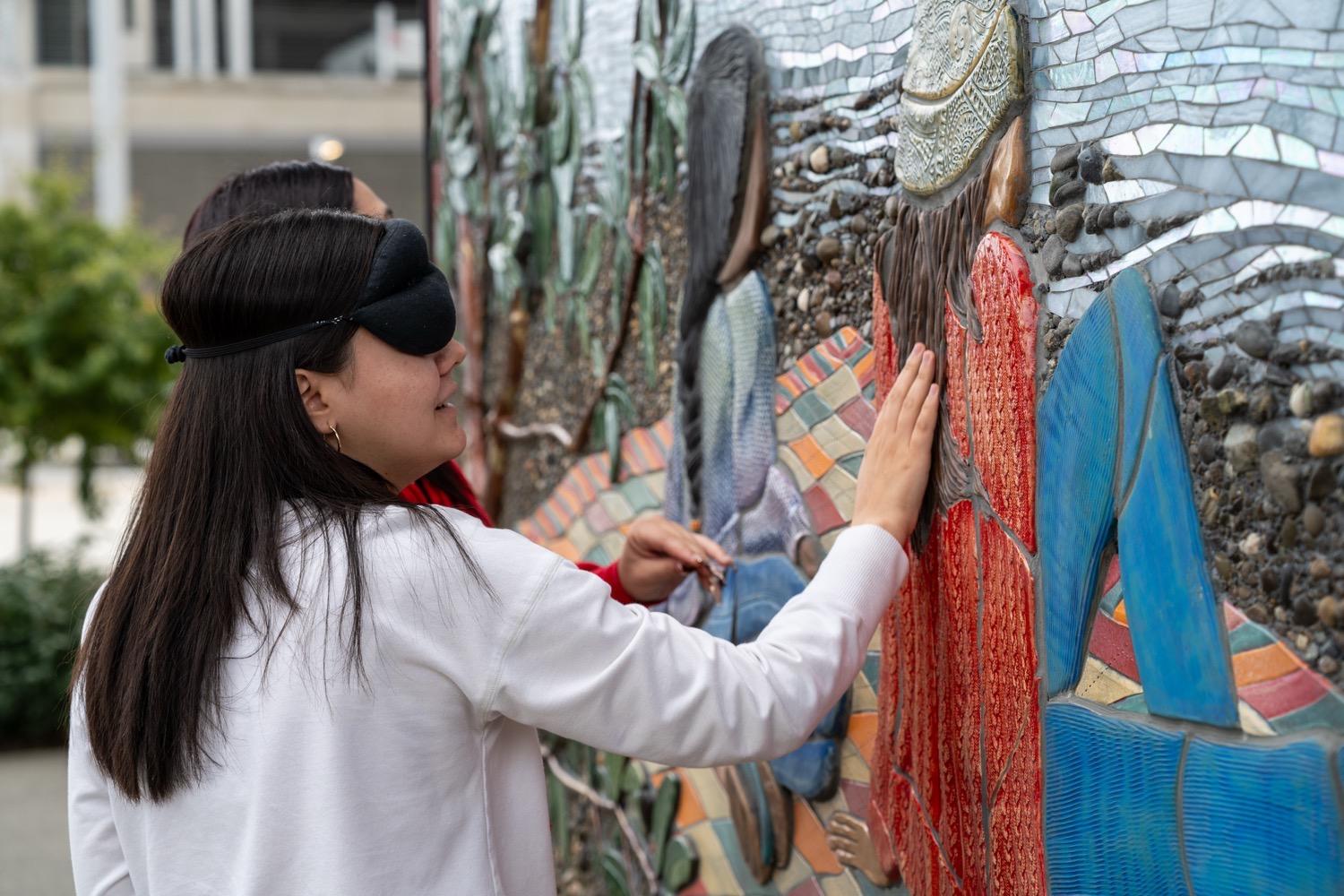
  • 🎨 Also work-related, this week we had a presentation to Highline’s Board of Trustees telling them about a project we’ve had in progress with Sound Transit’s art program (STart) over the course of the year. We’ve had three visually disabled students working with artists on a piece of tactile artwork for the Kent-DesMoines light rail station, giving their input on materials, colors, and other aspects to make the artwork effective for Blind and low-vision people. The piece is still being finished, but should be installed sometime in August. I’m really looking forward to seeing it!

  • 🚀 Outside of work, last Sunday was Norwescon’s summer picnic…or, well, summer-ish picnic, as for some reason it was much earlier in the year than usual. It was a nice day of hanging out with Norwescon people, chatting and tossing ideas around. Plus, on a personal note, I formally turned over administration duties for our Google Suite to someone else, taking one more thing off of my plate! I’m getting closer to having an actually reasonable amount of duties, instead of my usual “you do how much?” lineup.

📸 Photos

A Lego Star Trek Enterprise D sits on top of a bookshelf, next to Star Trek DVDs and Blu-rays, an Enterprise pizza cutter, Star Trek shot glasses, and three Norwescon mugs in Star Trek red, gold, and blue.
I finished the Lego Enterprise-D this week, and it now sits on display in my home office, next to my complete collection of Star Trek DVDs and Blu-rays, plus a few other Trek bits and bobs. While not visible, these bookshelves also hold my Trek book collection.
People gather under and around a picnic shelter as food is cooked on a grill.
At the Norwescon picnic.

📚 Reading

Three books finished over these two weeks, one of which was even non-fiction!

📺 Watching

  • This afternoon we watched Send Help (2026), Sam Raimi’s latest horror comedy, and really enjoyed it. Dark, twisted, funny, and with a very satisfying end.

🔗 Linking

  • Sarah Mizes-Tan at KNKX/NPR: Transgender ballot initiative could require genital exams for WA secondary school students: Just in case you thought WA was too blue for this sort of bigotry: “Student athletes in Washington state who want to compete in girls’ sports would likely have to obtain genital exams to participate if a controversial ballot initiative passes in November.”

  • Heidi Groover at the Seattle Times: Downtown Seattle may house new data center: “A Texas real estate firm filed permit applications with the city last week proposing a six-story building including a data center, office and retail space at Third Avenue and Virginia Street. The location once housed a Bed Bath & Beyond store and since last year has been home to the contemporary arts center Cannonball Arts.”

  • Ex Astris Scientia: The Evolution of Screen Ratios in Star Trek: “This article looks at the technical standards that shaped television and cinema, the artistic choices that influenced how Trek moved between these formats and how the franchise entered the era of modern widescreen TV with its new possibilities. It also highlights some odd and inconsequential decisions along the way, including humorous uses of inconsistent aspect ratios in crossovers. Finally, it examines the pros and cons of ‘cinematic’ screen ratios for television series.”

  • Hunter Ingram at Variety: How ‘For All Mankind’ Works With Apple to Revive and Upgrade the Forgotten Newton as Its Alt-History iPhone: “Apple products and their use in film and TV have long been a source of conversation. Who can carry an iPhone on screen? Are bad guys forced to use nondescript phones and computers so as not to sow chaos with a device bearing Apple’s famous logo? Well, ‘For All Mankind’ asks a different question altogether: Can its characters use a completely forgotten Apple product canceled two decades ago?”

  • Tierney Sneed, Jeremy Herb, and Gabe Cohen at CNN: Postal Service won’t deliver mail ballots for states that don’t hand over voter lists, under plan for Trump directive: “The March 2026 executive order is one of several moves Trump has made recently to seek federal control over elections and restrict mail-in voting, which he has repeatedly cast as a tool used by his opponents for election cheating despite no evidence of widespread voter fraud.”

  • Better Images of AI: “We aim to create a new repository of better images of AI that anyone can use, starting with a collection of inspirational images. We will continue to gather images for this repository and commission original work. We welcome image submissions and funding to commission and brief more artists.”

  • John Scalzi: Please I Beg of You Do Not Use “AI” In Your Business Communications: “Why would I want to do business with someone who can’t even write a single fucking email on their own? This is a ‘basic competence’ issue, folks. If you can’t get it together to write a simple business communication by yourself, what confidence should I have about any other aspect of your business? What value do you have for me?”

  • Catherynne M. Valente: The Democratic Urge to Lose (archive.is mirror of a Substack original): “I’ll tell you what we’re doing here. The same thing we do every single time a Democratic candidate gets any traction or momentum at all. Passively watch the media tuck a napkin into its bib and eat that D alive with a massive bowl of hot buttery hypocrisy to dunk them in before shrugging helplessly and losing again. What else could we possibly do? Not demand youth and experience and a perfect personal life from the cradle on and massively overclocked charisma and perfectly pure policy stances that satisfy the whole tent from blue dog to radical leftist from every single candidate for every single office or else fascism can just take us all? Don’t be stupid, if we did that, we might win!”

  • Chris Person at Aftermath: Ian’s Shoelace Site Is Still The Best Site For Tying Your Shoes: “But what makes Ian’s site truly great is not that it documents a few knots, but is a cornucopia of methods for tying and lacing your shoes. Ian’s Shoelace Site is from a different time on the internet, when people simply made websites that they were passionate about.”

  • BBSG: Bash Static Site Generator: “BSSG processes Markdown files and builds a minimal, accessible website suitable for personal journals, daily writing, or introspective personal newspapers.” Thinking this might be my first step into moving to a static site generator.

The AI Con by Emily M. Bender and Alex Hanna

Book 23 of 2026: The AI Con: How to Fight Big Tech’s Hype and Create the Future We Want by Emily M. Bender and Alex Hanna.

⭐️⭐️⭐️⭐️: Okay, yes — it could be argued that this book is simply reinforcing my existing biases. But it does a damn good job of that! For anyone less than enthusiastic about the AI invasion, and for some who are too enthusiastic but could perhaps be convinced to question their stance, this is an excellent and accessible takedown of the overhyped and existentially problematic push for “AI”.

I only had two issues:

One, that the this area is simply moving so fast that even though the book was just published within the past year (and so written probably mostly in 2024, so even the most current research available while writing would have been from 2023 or 2024), parts of it already feel out of date. Of particular note to me as someone working in education was the “Listen Up, Class” section (in chapter 4, starting on page 93), which begins with a couple paragraphs citing 2023 research claiming that ChatGPT hadn’t made many inroads into student cheating. In 2026 — anecdotally, at least, from what I see and hear about at the college where I work — that is definitely not the current state of things. Students submitting content created by ChatGPT and other genAI systems is a constant battle that teachers are trying to fight and causing serious problems in nearly, if not entirely, every academic department.

Two, that for some reason (apparently a publisher’s requirement, according to a LinkedIn post from Ms. Bender I found), none of the copious endnote references are numbered in the text. The endnotes include notes so that they can be connected back to the main text, but it’s a very odd choice for the publisher to have made. If, as suspected, this was done to make the book more accessible to a mass audience, I kind of wish there was a second edition available for readers not turned off by footnote/endnote notations.

Me holding The AI Con

Zombies of the Gene Pool by Sharyn McCrumb

Book 22 of 2026: Zombies of the Gene Pool by Sharyn McCrumb.

⭐️⭐️⭐️: Apparently I’d read this one 15 years ago and entirely forgotten. A sequel to the somewhat notorious Bimbos of the Death Sun, it’s a bit more reserved, swapping snarking on ‘80s SF fandom to looking back on ‘50s Golden Age fandom. It has much of the same obvious mix of affection for and exasperation with the SF scene, but also has many of the same drawbacks as Bimbos, particularly where women characters are concerned. As with Bimbos, it’s an enjoyable but definitely flawed bit of fluff that would be better if it spent more time laughing with its subjects (as Galaxy Quest does for Star Trek) instead of at them.

Me holding Zombies of the Gene Pool.