'Big Mac' details

Dr. Srinidhi Varadarajan, the head of Virginia Tech‘s recent construction of a 1,100-node Power Mac G5-based supercomputer (currently tentatively ranked as the 3rd fastest supercomputer in the word) gave a presentation at the O’Reilly Mac OS X conference this week. Lots of interesting little technical tidbits in the article, detailing just how they were able to get the project up and running.

If you’ve ever sat with a TiBook in your lap, you understand that there is a further significant issue. As hot as a G4 runs, a G5 runs hotter. With a traditional air-conditioning setup, the calculations showed that instead of emptying out the air three times an hour as would be typical, they would need to empty the air three times per minute. Computers tend to each cool front to back. So the plan was to arrange the computers in rows back to back and pull the hot air out of the hot aisle. This would have required wind velocity under the floor of more than 60 miles per hour and still would have resulted in some hot spots. They decided instead to use a refrigerator-like system. Chillers cool water to 40 degrees to 50 degrees, which is then used to chill refrigerant, which is piped into a matrix of copper pipes. Effectively, you have a distributed refrigerator.

More E-voting issues

Wired has two articles worth reading on e-voting machines and the security issues (specifically, the frightening lack of any) involved with them.

E-Vote Protest Gains Momentum

Swarthmore College students embroiled in a legal battle against voting machine-maker Diebold Election Systems have received a ground swell of support from universities and colleges nationwide.

The memos suggest the company knew about security problems with its voting machines long before it sold the machines to various states, including California, Georgia and, most recently, Maryland. The memos have popped up on numerous websites since August, despite attempts by Diebold to force ISPs and webmasters to remove them from the Internet.

E-Vote Software Leaked Online

Software used by an electronic voting system manufactured by Sequoia Voting Systems has been left unprotected on a publicly available server, raising concerns about the possibility of vote tampering in future elections.

The security breach means that anyone with a minimal amount of technical knowledge could see how the code works and potentially exploit it. According to a computer programmer who discovered the unprotected server, the files also contain Visual Basic script and code for voting system databases that could allow someone to learn how to rig voting results. The programmer spoke on condition of anonymity.

Electronic voting can be more secure and accurate than the systems that we’ve had such trouble with over the past few years, but only if the companies can be trusted, the systems are verified secure by a third-party review, and if there’s an additional printed “receipt” that can be tallied in case of recounts. The security breaches and known vulnerabilities of the current E-voting systems make it clear that in their present state, they cannot be trusted — and I, for one, would greatly prefer it if I could be sure that my vote in 2004 goes to the candidate I intend it to.

Automatic defrag in Panther

I have no idea whether or not this is a standard feature in other Unix systems, but it appears that there’s a very handy little “under-the-radar” feature in Mac OS X 10.3/Panther — automatic file defragmentation.

Everytime an application opens a file for reading, HFS+ checks if the file is fragmented and is less than 20MB in size. If so, it copies the file’s contents to a continuous region on the disk and frees up the previously allocated blocks.

What a wonderfully convenient feature. Even nicer, when someone asked if there were any official confirmation from Apple about the feature, someone else posted the source code from the Darwin (command-line only open source) version of the core system.

(via MacSlash)

Panther goodies

Lots of interesting tips and tricks for Panther are showing up on the web now that it’s been out a few days. Some of the niftier ones I’ve run across so far:

  • The Exposé blob (an on-screen trigger for the Exposé effect).
  • SIPS (Scriptable Image Processing System — Panther-specific command line image processing similar to ImageMagick or NetPBM).
  • System-wide inline text autocompletion.
  • When you hit command-tab to bring up the application list, you can choose which application to switch to with the mouse as well as with the keyboard.
  • Exposè is usable during a drag (start to drag a file from a visible window, invoke Exposè to find the target window, then drop the file into the target window).
  • Easily find special characters (accents, math functions, currency symbols, etc.) by choosing Edit > Special Characters… in any application.
  • Choosing your desktop picture now ties directly into your iPhoto library.
  • Lots of high-powered upgrades to the text services engine, giving us professional level typography options by default.

Kill Bill, Vol. 1

I’m going to keep my comments here fairly brief, as this is only the first part of a two-part story. So, briefly, first impressions of the first half of Kill Bill:

  • Much butt-kicking fun.

  • There is far less dialogue than you might expect from a Tarrantino film, but in this case, I can’t see it any other way.

  • There’s also a very bitter, sorrowful tone to the film that is easy to overlook during the fights and general carnage, but is very present, and very important to the tone.

  • Yes, it’s violent. Very violent. But two points on that:

    1. It’s Quentin Tarrantino. Did you really expect anything else?
    2. How can you take it seriously when every severed limb or head (and there are many) is apparently attached to a high-pressure firehose?
  • Best line (delivered by The Bride while spanking the last living henchman — a sixteen (?) year old boy — with the flat of her katana): “This is what you get for fucking with Yakuza! Now go home to your mommy!”

  • I hope that Vol. 2 gives us more of The Bride’s background. But if it doesn’t, that might not matter — in an almost zen-like way, she simply is. More background might actually detract from this.

  • Using anime for O-Ren Ishii’s background: very nice touch.

  • The fight scenes were deliciously over the top. Unrealistic, but enjoyably so.

  • One shot in the mass battle royale towards the end — a grainy, black and white travelling shot of a spinning hatchet — was almost a mirror of a shot in the diner scene of Natural Born Killers.

  • Favorite sequence (at least right now, immediately after my first viewing): the blue background silhouetted section of the battle in the restaurant.

  • I know I’m not catching the majority of the references Tarrantino is making throughout the film. That’s okay, though. I’m guessing there’s enough to fill an entire book — which will probably be at your friendly neighborhood bookseller not long after Vol. 2 is released.

  • This review (which I found thanks to Kalyx) may sum it up the best:

    Gratuitous in the most passionate, brutal and aesthetically exacting way, this first half of Quentin Tarantino’s blood-drenched mash note to the eclectic, disreputable genres he grooved on as a kid is a remarkably pure orchestration of imagery and attitude. The content of those magnificently moving pictures is whatever the opposite of pure might be: an endless orgy of degradation, dismemberment, cruelty and bile. The \”Pulp Fiction’ auteur has ratcheted it all up into a fantasy realm, and he has a point when he claims that anybody who thinks this disturbing stuff is happening to anything like a real person is crazy — or, at least, crazier than he is.

    Still, there’s nothing wrong with avoiding \”Kill Bill’ if you’re easily offended by violence to women, violence by women, violence observed by traumatized children or lots — LOTS — of violently detached body parts scattered all around the screen.

    But if you’re not like that: Man, is this movie cool.

Bubba Ho-Tep

On a whim for something silly and fun, Prairie and I went out and saw Bubba Ho-Tep today. It was exactly what we were in the mood for.

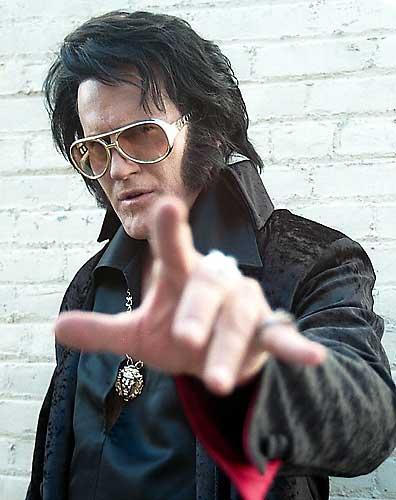
Bruce Campbell as Elvis

Bruce Campbell plays an elderly Elvis, spending the last of his days in a retirement home under the name of Sebastian Half, an Elvis impersonator who he switched places with when he got tired of constantly being in the limelight. Along with his friend John F. Kennedy (Ossie Davis) — also in the retirement home, and now a black man (“They dyed me this color!”) — he has to battle a resurrected Egyptian mummy who is using the retirement home as his personal feeding grounds, sucking the souls out of people so close to death that no-one blinks an eye when they pass on.

BHT was done surprisingly well. While definitely an action/comedy, it did a remarkable job of not taking the camp too far, and instead, taking the time to create real characters that the audience could believe in and empathize with. It may be the best actual acting I’ve seen Campbell do, too. He’s a lot of fun as Ash in the Evil Dead series, but those are so over-the-top that they don’t really feature Campbell the actor, merely Campbell the comedian (not that that’s a bad thing at all, mind you).

Here we have an Elvis facing mortality — questioning leaving show business, losing contact with his wife and daughter, and watching his aging body fall apart. The battle with the mummy is the first thing in years to give him something to live for, and Campbell does a wonderful job of creating the character.

The setting for the movie is brilliant, too. One of the oddities of mummy movies is always that the mummy, as a desiccated corpse, really isn’t the most threatening of monsters, shuffling along after its prey, who never seem to be able to outrun it. By setting the movie in a retirement home, filled with potential victims in wheelchairs and using walkers, suddenly the threat becomes a lot more real.

All in all, well worth the time and money to see, and definitely recommended.

Metadata is a good thing

Phil and I got into a conversation this morning (which he’s already mentioned) about the iTunes Music Store and the metadata (ID3 tags such as Artist, Year, Track #, Composer, etc. that are included with each song in iTunes) that they provide.

While I’ve played with it a bit, I don’t see myself becoming a big user of the iTunes Music Store for one very simple reason — their metadata doesn’t meet my standards. Specifically, the “Year” field is often wrong (for instance, Meat Loaf‘s ‘Bat Out of Hell’ is tagged as 2003, when it was re-released, rather than 1977, when it was originally released), and for the majority of the tracks on the store, the “Composer” field is empty — the Classical genre is the only time the Composer field seems to be used consistently.

Now, I fully recognize that for 95% (at least) of the population, this isn’t going to be a major thing at all. As long as the Artist, Album, and Track Name are there and correct, we should be happy, right? Well, sure, for most people. I’m just in that 5% who are picky (ahem…anal) about this (and it’s certainly not limited to my music, as I tend to be quite meticulous about keeping my books and movies alphabetized, and sometimes broken down by genre).

Part of why I like having all that information available is just the amount of different searches that can be done when it’s all in and entered correctly — and when you’re dealing with a music library that is upwards of 80Gb, emcompassing over 10,000 different tracks from around 1,200 CDs, that can be important!

To use one of the examples I gave Phil, Al Jourgensen has been active in a ton of different industrial groups over the years, including Ministry, the Revolting Cocks, Lard, and many, many others. As long as I have the Composer field entered correctly, then I can do a quick search through my library for “Jourgensen” and instantly I’ve got a list of every track in my collection that he’s worked on.

Another example: Bob Dylan has written an incredible amount of music, much of which has been covered by many different artists over the years. Suppose I felt like listening to all the covers of Bob Dylan tracks I had in my collection. Without good metadata, it’s not happening — but with the metadata, I can set up a smart playlist using the terms “Arist does not include Dylan, Composer includes Dylan”, and I’ve got a list of Dylan songs performed by anyone but the man himself.

As far as the Year field goes, I like to keep smart playlists for each decade — I touched on this briefly earlier this month — or just be able to sort a listing of songs chronologically. Having the correct year in the metadata is necessary for this, and years that are off can be pretty jarring (for instance, listening to a modern music playlist and suddenly having 25-year old rock could be a little odd).

So that’s why I have some of the habits I do (well, ignoring the deep-seated childhood psychological trauma), and why I’m not likely to use the iTMS for much more than occasionally grabbing a track to replace a scratched section of one of my CDs. I may use it for expanding my classical collection — I just bought a great collection of Bach‘s Brandenburg Concertos last week — but that’s probably going to be the extent of it for now.

What to do to fix that (and send more of my money Apple’s way)? Well, Phil and I batted this one about for a couple minutes. I’ve looked into this a bit in the past, and it seems that Apple doesn’t really have a lot of control over what metadata is and isn’t present for the songs in their store. If I’m remembering correctly, all encoding and tagging is done by the studios themselves, then provided to Apple for inclusion in the iTMS. So sniping at Apple isn’t likely to do much good, and it would likely be a bit beyond my ken to start harassing each of the various studios to pay attention to these little details (especially when, as I stated before, most people couldn’t give a flying fig about things like this).

The best case scenario, I think, is one that Phil mentioned: if Apple treated the iTMS library’s metadata in a similar fashion to the Gracenote CDDB (this is the service that iTunes connects to in order to automatically discover album information when you put a CD into your computer). With the CDDB, all information in the database can be updated by the users — if you put a CD into your computer and notice that some of the information is incorrect, you can make the edits and then re-submit the updated information back to the CDDB, essentially creating a self-updating and self-correcting public service.

If Apple could implement something like this for the iTMS, I’d be thrilled. Logistically, it’s a bit of a quandry, though, as it would likely need to include some sort of moderation to prevent someone submitting information for an album with every track titled “tHIz ALBum SuXX0Rzz!!!!!” or something equally intelligent. That extra added overhead creates more work for Apple, and as the iTMS is currently running in the red, Apple probably isn’t going to be anxiously looking for ways to put more money in for a feature that only 5% or less of its users are going to care about.

My suggestion, then, would be to create something akin to an “iTMS Pro” service. For, oh, \$5 a month (billed directly to the credit card already registered with the iTMS), an “iTMS Pro” subscriber could edit and submit information on tracks in the iTMS library, correcting information that might have been entered badly the first time (I’ve already noticed the occasional dropped space or inconsistent naming conventions), or adding information that wasn’t included, such as the Composer field. The information would still probably need to go through some sort of moderation process at Apple, but limiting the editing ability to people who were willing to pay the slight extra bit of money would weed out casual pranksters, and provide a few extra dollars to Apple to pay for that moderation process.

Is this going to happen? Oh, I seriously doubt it. But if it did, I’d be sure to sign up.

I like my metadata.

New toy: iSight

iSight screencapture

So I went and got myself a new toy today — Apple’s iSight webcam. I haven’t done a ton of playing with it so far, but from what I have done, it’s quite the nifty little addition to my arsenal of toys.

The packaging is up to Apple’s usual standards of excellence. The box unfolds in half to reveal all the pieces: the iSight itself, a plastic carrying case, and three types of stands (one for sticking to the top of a CRT, one for sticking to the back of an LCD screen, and one for clipping to the top of a PowerBook). A FireWire cable is included, packaged underneath the camera.

Setting it up is incredibly simple — plug it in. Instantly, iChat recognizes it, and you’re ready to go!

I didn’t have anyone online who I could test a two-way video chat with, but I was able to test a one-way video chat (me broadcasting, them receiving) with audio going both directions, and it worked fine. The iSight has a microphone built in, so no extra cables or pieces are required to get the audio portion of the chat working.

After playing with iChat for a bit, I bounced into Yahoo! Messenger for a few moments. While Y!M doesn’t have anywhere near the speed or quality that iChat does, and doesn’t support voice chat on the Mac, it was able to recognize the iSight and allow for video/text chatting with other Y!M users without a hitch.

All in all, I’m quite impressed. It may not be the most practical toy that I could have picked up — especially with so few other iChat/iSight users in my sphere of influence at the moment — but it’ll be quite handy to have around at those times when I can take advantage of it.