(Originally posted on Google Answers, I’ve taken the liberty of reformatting this fascinating look at past visions of the future that influenced the technology of today. Note that I am not the author of this piece.)
Question:
I WAS going to ask you to research whether or not there have been any women in Sci-Fi but I have answered that myself, having found Flash Gordon’s moll.
However it is a Sci-Fi question.
Can you list 10 real technological ‘things’ that have reputedly come out of Sci-Fi stuff written in the 20th Century?
Here’s an example, computer viruses were reputedly inspired by ‘When Harlie Was One’ by David Gerrold.
Answer:
I have chosen ten outstanding technological concepts which had their
popular origins in the world of sci-fi. It is debatable, in some
cases, whether the science fiction source was the actual originator,
but it’s certainly true that each of these ideas was given a boost
into reality by an SF writer.
THE GEOSTATIONARY SATELLITE: Arthur C. Clarke
Although this concept was not described in a work of fiction, it was popularized by a man primarily known for his flights of fancy, Arthur C. Clarke:
A geostationary orbit (abbreviated GSO) is a circular orbit in the Earth’s equatorial plane, any point on which revolves about the Earth in the same direction and with the same period as the Earth’s rotation. It is a special case of the geosynchronous orbit, and the one which is of most interest to artificial satellite operators.
Geosynchronous orbits and geostationary orbits were first popularised by science fiction author Arthur C. Clarke Sir Arthur C. Clarke in 1945 as useful orbits for communications satellites. As a result they are sometimes referred to as Clarke orbits. Similarly, the ‘Clarke Belt’ is the part of space approximately 35,790 km above mean sea level in the plane of the equator where near-geostationary orbits may be achieved.
— The Free Dictionary: Clarke Orbit
THE COMPUTER WORM: John Brunner
1975…John Shoch and Jon Hupp at the Xerox Palo Alto Research Center discover the computer ‘worm,’ a short program that searches a network for idle processors. Initially designed to provide more efficient use of computers and for testing, the worm had the unintended effect of invading networked computers, creating a security threat.
Shoch took the term ‘worm’ from the book ‘The Shockwave Rider,’ by John Brunner, in which an omnipotent ‘tapeworm’ program runs loose through a network of computers. Brunner wrote: ‘No, Mr. Sullivan, we can’t stop it! There’s never been a worm with that tough a head or that long a tail! It’s building itself, don’t you understand? Already it’s passed a billion bits and it’s still growing. It’s the exact inverse of a phage – whatever it takes in, it adds to itself instead of wiping… Yes, sir! I’m quite aware that a worm of that type is theoretically impossible! But the fact stands, he’s done it, and now it’s so goddamn comprehensive that it can’t be killed. Not short of demolishing the net!’ (247, Ballantine Books, 1975).
— Computer History Museum: Timeline
ORGANLEGGING: Larry Niven
A few organ transplants were being performed in the 1970s, but author Larry Niven was one of the first to write about some of the social problems that might accompany widespread use of this life-extending technology. Niven wrote several stories which involved huge “organ banks,” some of which were kept stocked by unwilling “donations” from prisoners who had committed petty crimes. A lucrative black market of human organ trafficking, which many believe exists today, was foreseen by Niven:
Organlegging is the removal of human organs by a means of theft for resale for profit. Larry [Niven] coined the phrase in his Gil the ARM Stories. The main character and detective of the future police force or ARM tracks down many of the ‘Organleggers’ and their crime syndicates and brings them to justice. Gil Hamilton’s most astonishing special ability is his telepathic psychic arm – but read the stories! The original Long ARM of Gil Hamilton collection was published in 1976.
Today the practice of selling organs for profit is becoming commonplace in the third world and increasingly these organs are being removed without the donor’s consent.
— Nivenisms in the News
THE WALDO: Robert A. Heinlein
Robert A. Heinlein, one of science fiction’s greatest visionaries, is credited with creating the name (and popularizing the concept) of the Waldo, a device with which a human can manipulate objects by remote. In Heinlein’s tale, titled “Waldo,” a wealthy genius who is enfeebled by disease uses mechanical hands to interact with the world:
Afflicted with myasthenia gravis from earliest childhood, Waldo lacks the muscular strength to walk or lift things with his arms. By living in the weightlessness of space he is able to move freely. His primary invention is a system of remote-controlled mechanical hands which the world has nicknamed waldoes.
— We Grok It: Waldo & Magic, Inc., 1942
Before their application in motion pictures and television, ‘Waldos’ primarily referred to the mechanical arms, telemetry, and other anthropomorphic gadgetry aboard the NASA spacefleet. NASA engineers in turn took the name from a 1940 Robert A. Heinlein novella about a disabled scientist named Waldo who built a robot to amplify his limited abilities.
— Character Shop: What’s a Waldo, Anyway?
GYRO-STABILIZED PERSONAL CONVEYANCE: Robert A. Heinlein
Robert A. Heinlein again. In a 1940 short story, “The Roads Must Roll,” RAH described the “Tumblebug,” a one-person vehicle that is stabilized gyroscopically, much like the Segway Human Transporter (now available) or the Bombardier Embrio (which is still in development). The same story described a public transport system, the “rolling road,” that is similar to mass people-moving devices now in use at large airports.
A tumblebug does not give a man dignity, since it is about the size and shape of a kitchen stool, gyro-stabilized on a singe wheel…. It can go through an opening the width of a man’s shoulders, is easily controlled, and will stand patiently upright, waiting, should its rider dismount.
— Danny’s Blog Cabin: Sci-fi authors predict the future (kind of)
THE WATERBED: Robert A. Heinlein
I’m not finished with Heinlein yet. ;-)
The modern waterbed was created by Charles Hall in 1968, while he was design student at San Francisco State University in California. Hall originally wanted to make an innovative chair. His first prototype was a vinyl bag with 300 pounds of cornstarch, but the result was uncomfortable. He next attempted to fill it with Jell-O, but this too was a failure. Ultimately, he abandoned working on a chair, and settled on perfecting a bed. He succeeded. His timing could not have been more perfect: the Sexual Revolution was under way, and Hall’s waterbed became enormously popular, making it one of the most notable icons of the 1970s. However, because a waterbed is described in the novel Stranger in a Strange Land… by Robert A. Heinlein, which was first published in 1961, Hall was unable to obtain a patent on his creation.
— The Free Dictionary: Waterbed
Heinlein described the mechanical details of the waterbed in Stranger [in a Strange Land], which is where the rest of the world learned about it. But what’s more interesting, and less known, is why he came up with the idea: Heinlein, a man of chronically poor health, was trying to create the perfect hospital bed.
— TSAT: Predicting the Future
HOME THEATER & WALL-MOUNTED TV: Ray Bradbury
Ray Bradbury is associated more with “soft” SF or fantasy than with “hard” science fiction. Nevertheless, there are several high-tech devices in Bradbury’s classic 1953 dystopian novel Fahrenheit 451 (which is absolutely unrelated to Michael Moore’s recent filmic diatribe). Most notable is Bradbury’s description of huge, photorealistic flat-screen televisions with elaborate sound systems in home entertainment rooms called “parlours,” which provide an array of soap operas and other mind-numbing diversions in a future society which has banned most books.
This may sound unremarkable to younger readers, but those of us who remember the tiny, indistinct black-and-white TV sets of the early 1950s were (and are) duly impressed by Mr. Bradbury’s vision.
THE FLIP-PHONE: Gene Roddenberry et al.
I’ve got to get my “Star Trek” plug in here somehow. The original, ’60s Trek looks extremely dated today; although it’s set hundreds of
years in the future, technology has caught up with it (and in some
cases surpassed it in ways that the creators could not have
anticipated). One thing that I find quite striking is the resemblance,
both in appearance and function, between the flip-open communicator
devices used by the crew of the Starship Enterprise and today’s
wireless flip-phones.
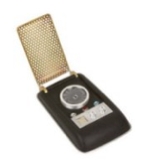 Here’s a photo of a communicator, circa 1967.
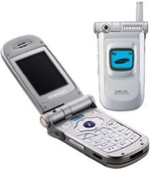 And here’s a Samsung flip-phone.
When “Star Trek: The Next Generation” replaced the flip-style communicators with a “com badge” in the late 1980s, the future was again prefigured. Today, wireless LAN-based lapel communicators are commonly used in hospitals.
THE TASER: “Victor Appleton”
Author Victor Appleton (the pseudonym of Howard Garis, also known for the “Uncle Wiggily” books) provided inspiration for the modern personal protection device, the taser (or “stun gun.”) The word “TASER” is an acronym for “Thomas A. Swift’s Electrical Rifle,” so named because the inventor was an admirer of Tom Swift when he was a child. The book “Tom Swift and His Electric Rifle” was published in 1911. Tom Swift was the adolescent hero of a series of books aimed at juvenile readers. Tom was the Harry Potter of his day. The books typically told of Tom’s adventures involving high-tech equipment such as a “sky train” or an “electric runabout.” Monorails and hybrid cars, anyone?
The Taser was developed in the late 1960’s by Jack Cover, who came up with the idea as a result of hearing about a U.S. commission which was looking into non-lethal ways police could deal with violent offenders. Cover based the Taser on a kind of stun gun he had read about in the Tom Swift fantasy stories of his childhood, thus the acronym, ‘Thomas A. Swift Electrical Rifle’.
First used by the Los Angeles Police Department in 1976, the Taser is now used by hundreds of police departments in the U.S.
— Smith Secretarial: High-Tech Non-Lethal Weapon New Option for Police!
MULTI-USER DOMAINS IN CYBERSPACE: Vernor Vinge
While many fans attribute numerous important details of cyberspace to author William Gibson, I’d like to look a bit farther back, to the seminal novella “True Names,” by Vernor Vinge. In this striking work of fiction (written in 1979 and published in 1981, long before personal computers and the Web became part of our daily lives), Vinge offers vividly imagined depictions of many concepts which are everyday Internet realities today. Vinge’s online communities presage chatrooms and multi-user domains in an uncannily accurate fashion (complete with a few disagreeable and destructive individuals who take pleasure in wreaking havoc). Vinge was, as far as I can tell, the first writer to use the term “avatar” to describe a digital image that represents an anonymous computer user. Vinge called the online access point a “portal.” As you read this 25-year-old story, it seems totally contemporary: much of what was fictional in 1979 is factual today.
True Names is about Roger Pollack, a well-to-do individual living in the early 21st century. In this wired world, Pollack is known on the ‘Other Plane’ of the computer net as Mr. Slippery, a top-flight warlock (hacker) and member of one of the foremost covens of such. Unfortunately, the government have figured out Mr. Slippery’s True Name, and captures him. But it’s not him they want: They want his assistance in finding and stopping another warlock, the Mailman, who they suspect of far worse plots than anything the garden-variety warlocks have concocted. With no choice, Pollack agrees.
Pollack contacts the rest of his coven, which the Mailman – who only communicates through time delay – has recently joined. The Other Plane is perceived by most as a fantasy world, and the details of the network are mapped to concepts familiar to that milieu. Individuals on the Other Plane adopt new identities, but keep their true names secret, since – as Roger has found out – blackmail is all too easy when someone knows who you are in the real world…
True Names was prescient in its day, foreseeing cyberspace and virtual reality in all its glory several years before William Gibson’s Neuromancer, and building on 70s stories like John Brunner’s The Shockwave Rider. Vinge correctly understood the importance of secrecy and cryptography, the coming pervasiveness of computer networks, and how the personal computer would open up the world of computing to the everyman.
— Pages of Michael Rawdon: Vernor Vinge
Read it! You’ll be entertained and amazed.
A personal note: I regard this novella so highly that, when choosing my Google Answers screen name in 2002, I very nearly went with the name “Erythrina,” a major character from “True Names.” I decided not to use this name after I told a friend about my plans, and she said “Erythrina??? Isn’t that a disease?”
Others…
A wonderful site called Technovelgy.com has a list of 652 science fiction devices and concepts, some of which have “come true.” I’ve selected a few of the most interesting items:
Thanks
Many thanks for a truly fascinating question. I shall sign off by borrowing a charming phrase from my friend and colleague Denco-ga:
Looking Forward,
Pink