
I really, really like the design of sunset dawning. Minimalist and gorgeous.
Help wanted: Apache/PHP
I’m planning on sticking with TypePad as my weblog host once everything opens up officially (tomorrow, from the looks of it). However, this poses a bit of a problem. While I’m slowly moving all of my old posts from my old weblog to this new site, there are still lots of links scattered throughout the ‘net that point to the old addresses.
I think I know of a solution, however, I’m not well enough versed in the intricacies of Apache and PHP to pull it off on my own. So, I’m asking for help!
Here’s what I’d like to do…
All of my old posts reside at my personal server at http://www.djwudi.com/longletter/. It’s a Mac OS X computer running Apache, with PHP enabled.
I know that Apache can handle redirects, based on rules set up in the httpd.conf file. I also know that pattern matching and text string munging can be carried out in PHP.
All of my old individual entry pages are stored in my webserver with the following directory structure:
http://www.djwudi.com/longletter/archives/year/month/day/dirified_post_title.php http://www.djwudi.com/longletter/archives/2003/07/31/help_wanted_apache_php.php
All of the pages on this new site are stored using a similar, but slightly different directory structure:
http://djwudi.typepad.com/eclecticism/year/month/truncated_title.html http://djwudi.typepad.com/eclecticism/2003/07/help_wanted_apa.html
What I’m envisioning for the final system is this:
- Anytime my webserver receives a request for a page that resides within the ‘/longletter/archives/’ directory, Apache redirects to a customised PHP script on my server.
- That script does three things:
- Presents a simple page to the user with wording to the effect of “This site has moved, one moment while we redirect you…”.
- Looks at the requested URI and converts it to what the new URI should be. As I’ve kept post titles consistent, and the directory structures are similar, this should be fairly easy with the right regular expressions.
- Parse the requested URI.
- Remove everything before the 4-digit year and replace it with the new base address.
- Remove the 2-digit day.
- Truncate the post title to fifteen characters.
- Remove the .php extention and replace it with .html.
- Redirects the users browser to the new, correct URI.
- Hey presto, we’re done — no matter which page was linked to at my old site, the user has been redirected to the corresponding page at my new site.
More brainstorming:
- The above method works well for links going to individual pages, but what about category archives or the main index page itself?
- Could the PHP script be made smarter? For instance…
- If the requested URI contains the year/month/day/title.php string, then the above transformation and redirect is processed.
- If the requested URI contains any other string (in other words, it doesn’t point to a specific post), then a page is presented that says something along the lines of “This site has moved, one moment while we redirect you to the new site…”, and a redirect is passed to the user’s browser that points to the index page of the new weblog.
Anyway, that’s what I’d like to do. It all seems straightforward enough in my brain, and I think that the technology I have available should be able to handle it all without a problem — I just don’t have the faintest idea how to code it.
Any and all advice, hints, tips, or straight-up solutions would be greatly appreciated. I’m not rich enough to offer untold wealth or cool prizes or anything, but I can offer much gratitude, public thanks and kudos, and probably pizza and beer (or a PayPal donation to a ‘pizza and beer’ fund, or some such thing).
And you won’t even have to fight me for the beer — I can’t stand the stuff. ;)
Revisionist Historians
I just noticed that Lane has titled his political blogroll “Revisionist Historians.” That’s wonderful!
That is all.
BlogStop
An online word game, found via MeFi and Ben Hammersley.
It’s really simple — each new comment must form an acronym of the last word of the previous comment. Care to see what we can come up with? Anyone?
50 ways to leave your lover…
…and here’s fifteen of them.
3. Newt Gingrich
Former speaker of US House of Representatives, big on family values, who visited his wife in hospital the day after she underwent surgery for cancer, to discuss the terms of their divorce.
(via Chaos Theory)
Help search engines index your site
We all know that Google is god. Chances are you’ve used Google when doing a search on the ‘net at least once, if not daily, or many times a day. If not, then I’ve heard rumors that there are other search engines out there — though I haven’t used any in so long, I can’t really vouch for the veracity of that rumor. ;)
I wanted to share a few tricks I use here to help Google (and other search engines) index my site, and to try to ensure that searches that hit my site get the most useful results.
All of the following tips and tricks do require access to your source HTML templates (in TypePad, you’ll need to be using an Advanced Template Set). While I’m writing this for an Advanced TypePad installation, the tips will work just as well in any other website or weblog application where you have access to the HTML code.
Specify which pages get indexed, and which don’t
What? One of the most important pages on a weblog from a user’s point of view is the main page. It has all your latest posts, all the links to your archives, your bio, other sites you enjoy reading, webrings, and who all knows what else. However, from the perspective of a search engine, the main page of a weblog is most likely the single least important page of the entire site!
This is simply because the main page of a weblog is always changing, but search engines can only give good results when the information that they index is still there the next time around. I’ve run into quite a few situations where I’ve done a search for one term or another, and one of the search results leads to someone’s weblog. Unfortunately, when I go to their page, the entry that Google read and indexed is no longer on the main page. At that point, I could start digging through their archives and trying to track down what I’m looking for — but I’m far more likely to just bounce back to Google and try another page.
Thankfully enough, though, there’s an extremely easy fix for this that keeps everyone happy.
How? One short line of code at the top of some of your templates is all it takes to solve the problem. We’re going to be using the robots meta tag in the head of the HTML document. The tag was designed specifically to give robots (or spiders, or crawlers — the automated programs that search engines use to read websites) instructions on what pages should or shouldn’t be indexed.
For the purposes of a weblog, with one constantly changing index page and many static archive pages, the best possible situation would be to tell the search engine to read and follow all the links on an index page (so that it finds all the other pages of a site), but not to index that page. The rest of the site, it will be free to read and index normally.
That’s very easy to set up, as it turns out. The robots meta tag allows four possible arguments:
- INDEX
- Read and index a page normally
- NOINDEX
- Do not index any of the text of the page
- FOLLOW
- Follow all the links on a page to read linked pages
- NOFOLLOW
- Ignore all links on a page
So, in order to do what we want, we add the following meta tag to our document, in the head section, right next to the meta tags that are already there:
<meta name="robots" content="noindex,follow" />
Now, when a search engine robot visits the index page of the site, it knows that it should not index the page and add it to its database, however, it should follow any links on that page to find other pages within the site. This way, searches that return hits for the site will be sure to find your archive pages for the information that is requested, rather than your front page, which may not have the information anymore.
Update: It turns out that this technique may have some side effects that I hadn’t considered, and might possibly not work at all. For more details, please scroll down to Anode’s comment and my reply in the comment thread for this post. Hopefully I’ll be able to dig up more information on this soon.
Fine tune what sections of a page get indexed
What? There is a proposed extension to the robots meta tag that allows you to not just designate which pages of a site get indexed, but also which sections of a page get indexed. I discovered this when I was setting up a shareware search engine for my old website, and have since gotten in the habit of using it. Now, this is not a formal standard, and I don’t know for sure which search engines support it and which don’t — the creator of this technique has suggested it to the major search sites, but it is not known what the final result was.
Now, why would you want to do this? Simply this: on many weblogs, including TypePad sites, the sidebar information is repeated on every page of the site. There is also certain informational text repeated on every page (for instance, the TrackBack data, the comments form, and so on). This creates a lot of extraneous, mostly useless data — doubly so when that information changes regularly.
By using these proposed tags, any search engine that supports them will only index the sections of a page that we want indexed, and will disregard the rest of the page.
How? Because this is based on the robots meta tag discussed above, it uses the same four arguments (INDEX, NOINDEX, FOLLOW, and NOFOLLOW). Instead of using a meta tag, though, we use HTML comment syntax to designate the different sections of our document.
For instance, every individual archive page on a TypePad weblog that has TrackBack enabled will have the following text (or something very similar):
Trackback
TrackBack URL for this entry:
http://www.typepad.com/t/trackback/(number)Listed below are links to weblogs that reference (the name of the post)
In order to mark this out as a section that we wanted the search engine not to index and not to follow (as the only link is to the page that the link is on), we would surround it with the following specialized tags:
<!-- robots content="noindex,nofollow" -->
<!-- /robots -->
For example, I would change the code in the TypePad Individual Entry template to look like this:
<mtentryIfAllowPings>
<!-- robots content="noindex,nofollow" -->
<h2><a id="trackback"></a>TrackBack</h2>
TrackBack URL for this entry:<br /><$MTEntryTrackbackLink$>
Listed below are links to weblogs that reference <a href="<$MTEntryPermalink$>"><$MTEntryTitle$></a>:
<!-- /robots -->
<mtpings>
The same technique can be used wherever you have areas in your site with content that doesn’t really need to be indexed.
Now, as I stated above, this is only a proposed specification, and it is not known which (if any) search engines support it. It also requires a healthy chunk of mucking around with your template code. Because of these two factors, it may not be an approach that you want to take, instead simply using the “sledgehammer” approach of the page-level robots meta tag discussed above.
However, I do think that the possible benefits of this being used more widely would be worth the extra time and trouble (at least, for those of us obsessive about our code), and I’d also suggest that should TypePad gain a search functionality, that these codes be recognized and followed by the (purely theoretical, at this point) TypePad search engine.
Put the entry excerpt to use
What? The entry excerpt is another very handy field to use in fine tuning your site. I believe that the field is turned off on the post editing screen by default, but it can be enabled by clicking on the ‘Customize the display of this page’ link at the bottom of the post editing screen.
By default, the entry excerpt is used for two things in TypePad: when you send a TrackBack ping to another weblog, the excerpt is sent along with the ping as a short summary of your post; and it is used as the post summary in your RSS feed if you have selected the ‘excerpts only’ version of the feed in your weblog configuration. However, it can come in handy in a few other instances too. One that I’ve discussed previously is in your archive pages. However, the excerpt can also be used to help out search engines.
You may have noticed that when you do a search on Google, rather than simply returning the link and page title, Google also returns a short snippet of each page that the search finds. Normally, this text snippet is just a bit of text from the page being referenced, intended to give some amount of context to give you a better idea of how successful your search was. There is a meta tag that lets us determine exactly what text is displayed by Google for the summary, though — which is where the extended entry field comes in.
How? We’re adding another meta tag here, so this will go up in the head section of your Individual Archives template. Next to any other meta tags you have, add the following line:
<meta name="description" content="<$MTEntryExcerpt>" />
Then save, and republish your Individual Archives, and you’re done. Now, the next time that Google indexes your site, the excerpt will be saved as the summary for that page, and will display beneath the link when one of your pages comes up in a Google search.
So what happens if you don’t use the entry excerpt field? Well, TypePad is smart enough to do its best to cover for this — if you use the <$MTEntryExcerpt$> tag in a template, and no excerpt has been added to the post, TypePad automatically pulls the first 20 words of your post to be the excerpt. While this works to a certain extent, it doesn’t create a very useful excerpt (unless you’re in the habit of writing extremely short posts). It’s far better to take a moment to create an excerpt by hand, whether it’s a quick cut and paste of relevant text in the post, or whether it’s more detailed (“In which we find out that…yadda yadda yadda.”). In the end, of course, it’s your call!
Use the Keywords
What? Keywords are short, simple terms that are either used in a page, or relate to the page. The original intent was to place a line in the head of an HTML page that listed keywords for that page, which search engines could read in addition to the page content to help in indexing.
Unfortunately, keywords have been heavily abused over the years. ‘Search Engine Optimizers’ started putting everything including the kitchen sink into their HTML pages for keywords in an effort to drive their pages rankings higher in the search engines. Because of this, some of the major search engines (Google included) now disregard the ‘keywords’ meta tag — however, not all of them do, and used correctly, they can be a helpful additional resource for categorizing and indexing pages.
How? One of the various fields you can use for data in each TypePad post is the ‘Keywords’ field. I believe that it is turned off by default, however you can enable it by clicking on the ‘Customize the display of this page’ link at the bottom of your TypePad ‘Post an Entry’ screen.
Once you have the ‘Keywords’ field available, you can add specific keywords for each post. You can either use words that actually appear in the post, or words that relate closely to it — for instance, I’ve had posts where I’ve used the acronym WMD in the body of the post, then added the three keywords ‘weapons mass destruction’ to the keywords field. You never know exactly what terms someone will use in their search, might as well give them the best shot at success, right?
Okay, so now you have keywords in your posts. What now? By default, TypePad’s templates don’t actually use the data in the Keywords field at all. This is fairly easy to fix, however.
In your Individual Archives template, add the following line of code just after the meta tags that are already there:
<meta name="keywords" content="<$MTEntryKeywords$>" />
Then save your template, republish your site (you can republish everything, but doing just the Individual Archives is fine, too, as that’s all that changed), and you’re done! Now, the next time that a search engine that reads the keywords meta tag reads your site, you’ve got that much more information on every individual post to help index your site correctly.
Conclusion
So there we have it. One extremely long post from me, with four hopefully handy tips for you on how you can help Google, and the rest of the search engines out there, index your site more intelligently. If you find this information of use, wonderful! If not…well, I hope you didn’t waste too much of your day reading it. ;)
Feel free to leave any questions, comments, or words of wisdom in the comments below!
Our friend, the humble 'title' attribute
Earlier this evening, I got an e-mail from Pops asking me how I created the little tooltip-style comment text that appears when you hover over links in my posts. I ended up giving him what was probably far more information than he was expecting, but I also figured that it was information worth posting here, on the off chance it might help someone else out.
It’s actually a really easy trick, though not one built into TypePad. Simply add a title declaration to the link itself. For instance, if I wanted the text “Three martinis and a cloud of dust” to appear when someone hovered over a link to Pops’ site, I’d code it like this:
<a href="http://2hrlunch.typepad.com/" title="Three martinis and a cloud of dust">Two Hour Lunch</a>
The end result looks like this (hover over the link to see the title attribute in action):
That little title attribute comes in wonderfully handy, too, as it can be applied to just about any HTML tag there is.
For instance, good HTML coding includes alt text for all images, so that if someone has image loading turned off in their browser, or if the image fails to load for any other reason, there will be some descriptive text to tell them what gorgeous vistas they are missing. However, in most browsers the only time that text shows is if the image doesn’t load. Using the title attribute in addition to the alt attribute when adding images, we can create that same style of comment when someone hovers over the image. For example:
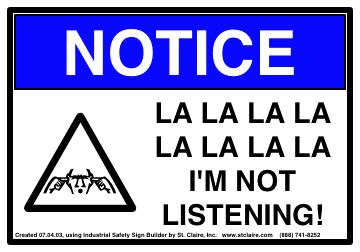
<img src="lalala.gif" width="360" height="252" alt="NOTICE: I'm not listening!" title="La la la la la la!" />
That way, when displayed in the browser, if the image didn’t load, the text ‘NOTICE: I’m not listening!’ would show instead. In addition, the text ‘La la la la la la!’ will appear if someone lets their cursor pass over the image. Not a necessary thing, but it can be fun for quick, pithy little comments. Here’s the example:
Another place I use title tags fairly regularly is when I make changes to a post after it’s first posted. HTML includes two tags (<ins> and <del>, for insert and delete, respectively) for marking up changes to text. When I go back in to edit a post after it first appears on my site, I use those tags with a title attribute to indicate when the change was made.
For example, suppose I posted the following:
Pops is a screaming loony, who shouldn’t be allowed within twenty yards of anyone who isn’t equipped with body armor and a machete.
Later, coming to my senses, I could change that like this:
Pops is a <del title="7/30/03 10pm: I think I was on drugs when I wrote this.">screaming loony, who shouldn't be allowed within twenty yards of anyone who isn't equipped with body armor and a machete</del> <ins title="Here's what I meant to say...">great guy, whose website has pointed me to some fascinating tidbits on a regular basis</ins>.
(I hope Pops doesn’t mind the sample text here.) ;)
On screen, after the update, the deleted text would display as struck through, and the inserted text would display underlined (standard editing notation), with the comments displaying on a cursor hover, like this:
Pops is a
screaming loony, who shouldn’t be allowed within twenty yards of anyone who isn’t equipped with body armor and a machetegreat guy, whose website has pointed me to some fascinating tidbits on a regular basis.
So there ya go — more information on the humble little ‘title’ attribute than you probably ever wanted or needed to know. I hope it helps!
Update: (See? There’s a title attribute right there!) As of this writing, the title attribute is barely supported in Apple’s new web browser, Safari. Titles on links will appear in the status bar at the bottom of the window if the status bar is turned on, but that’s it. No other title text will be visible. I’m hoping that this is fixed in a later update to Safari, but for the moment, that’s what we have to work with.
BuyMusic ripping off artists
Another good reason to avoid the BuyMusic service: apparently, through snapping up the back catalog of a very shady distributor, much of the BuyMusic catalog comes from independent artists who are not receiving any compensation for their work.
This from recording artist Jody Whitesides:
I did a search for one of my old CD’s that will be going onto iTunes and It turns out my CD was there on BuyMusic.com. As were the CD’s of several other bands that I’m friends with. All of whom were not contacted about being placed for sale there.
Here’s what I’ve deduced… BuyMusic.com (which I will refer to as BM) got their “vast” music library of 300,000 plus songs from a company called the Orchard. The Orchard is a distribution company that has consistently shafted artists by not paying them for CD’s sold nor returning unsold CD’s or cancelling contracts. So, without the express consent of what is likely lots of the Orchards catalog, BM has put it up for sale at the bargain price of \$.79 a song.
So now, they can tout they’re selling tracks at \$.79 and they can say they have a library of music of over 300,000 songs. But what they don’t tell you is that it comes from musicians/bands that were not asked for permission, and who will likely not see a penny of any sale made through BM. By their very own site policy they are committing copyright infringement. They have done this to lure PC/windows users to their site in hopes to sell the few major label aquired songs they do have, at a price that is much higher than Apple’s \$.99.
I’m currently looking into legal means to have my music removed from their site and strongly encourage users to not browse BM’s site nor purchase from it.
(via MacSlash)
Pet Peeves
Can we please please please stop using the target="new" attribute in links? I don’t want a new window. If I do want a new window, then I’ll right-click and use the “Open link in new window” command. But I don’t want you deciding that I must want a new window, just because you don’t want me taking the oh-so-horrid step of actually (gasp) leaving your site!
If you’ve got a good site, I’ll use the “back” button and come back. If you don’t have a good site, I’m not likely to come back no matter what the circumstances. But constantly forcing every link to open in a new window, taking control of how I browse away from me, you’re a lot more likely to piss me off to the point where I won’t come back than if you just let me browse normally.
Thank you for your time.
(And on that note, yes, I know that clicking on someone’s name if they leave a comment here does the exact thing I’m bitching about. I haven’t figured out how to get around that yet. If I can, you can be damn sure that I’m turning that little “feature” off.)
Update: Usability Guru Jakob Nielsen also hates this practice, so I’m not alone. Opening new windows for links breaks items one and two of his Top 10 new mistakes of web design article. So there. Bleah. :P
The constitutionality of fuck, 'fucker' and 'fucking fag'
This was originally posted at The Smoking Gun, but all they had was scans of the legal motion. I thought that this was far to good to leave locked up in images, so…well, here we go. ;)
(via Mathew)
Here’s the intro from TSG:
JULY 28–Yes, five months remain in the year, but we’re ready to announce the winner of the prestigious 2003 Legal Document of the Year award. The below motion was filed earlier this month in connection with a criminal charge filed against a Colorado teenager. The boy’s troubles started when he was confronted at school by a vice principal who suspected that he had been smoking in the boys bathroom. When presented to the principal, the kid exploded, cursing the administrator with some variants of the “F” word. For his outburst, the boy was hit with a disorderly conduct rap, which was eventually amended to interfering with the staff, faculty, or students of an educational institutional. Faced with what he thought was a speech crime, Eric Vanatta, the teen’s public defender, drafted the below motion to dismiss the misdemeanor charge. The District Court document is an amusing and profane look at the world’s favorite four-letter word, from its origins in 1500 to today’s frequent use of the term by Eminem, Chris Rock, and Lenny Kravitz. The criminal charge, Vanatta argued in the motion, was not warranted since the use of the popular curse is protected by the First Amendment. TSG’s favorite part of the motion is the chart comparing Google results for the “F” word and other all-American terms like mom, baseball, and apple pie. Sadly, Vanatta never got the chance to argue his motion before a judge. Because ten days ago he cut a plea deal that deferred prosecution of his client for four months–if the kid stays out of trouble during that period, the charge gets dismissed.
Filed in combined courts
Larimer County, CO
2003 Jul-1 PM 3:07DISTRICT COURT, LARIMER COUNTY, COLORADO
201 LaPorte Avenue, Fort Collins, CO 80521
(970) 498-6100THE PEOPLE OF THE STATE OF COLORADO,
Plaintiff,In the Interest of:
—–, a Child.
DAVID S. KAPLAN
Colorado State Public DefenderERIC VANATTA (#24823)
Deputy State Public Defender
Fort Collins Regional Office
1 Old Town Square, Suite 201
Fort Collins, Colorado 80524\
Phone: (970) 493-1212, Fax: (970) 498-8867
E-mail: ftcollins.defenders\@state.co.usMOTION TO DISMISS: THE CONSTITUTIONALITY OF FUCK, “FUCKER” AND “FUCKING FAG”
Counsel hereby asks the Court to dismiss the case at bar. He states the following:
- Mr. —– is charged with Interference with Staff, Faculty or Students of Educational Institutions, a class three misdemeanor. The charge was amended from the original charge of Disorderly Conduct.
- The basis of the prosecution is an alleged statement Mr. —– made to his principal at school. During lunch, Mr. —– was contacted by the vice principal for suspicion of smoking in the boy’s room. He was taken to the principal’s office where he allegedly called the principal a “fucker, a fag, and a fucking fag.” He was charged with the present offense based on his statements to the principal and he is being prosecuted for the words he spoke.
- In order to provide a context for the alleged crime, we must first examine the history of Fuck and its evolution in society. Fuck’s earliest recorded use is prior to the year 1500 from the English-Latin poem Flen Flyys: “Non sunt in celi quia fuccant uuiuys of heli,” which traslates to “they are not in heaven because they fuck the wives of Ely.” See [www.wikipedia.org/wiki/fuck].
- Although still offensive to some, Fuck is a more commonly used and accepted term in today’s twenty-first century society than it was in the past. Use of the word Fuck “has been accepted in R-rated movies (and occasionally in PG-13 movies, though not often). Since the 1970’s, the use of the word Fuck in R-rated movies has become so commonplace in mainstream American movies that it is rarely noticed by most audiences.” Id. Some movies such as Scarface, Porky’s and Goodfellas are known for the extensive use of the family of Fuck words (Fuck, Fucking, Fucker, Fuckface, Fucked, Absofuckinglutely, etc.) and in the non-US version of the comedy Four Weddings and a Funeral, Fuck is the chief word and repeatedly uttered during the first five minutes of the film. Id. Pulp Fiction was nominated for seven academy awards and took home the Oscar for best screenplay with its zealous and gratuitous use of Fuck phrases. It would be far fetched to argue that the Fuck family has not made its way into mainstream society.
- In the world of performing arts, Fuck and its many variants are not limited to Hollywood and the big screen. George Carlin, a well known and admired American comedian, for years has based his act on the use of the more colorful words in the English language, including extraordinarily large amounts of Fuck phraseology. In fact, one of the most well known comedic skits in American history is George Carlin’s “Seven Dirtiest Words,” two of which are Fuck and Motherfucker. Andrew Dice Clay, Eddie Murphy, Chris Rock, Robin Williams and countless others have used the Fuck family to entertain audiences across the land, enriching their lives with the entertainment and comedic value of Fuck and its progeny.
- The word Fuck can be heard almost anywhere at anytime, not just at your local movie theatre or comedy club. Numerous other mainstream and well respected artists have used the family of Fuck words in their music and performances. The Rolling Stones (who have nine number one albums, thirty-four top 10 albums and thirty-eight gold/platinum albums) have used the word in numerous recorded songs and hoards of additional live performances. Other popular musical artists such as Eminem, Lenny Kravitz, Tupac Shakur, Kid Rock, Busta Rhymes, 311, Bad Religion, Beck, Dr. Dre, Blink 182, Spleen Dingo and Everlast have actually titled songs that contain some variation of the word Fuck. For a complete listing of at least 417 song titles containing a member of the Fuck family, one need only access to a computer to visit the non-pornographic site [inlyrics.com]. Literally millions of Fucking recordings have been distributed by national recording artists, who are backed by national record labels, who seem not to have a problem proliferating this prolific word and its closely related cousins. Counsel knows of no record label or record label executive that has been prosecuted for titling a band, a song or an album with a member of the Fuck family.
- From Fa (a syllable used to represent the fourth tone of a major scale or sometimes the tone F) to Fytte (archaic version of Fit), there are roughly eight thousand six hundred words in the English language that begin with the letter F. Webster’s 3^rd^ New International Dictionary of the English Language, Unabridged, pp. 811-926, (1986). Fuck has the unique distinction of being the only word commonly known as the F word. Fuck is so popular that a 272 page book entitled “The F Word” was published by the well respected national publisher Random House Books in 1999. Coincidentally, Random House also happened to be 1999’s number one ranked distributor of children’s books. “The F Word” is readily available at the world’s largest online bookseller, Amazon.com, or your local Barnes and Noble bookseller for around fifteen dollars.
- A search of internet web sites suggests Fuck is a more commonly used word than mom, baseball, hot dogs, apple pie, and Chevrolet. Google Search Engine at [Google.com] on June 25^th^, 2003.
- Mr. —– is alleged to have spoken two different variations of the root word Fuck. The following table depicts the number of internet search engine hits for —– alleged “Fucker” and “Fucking” statements as compared to Fuck itself and other commonly heard words or phrases. All results are approximate.
| Word | Approximate number of hits |
|---|---|
| Fuck | 24,900,000 |
| Fucking | 24,700,000 |
| Fucker | 735,000 |
| Mom | 9,040,000 |
| Baseball | 13,600,000 |
| Hot Dogs | 607,000 |
| Apple Pie | 308,000 |
| Chevrolet | 4,090,000 |
| Freedom of Speech | 542,000 |
| First Amendment | 933,000 |
| Unconstitutional | 691,000 |
| Sticks and Stones May Break My Bones | 7,360 |
- Fuck has distinct meanings based on the context in which it is used. When formally defined:
- \”FUCK, n, 1680
- usually obscene: an act of copulation
- usually obscene: a sexual partner
- usually vulgar: DAMN
- usually vulgar: used especially with the as a meaningless intensive \
\” Merriam-Webster’s Online Dictionary, www.m-w.com (emphasis in original)
The Cambridge English Readers Online Dictionary adds more zest to the definition of fuck and fucking (emphasis in original):
- \”fuck (EXTREME ANGER) exclamation offensive
- used when expressing extreme anger or annoyance, or to add force to what is being said:
- Fuck — the bloody car won’t start!
- Shut the fuck up!
- Who the fuck does she think she is, telling me what to do?
- fucking adjective, adverb offensive
- used to emphasize a statement, especially an angry one:
- What a fucking waste of time!
- He’s a fucking idiot.
- He’d fucking well better do it.\”
- Fuck possesses incredible versatility. It can be a noun (you fuck), a verb (everything Billy touches, he fucks up), and adjective (I’m really fucking broke), an adverb (I’ve been fucking drinking too much), an exclamation (holy fuck, Batman!) or question (what the fuck?). This verstility could partially explain the prevalence of the word and why it is so readily available to anyone with access to a computer, VCR, CD player, eight track recorder, DVD player, phonograph, cassette deck or Blockbuster Video outlet. It may explain why Fuck can be used in almost any sentence at any time no matter what the circumstances and why the word has become almost commonplace in United States culture and society.
It is against this backdrop that we turn to the situation at hand.
The question presented by the case at bar is not whether Fuck is a desirable or attractive word, or whether a juvenile should be calling his principal a fucker or a fucking fag. Rather, the question is one of constitutionality and whether the State can criminalize the speech in question by application of the statute at issue. The prosecution is attempting to hold a juvenile criminally responsible for the age old tradition of name-calling. Although Mr. —– could have selected a more desireable choice in prose such as “I respectfully dissent” or “I am disappointed with your attitude, sir, and politely ask you to cease and desist,” the use of the words fucker and fucking nothenless do not amount to criminal conduct in this particular context.
The statement alleged against Mr. —– is protected by the First and Fourteenth amendments to the United States Constitution. The United States and Colorado Constitutions both provide that no law abridging or impairing freedom of speech shall be enacted. U.S. Const. Amend. I, applies to the states through U.S. Const. Amend. XIV, and Colo. Const. Art. II, §10.
Freedom of thought, speech, expression and ideas are the very concepts upon which America’s liberty is founded. An extremely limited number of exceptions have been judicially carved from one of the most fundamental principals of American jurisprudence. Courts have, on occasion, upheld the constitutionality of statutes which prohibit obscenity, libel, incitement, invasion of substantial privacy interests of the home and “fighting words.” People v. Hayden, 548 P.2d 1278 (Colo. 1976).
Fuck is an entirely legal word that may be uttered in public places so long as the manner in which it is uttered will not cause a violent reaction. Cohen v. California 403 U.S. 15 (1971). (“Fuck the Draft” jacket worn in a courthouse was protected by the first amendment.) In overturning a disorderly conduct conviction, the Cohen Court went on to state:
Against this perception of the constitutional policies involved, we discern certain more particularized considerations that peculiarly call for reversal of this conviction. First, the principle contended for by the State seems inherently boundless. How is one to distinguish this from any other offensive word? Surely the State has no right to cleanse public debate to the point where it is grammatically palatable to the most squeamish among us. Yet no readily ascertainable general principle exists for stopping short of that result were we to affirm the judgement below. For, while the particular four-letter word being litigated here is perhaps more distasteful than most others of its genre, it is nevertheless often true that one man’s vulgarity is another’s lyric. Indeed, we think it is largely because governmental officials cannot make principled distinctions in this area that the Constitution leaves matters of taste and style so largely to the individual. Additionally, we cannot overlook the fact, because it is well illustrated by the episode involved here, that much linguistic expression serves a cual communicative function: it conveys not only ideas capable of relatively precise, detached explication, but otherwise inexpressible emotions as well. In fact, words are often shosen as much for their emotive as their cognitive force. We cannot sanction the view that the Constitution, while solicitous of the cognitive content of individual speech, has little or no regard for that emotive function which, practically speaking, may often be the more important element of the overall message sought to be communicated. Indeed, as Mr. Justice Frankfurter has said, “[o]ne of the prerogatives of American citizenship is the right to criticize public men and measures — and that means not only informed and responsible criticism but the freedom to speek foolishly and without moderation.” Baumgartner v. United States, 322 U.S. 665, 673-674 (1944). Finally, and in the same vein, we cannot indulge the facile assumption that one can forbid particular words without also running a substantial risk of suppressing ideas in the process. Indeed, governments might soon seize upon the censorship of particular words as a convenient guise for banning the expression of unpopular views. We have been able, as noted above, to discern little social benefit that might result from running the risk of opening the door to such grave results.
Cohen at 25-26 (emphasis added)
The Colorado Supreme Court used the same reasoning in citing and following Cohen by overturning a municipal conviction based on the defendant, Mr. Wade, yelling “Fuck You” at a meeting of over two hundred people at the University of Denver campus. Ware v. City and County of Denver, 511 P.2d 475 (Colo. 1973).
The statement “I don’t need this fuckin’ school anyway” in concert with violently slamming a door was found to be constitutionally protected speech. The statement was made by a juvenile to a police officer in a school setting after the juvenile was called to the principal’s office to be informed that she was being expelled from school. L.M.A.W. v. State, 611 So.2d 497 (Ala. Cr. App. 1992) (conviction for disorderly conduct overturned).
“Shut the fuck up” and words to the effect of “don’t let the door hit you on the ass on the way out” were ruled to be constitutionally protected speech. B.E.S. v. State, 629 So.2d 761 (Ala. Cr. App. 1993).
A juvenile telling a police officer “fuck you” was held to be constitutionally protected speech. R.I.T. v. State, 675 So.2d 97 (Ala. Cr. App. 1995) (conviction for disorderly conduct overturned). The R.I.T. court reasoned that police officers are specially trained to deal with vulgarities and situations when others may be verbally abusive towards them, and thus “fuck you” was not likely to provoke a violent response.
A juvenile calling a police officer a “fucking pig, fuckin’ kangaroo” and telling the officer “fuck you” during a traffic contact was found to be constitutionally protected speech. State v. John W., 418 A.2d 1097 (Me. 1980). Just like the R.I.T. court, Id., the John W. court also reasoned that police officers deal with these types of situations on an every day basis and therefore “fucking pig, fuckin’ kangaroo and fuck you” were not likely to invoke a violent response.
Finally, the Arizona case of In Re Louise C. is almost directly on point with the case at bar. Louise C. was brought to the principal’s office in relation to conduct with another student. In the presence of the other student, the principal, and the vice principal, Louise C. was asked whether she planned to fight the other student. She lashed out and said “Fuck this, I don’t have to take this shit” and walked towards the door. When the principal asked her to stop she said “Fuck you, I don’t have to do what you tell me” and slammed the door behind her. She was later suspended from school for the incident. Louise C.’s statements and conduct were found to be constitutionally protected by the First Amendment. In Re Louise C., 3 P.3d 1004 (Az. App. 1999).
The state has the power to protect its citizenry from actual harm, and thus has the power to outlaw one yelling “Fire!” in a crowded theatre. See, Schenck v. United States, 249 U.S. 47 (1919). However, yelling “Fuck!” in a crowded theatre does not create a clear and present danger to anyone and thus cannot be outlawed. Although they are both four letter words that start with F, the distinction is constitutionally significant.
The elements of Interference with Staff, Faculty or Students of Educational Institutions require proof beyond a reasonable doubt that Mr. —– unlawfully and willfully impeded the staff and faculty of the school. The elements also require that he do so by using restraint, abduction, coercion or intimidation. It is difficult to imagine how calling one’s principal some naughty words hinders his ability to do his job. Although counsel has not seen a formal description of what his job requires, typically a principal is called on to deal with situations precisely like the one at hand. This is surely not the first time the principal has heard an offensive remark or been called a bad name. In contrast to the general public, one would expect a principal to have special training in dealing with situations that require non-criminal discipline and reprimand. In fact, rather than violently responding to the insults, the principal suspended Mr. —– from school for the incident in question, an entirely legal and appropriate reaction to the alleged statements. However, criminal charges and the potential sanctions that come along with them are categorically different than the in-house sanctions that Mr. —– has already suffered.
Fuck is certainly a controversial word that may be appropriate in certain venues and locales (Florida Elections Commission, speed eating contests, public defender offices) and may be inappropriate in others (weddings, Chuck-E-Cheese pizza parlors, district attorney offices). Some people may believe it is always inappropriate. But in all but a very few circumstances, the First Amendment to the United States Constitution prohibits our government from making that determination. This case falls outside those very limited circumstances and as such, no conviction can result from Mr. —– alleged statements.
Therefore, the Court must dismiss this case.
DAVID S. KAPLAN
COLORADO STATE PUBLIC DEFENDER(signature)
______________________________
ERIC VANATTA (#24823)
Deputy State Public DefenderCertificate of Service
I certify that, on 7/1/03, the foregoing document was served by delivering X mailing _____ faxing _____ it to opposing counsel.(signature)
_______________