
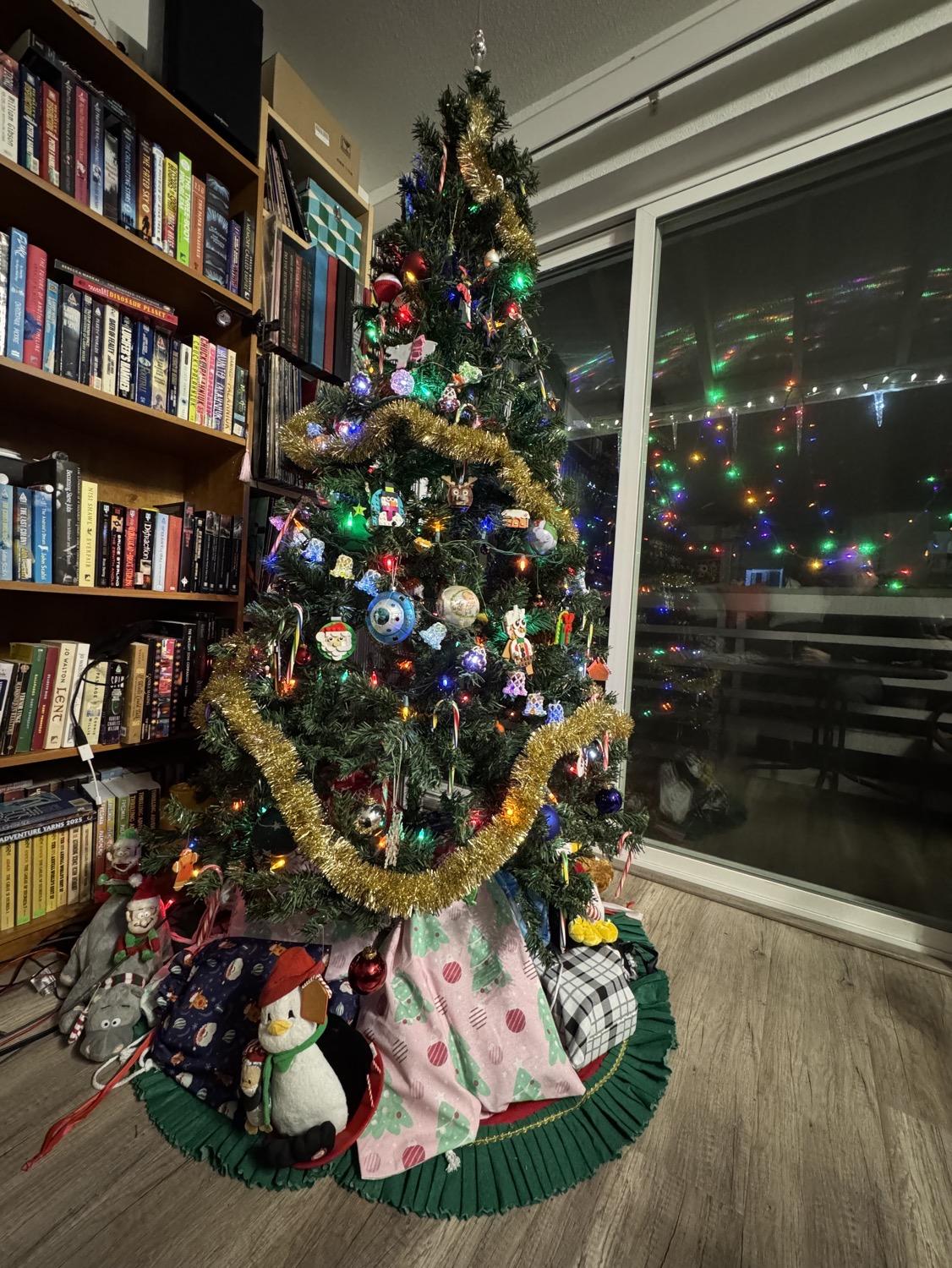
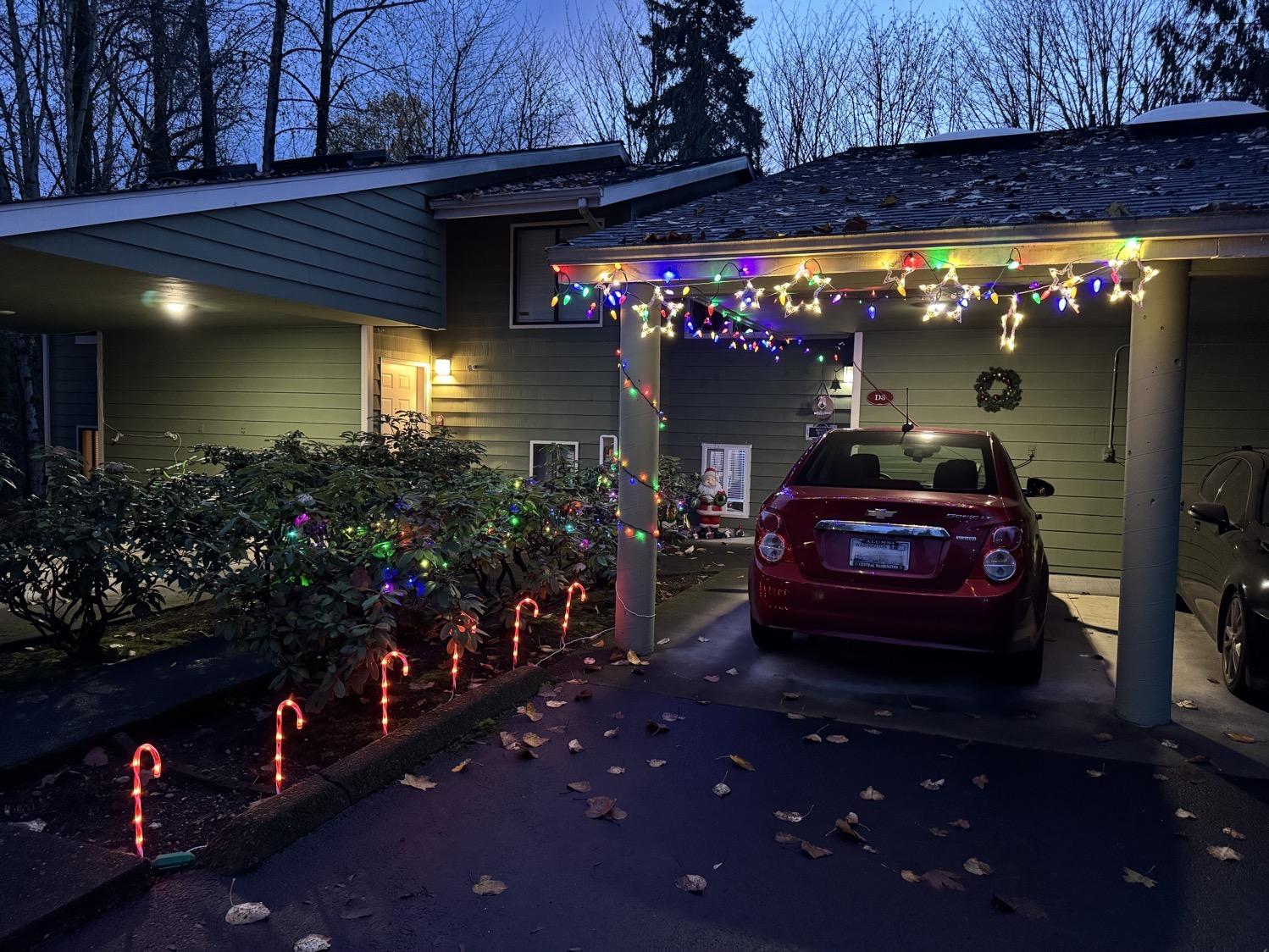
This, of course, was Thanksgiving week here in the U.S., so it was a three-day work week followed by a four-day weekend…which, really, is just how it should be every week, isn’t it? We did our usual thing of staying home and avoiding holiday travel, having a nice quiet holiday weekend of resting, munching on good food, reading books, watching a couple movies, and bringing out the Christmas decorations.
📸 Photos


📚 Reading
I finally finished Jonathan Strange & Mr Norrell, which I’d been slogging through for over a month. Had it not been part of my Hugo Best Novel reading project I’d probably have given up midway through, but I’m stubborn. This just was not my kind of book.
📺 Watching
-
Planes, Trains and Automobiles (1987) ⭐️⭐️⭐️: Amusing, but not a regular tradition; it kind of drags on. It was fascinating seeing and remembering what travel (and dealing with travel problems) was like in the mid-80s, without cell phones, internet reservations, ATMs, and similar modern conveniences.
-
Edward Scissorhands (1990) ⭐️⭐️⭐️⭐️: Still excellent. Also, and amusingly, while it was all very Tim Burton, and being in the mansion on the hill was like being in Burton’s head, many of the scenes in the town struck me as having nearly a Wes Anderson feel. More saturated, of course, but there was a lot of symmetrical framing of shots and stylized dialogue that were very reminiscent of Anderson’s films.
🔗 Linking
-
David Roskin in The Guardian: Hollywood’s dark era: where did all the colour from movies go?: “We all know the late-night slog of finding something to watch, flicking between streaming services until settling on a series someone mentioned at work. And then a few minutes later, you’re squinting, adjusting your lighting or playing around with TV settings – it’s a night-time scene and you’re unable to make out what’s going on. Prompting the question: ‘When did everything on screen get so dark?’”
-
Alexa Peters at KNKX NPR: Local businesses reconsider live music as licensing fees soar: “PROs are companies that represent songwriters, composers and music publishers and collect royalties from the live performance of their copyrighted works on their behalf. Per U.S. copyright law, any establishment that presents live or recorded music must obtain a “Public Performance License” from a PRO to legally use copyrighted music they represent for performances, overhead house music, jukeboxes, and even karaoke. ¶ For years, this relationship between venues and PROs has gone on behind the scenes as a necessity of live music presentation. But, as more PROs have emerged, and rising costs make it more difficult for grassroots music venues and third places, like restaurants, to keep live music going, PROs are drawing more scrutiny.”
-
Brian Merchant in The Atlantic: The New Luddites Aren’t Backing Down (archive.is link): “Now, with nearly half of Americans worried about how AI will affect jobs, Luddism has blossomed. The new Luddites—a growing contingent of workers, critics, academics, organizers, and writers—say that too much power has been concentrated in the hands of the tech titans, that tech is too often used to help corporations slash pay and squeeze workers, and that certain technologies must not merely be criticized but resisted outright.”
-
T.M. Brown in The New York Times: They’re Trying to Ditch Their Phones. Their Methods Are Unorthodox. (gift link): “The Lamp Club is part of a growing ecosystem of ‘neo-Luddite’ groups across the country that encourage people to transform their relationship to technology. Other groups include the Luddite Club, APPstinence and Breaking the (G)Loom — organizations that, for the most part, were started not by parents wishing their teens would get off their devices but by the teens themselves, who fault phones for fraying human connections as well as accelerating inequality and climate change. There are now more than two dozen Luddite Clubs in North America, from Ithaca, N.Y., to Irvine, Calif.”
-
Elizabeth Spiers: Requiem for Early Blogging: “The growth of social media in particular has wiped out a particular kind of blogging that I sometimes miss: a text-based dialogue between bloggers that required more thought and care than dashing off 180 or 240 characters and calling it a day.”
-
Josh Collinsworth: Alchemy: “The struggle that produced the art—the human who felt it, processed it, and formed it into this unique shape in the way only they could—is integral to the art itself. The story of the human behind it is the missing, inimitable component that AI cannot reproduce. ¶ That’s what I and so many others find so repulsive about generative AI art; it’s missing the literal soul that makes art interesting in the first place.”
-
Aaron Greenbaum at Slashgear: Legendary Sci-Fi Vehicles: How They Were Really Built: “If a producer wants a sci-fi vehicle to have a tangible presence and a sense of realism, they have to use a live, physical model. For larger vehicles or when cars and spaceships perform feats of fantastical daring, a miniature is often required, but when the vehicle has to interact with actors or live sets, it is usually built to scale using available parts. Here are 10 iconic sci-fi vehicles and how they were made.” Light on details, but still entertaining.
-
ableplayer on GitHub: “Able Player is a fully accessible cross-browser HTML5 media player.”
-
Rebecca Solnit at The Guardian: A year on from Trump’s victory, resistance is everywhere: “Resistance is everywhere, both geographically and in terms of the constituencies participating: civil society and civil servants; human rights, climate and environmental groups (who in many cases had plans in place before the election and hit the ground running when the new administration came in); religious leaders and institutions, elected officials at all levels from city councils to the US Senate, the military, lawyers and judges, educators and students, librarians, of course, medical professionals, journalists, editors and publishers, people in the arts. Of course there’s been shameful collaboration, submission and silence from many figures in most of these constituencies as well. It has been striking that the most wealthy and theoretically most powerful have, in this crisis, often been the first to surrender. It’s non-elites who have stood on principle even when it means taking risks.”
-
Nicholas Deshais at The Seattle Times: Light rail’s push to Federal Way gives students, workers front-door access (archive.is link): “Unless you were looking for it, Highline College used to be kind of hard to find, even when it was right next to you. ¶ Not anymore, thanks to the region’s growing light rail and its new Kent Des Moines Station directly across 99, which, not coincidentally, was almost called Highline Station. With the train coming, Highline reoriented itself to the east, widened the alley and renamed it College Way, demolished the ice cream shop and, in 2019, erected the Campus View building, which has retail and office space on the first floor and housing for 160 students on the four floors above. Two tall signs blare out the college’s name on either side of College Way, for any driver — or light rail passenger — who may be unaware.”