Jason Webley Elevanniversary

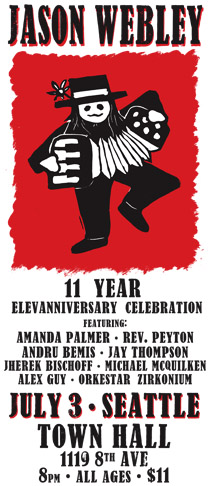
Poster for Jason's 11th Anniversary ShowLast night, Prairie and I went out to see Jason Webley’s Elevanniversary show, our first Webley show in a few years. We’d been skipping them lately, but between this being his eleventh anniversary show, having it at Seattle’s Town Hall (a venue we really like), and the guest list he’d lined up, we decided this was one we wanted to see. In the end, while it wasn’t our all-time favorite Webley show, it was still good, (mostly) a lot of fun, and we’re glad we went. I took a few pictures during the course of the night, and they’ll be up eventually, but as we sat towards the back and I was more interested in just enjoying the show, it won’t be among my most comprehensive sets of Webley documentation. I’m sure you’ll all survive. :)

We headed downtown a little early, in order to make sure we got a good parking space close to Town Hall and have time to get dinner before the show. Parking successfully obtained, we wandered down to the Cheesecake Factory for dinner, after stopping off to get a few pictures of what little is left of the Alfaretta Apartments at 8th and Seneca. As crappy as that building was, I liked my little apartment there, and it was where I was living when Prairie and I first met, so it was a little sad to see it reduced to just a few walls and a lot of rubble. After dinner we spent a while wandering around Barnes and Noble, talking each other out of spending money on new books when there are so many good used books available far cheaper, and then headed back up the hill to Town Hall.

There was already a small crowd of people milling about when we returned to Town Hall, and it wasn’t long before a table was set up to process those of us who had will call tickets waiting. (A quick aside: I’ve got to give props, this was by far the most organized and prompt Webley show we’d ever been to. Getting our tickets only took a few minutes, the doors to the lobby actually opened at, and perhaps slightly before, the scheduled 7:30pm, we got into the house and found our seats by 7:45, and the lights dimmed to begin the show at 8:05. Impressive!) Tickets in hand, we waited for the doors to open, and ended up spending a pleasant few minutes chatting with Paco, a burlesque performer from Baltimore who was in town for the weekend to visit Seattle and see the Elevanniversary show.

Once in the auditorium, Prairie and I grabbed seats towards the back of the house on the assumption that most rowdiness would be towards the front, and this would make it easier to dodge overexcited fans later on. As we were all entering and finding our seats, Seattle’s Orkestar Zirkonium was providing entrance music, their euro-klezmer-ish style setting a good tone for the evening to come, as balloons both big and small bounced around the room and Jason’s ever-present goddesses danced and twirled through the aisles.

The show itself was divided roughly in half, with the first half devoted to Jason’s friends and collaborators doing short sets on their own, and Jason coming out for the second half. This ended up having some definite pros and cons: on the plus side, we got some more exposure to the people Jason’s been working with over the past few years, all of whom had quite enjoyable sets; however that also meant that Jason himself had a somewhat abbreviated setlist, and many of the quieter, more introspective songs that Prairie and I enjoy so much were passed over in favor of the louder, more exciting, get-everyone-bouncing-around songs. As fun as those are — and plenty of people were quite rightfully enjoying them — we’re just not quite so bouncy, and missed hearing some of our old favorites. Still, different shows have different intents, and this minor grousing shouldn’t at all be taken to mean that we didn’t enjoy ourselves!

Anyway, the first guest performer up was Andru Bemis, who worked with Jason on the How Big is Tacoma EP, with three of his own songs. Jay Thompson (of Eleven Saints fame) read a few poems for us, then the Rev. Peyton came on (though without his Big Damn Band). Some of Jason’s goddesses did a silly Billy Joel “We Didn’t Start the Fire”-inspred pseudo-retrospective of Jason’s career, accompanied by only a big bass drum. Then the last guest performer, and for many people in the audience the most eagerly anticipated, Amanda Palmer, of both Dresden Dolls and solo fame, not to mention her work with Jason and Evelyn Evelyn.

After Amanda’s set, we were treated (after some slight technical issues) to a short, four-minute edit of video from Jason’s first public performance from eleven years ago, featuring songs from his first album, Viaje. It was fun to see — younger, shorter hair, a bit more unfinished, but definitely Jason.

After the video, out came Jason, along with his usual bandmates Alex (Sprout) Guy, Jherek Bischoff, and Michael McQuilken. They did a few of Jason’s songs (including possibly my favorite-ever rendition of Goodbye Forever, Once Again), and then he invited his guest performers up one-by-one to perform songs from their collaborative EPs. Before his collaborators started joining him, though, Jason invited onstage one of the first people to welcome Jason into the world of busking when he started all those years ago, Seattle legend Artis the Spoonman, who joined Jason for an incredible performance. Then, Jason’s co-conspirators: Andru, then Rev. Peyton, then Amanda. After this there was the one “WTF?” moment of the night for us — a short, bizarre, techno-Devo-ish piece that just seemed odd and out of place. Perhaps there was an in-joke that Prairie and I have missed out on, but it pretty much just confirmed for us that Jason doesn’t have much of a future in the rave scene.

Next up came a short word about Sunday’s Camp Tomato, along with indoctrinating (or, for many of us, re-indoctrinating) us all into the Tomato Scouts, with both the Tomato Scout Oath and the Tomato Scout Song. Jason read a sweet short story about a boy with a dream of feathers, boats, balloons, tomatoes, and lots of friends, only to wake up to find that the dream was still ongoing, and then he started inviting more performers on stage. Alex, Jherek and Michael came back on stage, joined by a string trio of two cellos and one violin; after a few songs, they were joined by the Orkestar Zirkonium; shortly afterwards, Jay Thompson came on for “Eleven Saints“.

Many more balloons were launched, both big and small, people got up and danced in the aisles, and the marionette version of Jason from a few years back floated around the room underneath big red balloons. Finally, Jason and company launched into “Music That Tears Itself Apart“, arms stretched upwards, fingers waggled, arms slowly dropped down, and much mass tickling was accomplished, and then finally, the concert was at an end.

Though there was a giant tomato cake over in Freeway Park, Prairie and I were ready to head home, and so we wandered up the two blocks to the car, leaving the post-show festivities to the younger, more energetic set, while we worked our way home and fell into bed.

Happy Elevanniversary, Jason. We’re glad we could be there.

I Did Some Wonder Loaf

I’m about halfway through cleaning up the audio import of the original Woodstock 3-LP soundtrack album, and was just reminded of one of the funniest little videos I’ve run across in a long time.

I love Joe Cocker‘s version of The Beatles‘ “With A Little Help From My Friends” (and his version of “Come Together” from Across the Universe — actually, as good as the originals are, I prefer Joe’s versions), but in all honesty, I’ve never been entirely sure just what he’s singing. I know what the lyrics are, or at least what they should be…I just don’t think Joe did.

Here’s one person’s take on interpreting Joe’s mumblings, apparently done as a birthday present for a friend. I love this…absolutely hilarious.

Archie vs. Pulp: Common People (Again)

Slightly over a year ago, I found an inspired bit of silliness which replaced the text from an old Archie comic with lyrics from Pulp’s “Common People.” Deciding to continue the silliness, I used iMovie to put the audio of Pulp’s song under some simple ‘animation’ of the altered comic panels, and uploaded the end result to YouTube. At the time I did this, YouTube’s draconian audio scrubber that the music groups use to try to assure that we only listen to and enjoy music in ways that they approve of told me this:

Dear Member:

This is to notify you that your video Archie vs. Pulp: Common People has been identified as containing content that may be owned by someone else. The material identified in your video, the person claiming ownership of the material, and the policy they have designated for its use on YouTube are detailed below.

Material Copyright Holder Policy Countries
Audio from PULP-COMMON PEOPLE UMG Allow Everywhere

If the policy listed is “Allow,” you do not need to take action.

All seemed fine — though the song had been recognized and flagged, UMG had an ‘allow everywhere’ policy, so the video was fine. I thought that was nice, and thanked them in my blog post and on the YouTube page.

Apparently something has changed at UMG, and they’ve decided that graciously allowing fans to use bits of their artist’s music in projects like this isn’t kosher, because this morning I got a somewhat innocuous sounding email from YouTube…

Your video, Archie vs. Pulp: Common People, may have content that is owned or licensed by WMG.

No action is required on your part; however, if you are interested in learning how this affects your video, please visit the Content ID Matches section of your account for more information.

…which didn’t sound too horrid. My video “may have content” they own, “no action is required,” if I want to know how this affects my video, etc. Well, sure I wanted to know how this affected my video, so I went to YouTube, and found out that this affected my video quite a lot: it doesn’t exist anymore.

Your video, Archie vs. Pulp: Common People, may have audio content from COMMON PEOPLE by PULP that is owned or licensed by UMG.

As a result, your video is blocked worldwide.

What should I do?

Use AudioSwap to replace the audio in your video with a track from our library of prelicensed songs. After you swap, your video will be available globally.

Under certain circumstances, you may dispute the copyright claim from UMG. These may be any of the following:

  1. the content is mistakenly identified and is actually completely your original creation;
  2. you believe your use does not infringe copyright (e.g. it is fair use under US law);
  3. you are actually licensed by the owner to use this content.

Great. So I can replace the audio with different music — which wouldn’t exactly make sense — or I can enter the dispute process and try to convince someone that my use is Fair Use. I believe it is, but I’m guessing I’d probably end up on the losing end of that conversation.

And, of course, I don’t have the original iMovie file, so I can’t re-export the video to find some other way of hosting it.

However…

When I loaded my blog post, it seems that the block wasn’t totally implemented yet, as the embedded version of the video was still active (though I don’t expect this to last very long). After switching the video to High Quality to make sure the best possible version was downloaded to my computer for playback, a little bit of digging into Safari 4’s Web Inspector gave me the Google Cache URL of the video.mp4 file. A quick copy-and-paste of that URL into Safari’s URL bar, and a few moments later, the video file was sitting in my Downloads folder.

So, once again, after an upload to my webserver and through the magic of self-hosting, the video lives!

[flashvideo file=files/2009/04/archiepulp.mp4 /]

As before, credit where credit is due:

Why I Wish NIN’s ‘Strobe Light’ Was Real

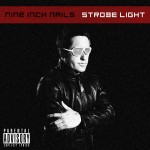
Produced by Timbaland!The April Fool’s joke that got the biggest laugh out of me today was this gag from Trent Reznor, promoting the release of Nine Inch Nails’ newest album, ‘Strobe Light’, produced by R&B/Hip-Hop/Pop producer Timbaland. If that’s not enough to get a laugh, there’s the beautiful tracklisting that spoofs alt.goth culture while coming up with totally off-the-wall ideas for potential collaborators for such an album…

  1. intro skit
  2. everybody’s doing it (featuring chris martin, jay-z AND bono)
  3. black t-shirt
  4. pussygrinder (featuring sheryl crow)
  5. coffin on the dancefloor
  6. this rhythm is infected
  7. slide to the dark side
  8. even closer (featuring justin timberlake and maynard james keenan)
  9. on the list (she’s not)
  10. clap trap crack slap
  11. laid, paid and played (featuring fergie of the black eyed peas and al jourgensen)
  12. feel like being dead again
  13. still hurts (featuring alicia keys)
  14. outro skit

As the day wore on, I started thinking about just why this particular joke appealed to me so much, and why — as horrid as this may seem to some people — yes, I wish this one wasn’t a hoax. If this were a real album, I’d gladly pay good money to pick it up.

Sometime back in 1990 or 1991, I found ‘Pretty Hate Machine‘. I don’t even remember quite how I found it, though I think it was a cassette being passed, copied, and dubbed around the Anchorage alternoscene at the time, spreading the word the way good music does — via word of mouth. You know, exactly the way the music industry does everything in its power to prevent. Anyway.

It’s no exaggeration to say that I got really into NIN…perhaps even minorly obsessed. As the years went by, I grabbed every bit of music I could find that escaped from Trent’s clutches. All of NIN’s albums and singles, bootleg CDs of live albums, side projects, other bands that he did remix or production work for…anything I could find, I snagged. This archived page from my first website (circa 1996) catalogs everything I’d managed to track down at the time (including the Butch Vig remix of ‘Last’ which, when I found it, I’d had to download in five or six chunks and then piece together into a single 2MB .mp3 file in order to listen to it…and since the track is four and a half minutes long, you can guess that it was highly compressed and not very good quality).

Anyway, the point is I was huge into NIN and, more broadly, anything that Trent worked on. As far as I was concerned, he could do no wrong. A big part of why I was such a fan was the breadth of style that Trent’s work encompassed. While yes, all of Trent’s work fits solidly in the ‘industrial’ über-genre, there was a definite sense of progression and evolution to his work between 1988 and 1994. Songwriting, production, the sounds and techniques, all of it grew from album to album.

After ‘The Downward Spiral‘ and its associated remix albums were released, Trent took a bit of a break. During that time, the occasional article would come out detailing Trent’s personal struggles, and occasionally there’d be a interview or two, usually something along the theme of, “what will NIN do next?”

In one of these interviews — and sorry, but I haven’t got a clue when, in what magazine, or in what context this appeared in — Trent was talking about how he’d been listening to a lot of hip-hop, and getting to know and working with a lot of pop and hip-hop artists. He talked about how they’d been influencing his music, and said something about how his next release would probably piss off a lot of his early fans, because of his new inspirations and the new directions he was going to take. About the same time, he did a remix of Puffy Daddy and the Family’s ‘Victory’ that absolutely floored me. I don’t like ‘gangsta’ rap, I’m by no means a fan of P-Diddy, but Trent’s work on that song took the inner-city extroverted rage of the ‘gangsta’ and wrapped it in the distortion-ridden black-clad self-destructive introverted rage of the industrial genre and made it work. Okay, so that description doesn’t exactly make it sound appealing, but hey, that’s what it sounds like to me.

This really exited me. I’ve never been much into rap (and especially hardcore ‘gangsta’ rap), but I’ve often found that that’s less to do with the rapping — I’ve heard some incredible rapping over the years — and more to do with the boring, unimaginative beats and the violent, misogynistic lyrics. Rappers who could do something interesting were fine, and when I’ve found them, I’ve been more than happy to toss money their way (I’ve got a pretty good collection of both The Beastie Boys and Public Enemy, among others [yes, I know…could I be any more of a middle-class white boy?]). Most of it just didn’t catch my interest.

But if Trent could combine his songwriting and production skills with the catchy pop hooks and lyrical skills of some of the best of the hip-hop world? I was really looking forward to seeing what would come out. After his years of coming up with music that I loved, I trusted Trent to find good artists to work with, and even if I didn’t end up liking everything that came out of this “new direction,” I felt sure that there would probably be more than a few gems that would make it worthwhile.

So I waited. Sometimes more patiently than others, but I waited. And eventually, word came out that there was finally going to be a new Nine Inch Nails album. Finally! The day of release, I went to the store and got my copy of ‘The Fragile‘, took it home, put it in my CD player…

…and that was one of only a few times that I’ve bothered to actually listen to that album straight through. For the first time since I’d discovered him, Trent had created a Nine Inch Nails album that, to my ears, was simply “more of the same old thing.” Only it was a little more disappointing than that, it actually felt like it was less of the same old thing. It felt to me like he’d just taken all of the moody, introspective, instrumental or near-instrumental noise collages from ‘The Downward Spiral’ and its two remix albums and stretched them out into two discs worth of droning, with a few tracks that he’d thrown a drum kit at for a little variety.

Obviously, I was let down.

I still have a lot of respect for Trent’s abilities, and I’ve kept an eye on his work since then, but ‘The Fragile’ was the last full album of NIN’s that I’ve bought. I gave the five-dollar version of Ghosts I-IV (which only has Ghosts I, or tracks 1-9 of the full album) a shot, and have been grabbing whatever he releases for free as they’ve been announced (The Slip and the NIN|JA 2009 tour sampler), but still, none of it grabs me. It all feels like as much as Trent has been doing a bang-up job creating (from what I’ve heard and read) incredible live shows, online ‘Alternate Reality Games’ for his albums, and telling the music industry to take a flying leap, his music just doesn’t seem to have gone anywhere since the mid-1990’s.

Or, perhaps, I’m just a stodgy old Elder Goth wannabe, pining for the good old angst-filled days of his black-clad youth. It’s a possibility.

So, when I see the hoax promo page for ‘Strobe Light’, I laugh at the silliness of it all…but I also wish, just a little bit, that it wasn’t a hoax. That Trent had actually followed through with his threats of oh-so-long-ago, gathered together with pop and hip-hop artists, blended and mangled their talents with his, and produced something truly interesting, bridging the brainless shiny of the pop world, the brainless bling of the hip-hop world, and the hopeless angst of the goth/industrial world into one bizarre, but brilliant, whole.

30 Years of CDs

Looks like the venerable Compact Disc turned 30 years old on Sunday.

Compact discs weren’t always impromptu drink coasters. Once, in the not-so-distant past, they played music, contained pictures, and let people play video games with tacked-on FMV sequences. And today, the venerable CD turned 30.

Of course, the CD didn’t immediately take off right then and there…it wouldn’t be until October 1, 1982 that Billy Joel’s 52nd Street became the first CD album released. It was conveniently released in Japan alongside Sony’s brand new CDP-101 Compact Disc player. The album (and more importantly the medium it was pressed upon) changed history, as more compact disc players were introduced into the market beginning in 1983. The music CD would reach its zenith with The Beatles “1” (30 million in sales), before beginning its eventual and inevitable fall to the Mp3 in the mid-2000’s (in 2008, for example, CD sales dropped 20%).

The first CD I ever bought was purchased while on a trip of some sort — I’m not sure, but I think it was during a trip to the Episcopal Youth Event one summer. A group of us Episcopal Youth had flown from Anchorage to Seattle, from whence we’d load up in a van and drive to Missoula, Montana for the EYE. While in Seattle, we got to browse through the Pike Place Market. This was my first time there, and I remember two things clearly: seeing a prop phaser (possibly a replica, though I’ve always remembered it being an original prop) at Golden Age Collectibles for quite a few hundred dollars more than I had available to me; and browsing through one of the music stores in the Market and finding a “Limited Edition” of Queen’s “The Miracle” album.

I didn’t even have a CD player at this point, but this was a limited edition! Who knew how long it would be on the market, or whether we’d ever be able to get it in the frozen wastelands of Alaska! As a Queen fan, I had to have it, and I plunked my money down. Of course, it wasn’t long before I discovered that “Limited Editions” are rarely anything but marketing drivel, but hey, I had my first CD.

(I did this with my DVD collection as well, picking up the original, un-edited release of “The Devil’s Advocate” before that pressing was recalled to have the unauthorized appropriation of the Ex Nihilo sculpture digitally edited out. This time, I’ve got a Special Edition that’s truly special!)

Amusingly, before that point, I wasn’t convinced that CDs were going to take off. In fact, it would be far more accurate to say that I was convinced that they wouldn’t take off. I mean, really, they didn’t seem that that much of an improvement over the tapes I’d been collecting for some time by then. They didn’t seem to sound any different, and you couldn’t even repurpose them when you got tired of the music that was on them! At least with cassettes, you could tape over the little holes at the top and put whatever you wanted on there after you were bored with that album. These CD things would be useless if you decided you didn’t want the music!

Of course, better CD players and better stereos soon convinced me that yes, there was a (very) audible improvement in sound quality, my CD collection soon grew to far outstrip that of my cassette collection, and now the majority of the 1,500-some CDs I own are in storage, while any of that music (and so much more) is available at a moments notice on my computer. And yet, I spend a chunk of my free time importing old LPs, 45s, and 78s to my computer, relishing the warm tones and old, outdated, analog crackles and pops of my collection of vinyl. The more things change, the more they stay the same.

Vinylicious

Introducing a new blog: Vinylicious! I’m no hardcore vinyl collector, but I do keep an eye out for fun oddities to add to the collection I do have (which itself owes a large debt of gratitude to my dad), and I’m planning on using Vinylicious to share some of the goodies I’ve found.

The plan is to update weekly on Sundays with another album. We’ll see how long I can stick to that schedule. ;) For now, I have two albums to get started: Discotheque for Polka Lovers and It Happened in Sun Valley.

The Answer is Probably “Yes”

I’m trying to decide if I’m a hypocrite for being unsure about how I feel about Kid Rock’s new single “All Summer Long” — which, though catchy, is little more than new lyrics on top of the riff from Warren Zevon’s “Werewolves of London” — when I’m sitting on a 10.79 GB collection of 1,462 mashups.

(Update: Y’know, after watching the video, even if I am on the hypocritical side of things, I’m feeling less guilty about it, based solely on the fact that Kid Rock is incredibly skeezy. Ick. I feel dirtier just having watched that.)

(Second update: The worst part is, the song is damn catchy, though that says far less about Kid Rock than it does for Warren Zevon and Lynyrd Skynyrd, whose “Sweet Home Alabama” is also sampled.)

The Phantom of the Opera

Yesterday afternoon, Prairie and I got a call from her sister H offering us tickets to the closing night show of The Phantom of the Opera at the Paramount. She’d gotten sick earlier in the day and just wasn’t up to going out, so she and P decided to see if we wanted to go. We, of course, were happy to take them (after passing on our sympathies, of course), and headed out for an unexpected but not unwelcome night out at the theater.

I’ve grown up with Phantom, from having the soundtrack nearly as long as I can remember to owning the behind-the-scenes book The Complete Phantom of the Opera to having performed a few of the numbers during my days in the Anchorage Children’s Choir, and this was my second time seeing the show. While not unfamiliar with the show — its nearly impossible to have an interest in modern theater culture and not know about Phantom — this was Prairie’s first opportunity to see it on stage.

The show itself, while enjoyable for the spectacle, wasn’t at all a great show. The performances were good, though I wouldn’t really rate them much better than that, and much of the spectacle felt a little rushed, like you didn’t really have time to appreciate the moment before being whisked off to the next scene. There were no flubs, it certainly wasn’t a bad performance, and we both enjoyed the grandeur of the whole thing. It just wasn’t stellar.

Additionally, we’re curious if we might be more appreciative of the less-expensive balcony seats for our next show at the Paramount. Each time we’ve gone to a show and splurged for floor seats, the sound mix in the theater has been surprisingly bad, with the actors overly loud compared to the music and many of the group numbers turning into a muddled, unintelligible mess. We don’t remember having this issue when we’ve seen shows from the balcony, though, so we’re curious if the acoustics in the Paramount happen to favor the balcony. For our next show, we’re going to stay away from the floor and see what we think.

Lastly, two points that I’ve touched on before but that, unfortunately, still need to be addressed (and, realistically, probably aren’t going to change in the foreseeable future):

It’s truly distressing how few people think of theater as Theater (with a capital ‘t’). Both Prairie and I were brought up to see a night out at a show as something special. It’s not something that happens every day (or even every week or month), and so it’s not something to be taken completely casually. It is something that should be dressed for: I’d argue for good business work clothes at the minimum, if you’re not actually going to take the time to dress up. Above all, jeans and t-shirts? Not acceptable!

The crowd at last nights show, admittedly, was a bit better than we’ve seen at other shows in the past. That said, I still hold that ratty jeans and tracksuits should be unacceptable at the theater.

One last thing: a standing ovation should be given for extraordinarily good performances. Not for every performance you happen to be at. Not for slightly above average performances. And certainly not for performances with flubbed lines, broken props, and bad sound. I’ve noticed this trend a lot lately, where it’s more rare to be at a performance that doesn’t get a standing ovation than to be at a performance that does. That’s really not how this is supposed to work, folks. A standing ovation is something special, to be reserved for those truly stand-out performances, not used for every performance you bother to attend.

Prairie and I just sat in our seats last night. The people around us probably thought we were being rude (ironic, given that I had to shoot the twit on my left a few glares when she started singing along with the show), but it just wasn’t an ovation-worthy performance. Good, yes; worthy of applause and appreciation, yes; worthy of a whoopin’ and hollerin’ standing ovation? Certainly not.