Anonymous Astronauts

I haven’t yet read the whole thing, but I’ll (shamelessly) snag the same pullout that John Gruber did when he linked to this piece:

It’s a little strange when you think about it: Just about every American ninth-grader has never lived a moment without astronauts soaring overhead, living in space. But chances are, most ninth-graders don’t know the name of a single active astronaut—many don’t even know that Americans are up there. We’ve got a permanent space colony, inaugurated a year before the setting of the iconic movie 2001: A Space Odyssey. It’s a stunning achievement, and it’s completely ignored.

Trust

There has been a tendency to mock people that want to buy products simply because a certain company makes them. Some will say this type of buyer is being guided by marketing, or is just a follower, but in reality it comes down to trust. Many people trust Apple. It is this very important connection with users that will likely get people to at least try the Apple Watch, and for Apple that is the best outcome they can wish for.

There is a better than 50% chance that I’ll be ordering an Watch on the day they’re added to the Apple Store.

So. Very. S…l…o…w….

WordPress has gotten, really, really slow for me on this site, both on the outward-facing public side, and on the backend. I’m wondering if it might be a side effect of years and years of blogging (building up a total of almost 6,500 posts and almost 13,000 comments), plus trying various plugins here and there that probably often added extra fields to the database. I’m very tempted to do a full nuke-and-pave, exporting all the entries, building a brand-new WordPress install from the ground up, and then re-importing everything, but I worry about breaking all sorts of links (incoming, internal, and images) that I’d likely never have time to go back through and fix. At what point does the hassle of rebuilding stop outweighing the annoyance of a slow website?

No such thing as “just metadata”

With all the recent news concerning the NSA’s surveillance programs (Prism et al.), one of the common defenses has been that for at least some of these programs (though not all), the government is “just” collecting metadata. For example, should the government access your email records, they might not have access to the content of the email, merely the associated data — like who you communicate with, when, how often, who else is included in the messages, and so on.

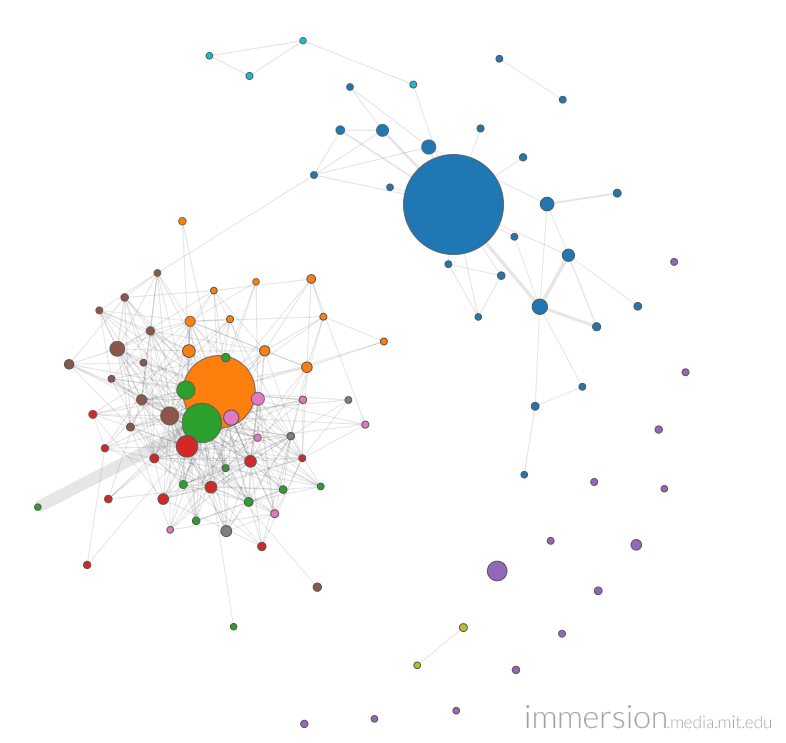
Techdirt has a good overview of why the “it’s just metadata” argument is a foolish argument to make — basically, there is a lot of information that can be derived from “just metadata” — but there’s also an MIT project called “Immersion” (noted in the TechDirt article, though I found it elsewhere) that gives a good visualization of what can be learned from a relatively limited dataset.

Immersion scans your Gmail account (with your explicit permission, of course), and then runs an analysis on the metadata — not the content — of your email history to create a diagram showing you you communicate with and the connections among them.

As an example, here’s my result (with names removed). This is an analysis of almost 52 thousand messages over nearly nine years among 201 separate contacts. Each dot is a single contact, the size of the dot is a measure of how often I’ve communicated with them, and the lines between them show existing relationships between those people (based on messages with multiple recipients).

Immersion Contact Map

In that image, there are two obvious constellations: the blue grouping at the top right are my family and long-time friends; the orange/green/red/brown grouping to the left are my Norwescon contacts. The scattering of purples and yellows are contacts that fall outside of those two primary groups. While there’s not much here of great surprise or import for me, I did already learn one thing of interest — apparently one of my old high school friends has had some amount of contact with one of my Norwescon friends (that’s the single line connecting the two constellations). Now, I have no idea what sort of relationship exists between them — it could be nothing more than my sending a group email that included one and accidentally including the other as part of the group — but some sort of relationship does, and that’s information I didn’t have before.

Now, my metadata is fairly innocuous. But for argument’s sake, suppose I was involved not with Norwescon, but with some other group of people that, for whatever reason, I wanted to keep quiet about. Maybe I’m involved in the local kink scene, and could face repercussions at my job or in my personal life if this became known. Maybe I’m having a gender identity crisis that I’m not comfortable publicly discussing, but have a strong internet-based support group. Maybe I’m part of Anonymous or some similar group, discussing ways to cause mischief. Maybe I’m a whistleblower, and these are my contacts. Maybe I’m a news reporter who has guaranteed anonymity for my sources — but suddenly, this metadata exposes not only who I communicate with, but when and how often, and if there’s a sudden ramp in communication between me and certain contacts in the weeks or months before I break a big story with a lot of anonymous sources, suddenly they’re not so anonymous any more. And, yes, of course, because no list like this would be complete without the modern boogeyman that is the government’s excuse for why this surveillance is necessary — maybe I’m a terrorist. (For the record, I’m none of the above-mentioned things.)

However, of that list of possibilities, terrorism (or, less broadly, investigation of known or suspected crimes) is the only one that the government should really have any interest in, and that’s exactly the kind of investigation that they should be getting warrants for. If they suspect someone, get a warrant, analyze their data, and build a case from there. But analyzing everyone’s data, all the time, without specific need, without specific justification, and without warrants? And then holding on to the data indefinitely, allowing them to troll through it at any time for any reason, whether or not a crime is suspected?

There’s a very good reason why terms like “Orwellian”, “Big Brother”, and “1984” keep coming up in these conversations.

Now PGP-enabled

With all the recent concerns about security and privacy in the world of PRISM, I finally decided to carry through on something I’d considered from time to time in the past, and have set myself up to be able to handle PGP encryption for my mail. I’m using GPGTools for the OS X Mail client and Mailvelope for Chrome when I need web access to my Gmail account.

To be honest, I don’t know how often I’ll actually use PGP for anything other than signing my messages — I can’t think of a time when I’ve ever been truly concerned about what someone might find if they snooped through my email (they’d probably be pretty bored) — but as long as the option is there, might as well make sure I’m set up to use it in case I ever feel the need.

My PGP public key follows:

Read more

You’ve Got A Dirty Speech Synthesizer

An amusing little anecdote about Watson, the IBM supercomputer that was featured on Jeopardy, that might seem a little familiar to those of my friends who are parents:

Two years ago, Brown attempted to teach Watson the Urban Dictionary. The popular website contains definitions for terms ranging from Internet abbreviations like OMG, short for “Oh, my God,” to slang such as “hot mess.”

But Watson couldn’t distinguish between polite language and profanity — which the Urban Dictionary is full of. Watson picked up some bad habits from reading Wikipedia as well. In tests it even used the word “bullshit” in an answer to a researcher’s query.

Ultimately, Brown’s 35-person team developed a filter to keep Watson from swearing and scraped the Urban Dictionary from its memory.

Gee, seems like parenting would be a little easier (if less embarrassing–and, of course, amusing) if the solution was that easy for people!

(via Techdirt)

Input-Only iPad

The iPad has lots of good creation tools, but it really does excel at providing a convenient way to veg out, and as much as I like having it, I think it has been more than a little responsible for my lack of blogging. Why take the time and effort to write anything when it’s so easy to kick back and let page after page of text and images flow past my eyes?

Meanwhile, I’ve neglected posting to Eclecticism; I have probably a few gigabytes of audio ripped from old vinyl waiting to be processed, imported to iTunes, and perhaps posted to Vinylicious; when I bother to pick up my camera, shots sit on the memory card for weeks or months, and then sit in Aperture for months before I finally get around to processing them and posting to my Flickr account; and who knows how many other projects have been left half-finished here and there.

All in all, while it’s been a busy year, on this level it feels like I don’t really have much to show for it.

So: As the iPad does have the capability to be far more than just a portable idiot box, it’s time to start taking advantage of that. I’ve got the iPad, a text editor, a nice little wireless keyboard (the onscreen keyboard works great and all, but it’s best for short bursts of text–tweets, status updates, comments, short emails, etc.–a real keyboard is much nicer for anything longer than one or two paragraphs), and a whole mess of lately underused grey matter rattling around in my skull. In theory, I should be able to put those together and, perhaps, get back in the habit of babbling on a semi-regular basis.