
So…Free Guy is basically The Truman Show, but starring Deadpool, right?
TV And Films
The shows and movies I like (or don’t).
Ghostbusters: Afterlife Trailer
First things first: I really enjoyed the recent Ghostbusters reboot, am disappointed that so many people attacked it and its stars so viciously, and am disappointed that rather than continuing that story, it’s apparently being ignored in favor of continuing the original story. Even some of the statements from the upcoming film’s creators were quite questionable, even if they were quickly walked back afterwards. So when the first trailer dropped today, I went into it with a pretty healthy dose of skepticism.
That said — it’s a good trailer, and while all of the above comments absolutely still apply, I’m now a lot less skeptical than I have been. While I’d still love to see a continuation of the reboot continuity, this new film picking up the original continuity does look promising.
Plus, it was fun watching this for the first time with Prairie, because I didn’t clue her in to what we were watching, and she didn’t realize what it was for until the reveal about halfway through (right at the “Whoa…killer replica!” line). Her final reaction was much the same as mine — still bummed that the reboot is being ignored, but also looking forward to the new film.
RIP D.C. Fontana
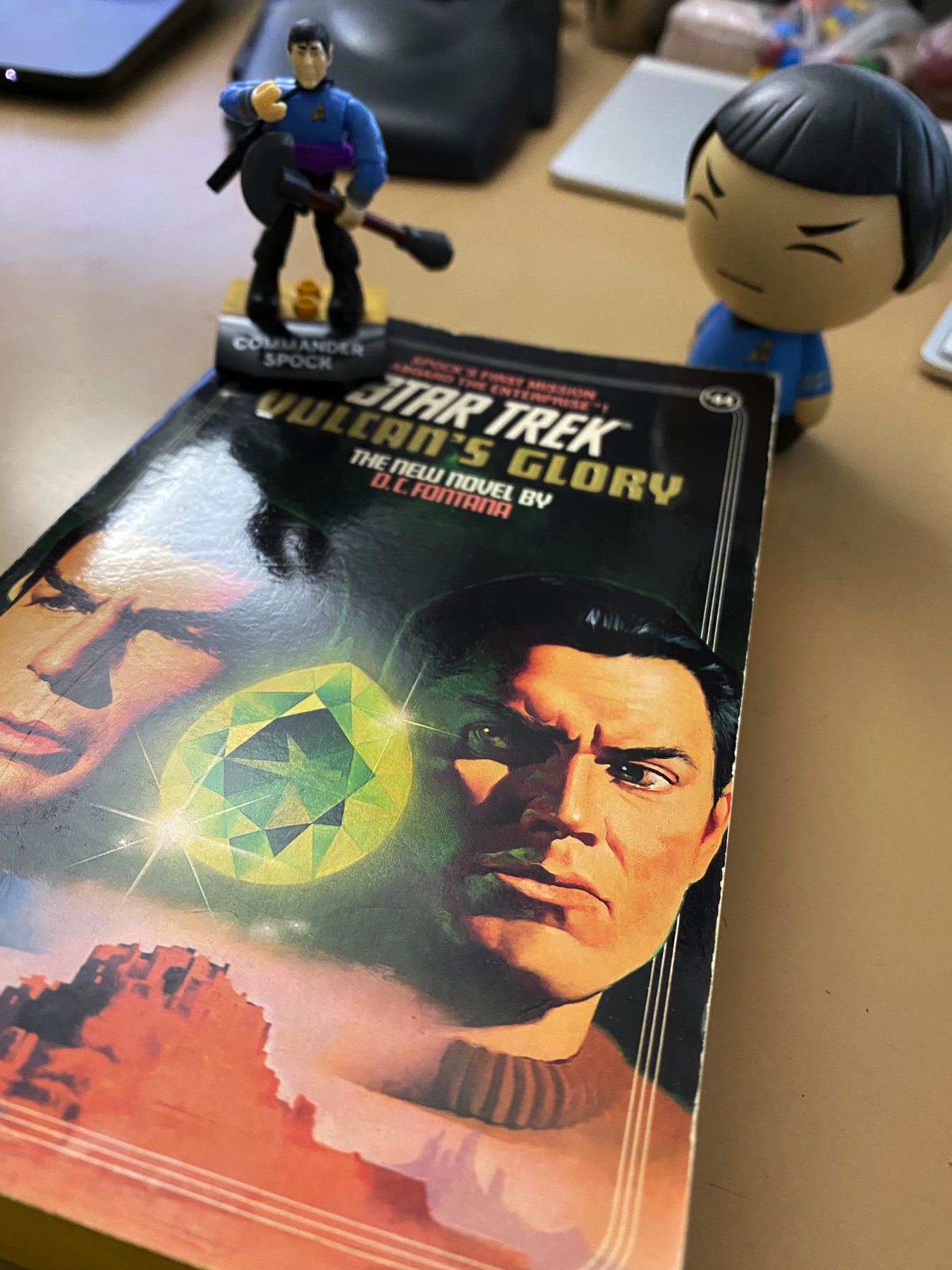
Sad news — D.C. Fontana, one of the pillars of Star Trek, has died.
As a writer, Fontana is credited with many episodes focusing on Vulcan culture and helped blaze a trail for female writers in sci-fi television. She is the mind behind The Original Series and The Animated Series episodes like “Yesteryear” and “Journey to Babel,” which introduced Spock’s father Sarek and mother Amanda. She co-wrote the Hugo Award nominated The Next Generation episode “Encounter at Farpoint” with Gene Rodenberry, and she continued to write for TNG and Deep Space Nine. Her last produced credit was an episode of webseries Star Trek: New Voyages, starring Walter Koenig.
There are no humans in Star Wars.
This should be obvious from the title card. We’re a long time ago, in a galaxy far, far away. Human beings evolved on this planet, Sol 3, over the last sixty million years or so depending on how you count. If we don’t want to go all “Chariots of the Gods?” we have to throw out the notion that the people represented by human actors in Star Wars movies are in fact human. They’re something else.
Why represent them as human? Let’s assume that the Star Wars movies are dramatizations of real history: that Luke, Leia, Han et. al. actually existed in a galaxy long, long ago (etc.), and that George Lucas accessed this history via the Force and wanted to represent it on film. Star Wars tells the story of a dominant-species empire arising from a pluralistic society, then being overthrown by courageous rebels and warrior monks. Lucas had to cast this drama with human actors, and the obvious choice was to use unmodified humans to represent the most common species.
While convenient, this approach does present one problem: watching the Original Trilogy, we assume that the ‘humans’ of the GFFA (Galaxy Far Far Away) are biologically and sociologically identical to Sol 3 humans. When obviously they’re not! In fact, I think a few important context clues present a very different picture of the dominant race of the Original Trilogy.
Read the rest of Max Gladstone’s theory for what he thinks is the most likely answer. From 2013, but I just came across this link today.
Found on Facebook, original creator unknown, but it sure made me laugh. Welcome to the holiday season!

📚 fifty-six of 2019: Taking Wing, by Michael A. Martin and Andy Mangels. ⭐️⭐️⭐️
Captain Riker’s first assignment post-Nemesis. Also, quite coincidentally, in many ways a sequel to the last Trek novel I read, with several direct ties, and by the same authors. 🖖

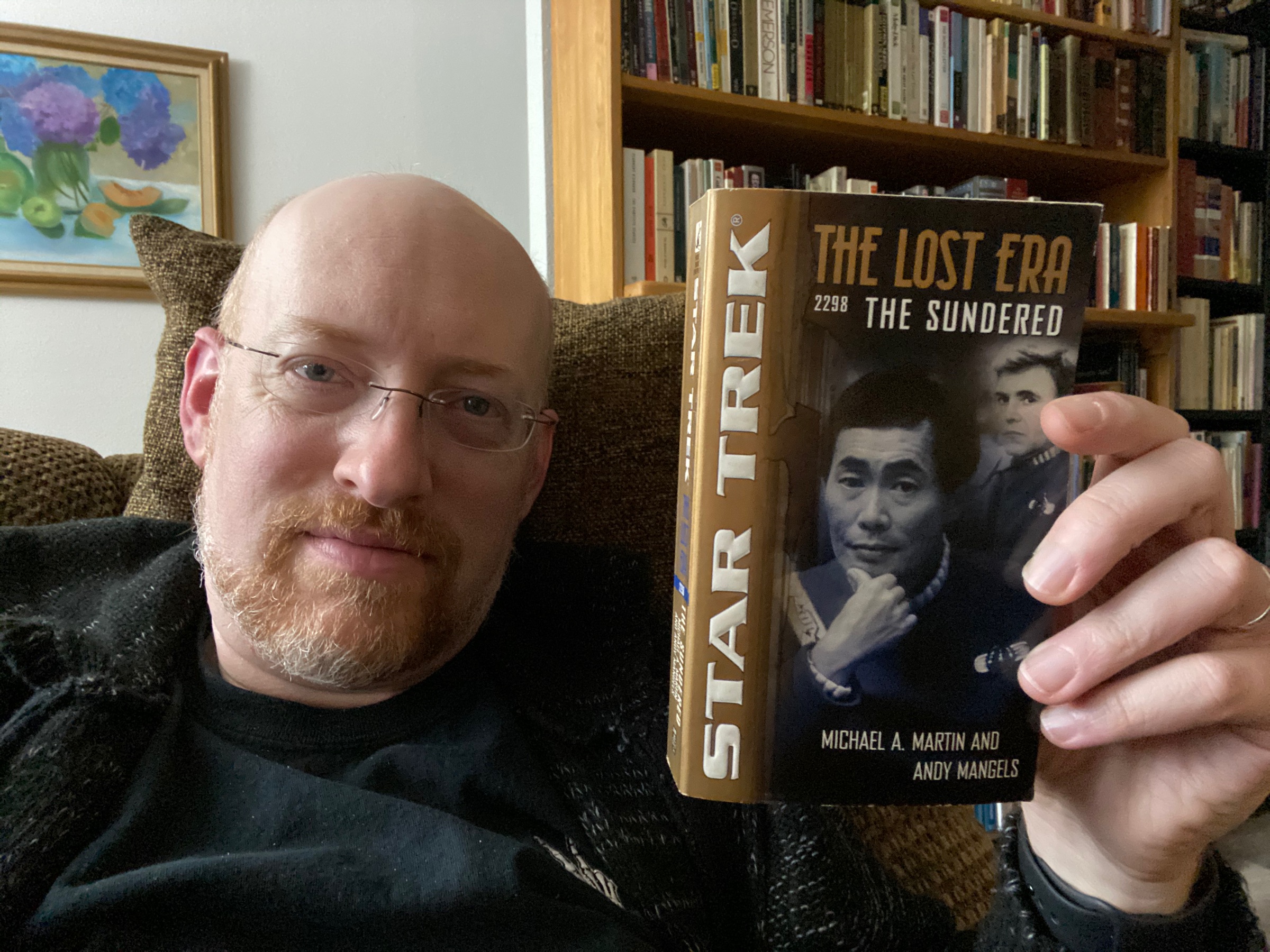
📚 fifty-four of 2019: The Sundered, by Michael A. Martin and Andy Mangels. ⭐️⭐️⭐️
Captain Sulu and the crew of the Excelsior mix it up with Tholians and a mysterious new race with ties to Earth. A good, easy bit of fluff to spend a quiet day reading. 🖖
Monty Python and Enjoying Problematic Media
There are the Monty Python skits everyone knows and remembers fondly. Then…there are the others.
One of the interesting things about going through all four seasons of Monty Python (not watching, but stepping and skimming through as I add chapter markers for the skits to my rips of the just-released restored box set) is realizing just how frequently blackface (and full-body makeup) appears. It’s not every skit or even every episode, but it’s not just a one-off occurrence, either.
I’m sure this isn’t exactly breaking news, nor particularly surprising to those who have a more in-depth familiarity with Monty Python over the years than I have. I watched it in my youth, I know the most popular sketches, have watched and own many of the movies, and so on, but haven’t just sat and watched the shows themselves in ages (and I have to wonder how much the shows I saw were edited for US/PBS broadcast when I was first seeing them). And while the full rewatch will happen a bit later, after I’m done getting the rips chapterized, converted to .mp4, and added to my Plex server, even this quick skim through has been a somewhat eye-opening experience.
This doesn’t mean I’m no longer a fan of Monty Python. But it’s another reminder that it’s okay to be a fan of problematic media, but you should be able and willing to recognize and think critically about those parts that are problematic, rather than just glossing over them or shrugging them off.
Short Treks E07: “Ask Not”: A bit predictable — I figured out what was going on long before the reveal — but still enjoyable, and better than the last two. About those views of Engineering, though…how is there room for all that with all the empty space around the turbolifts? 🖖
Editing Chapter Markers in .mkv files
A gorgeous, fully restored Monty Python’s Flying Circus Norwegian Blu-ray Edition box set has just been released, and while I can definitely say that it looks great, others have reviewed it far more comprehensively than I’m able to do, and if you’re into the technical details, there’s some fascinating information about the restoration process in this article.
However, there is one small thing about the set that is a little unfortunate: Each episode only has three chapter stops.
Since I’m in the habit of ripping all of my DVDs and Blu-rays for storage and playback through my Plex media server, I decided to see if there was something I could do about that. Turns out there is! Here’s a rundown of the process, in case anyone else is curious (or if I need to remind myself how to do it for future projects).
- Rip the disc using MakeMKV to individual .mkv files for each episode (and while you’re doing so, you might want to pay attention to the subtitles as well.
-
For each episode, open the .mkv file with the MKVToolNix GUI. Go to the “Chapter Editor” tab, and (at least in this case) remove the existing chapters.
-
At the same time, open the .mkv file with a video player that allows for frame-by-frame scanning and that can display timecodes down to the millisecond (I use Aegisub).
-
In MKVToolnix, use the “Add Chapter” button to create the first chapter; you’ll see it appear in the “Chapters:” list. Click on the chapter to enable editing. Set the start time to “00:00:00.000”. Optionally (but recommended), set the “Name” for the chapter: This could be as simple as “Chapter 1”, or a more descriptive chapter name (in this particular case, the highly detailed books of notes that came with the Monty Python set came in very handy for identifying the chapters and titles).
-
Scan through the video file with your video player until you find the end point of the opening chapter/beginning point of the next chapter. Read the timecode from the video player, and use that to set the “End:” time in MKVToolnix (for example, “00:00:30.831” is zero hours, zero minutes, 30.831 seconds into the video).
-
Click the “Add chapter” button to add the next chapter, and set its start time to the same timecode as the end time of the prior chapter.
-
Continue on until all chapters have been defined.
-
Once all chapters are defined, in MKVToolnix’s “Chapter Editor” window, choose “Save to Matroska file”. Select the .mkv file you’re working with, and click “Save”. Don’t worry if you get a warning that the file will be replaced, MKVToolnix will only replace the chapter markers, and will not wipe out the rest of the file.
Once that’s done, the .mkv file will have correct chapter markers set. If you then do any further encoding (such as converting from .mkv to .mp4 with Handbrake, which I do for my video storage to save space), those chapter markers will be preserve. This makes skipping around and finding particular points in the video (in this particular case, going directly to specific sketches within each episode) much easier.
It’s the one downside to an otherwise incredible set, and while this solution isn’t exactly simple or fast, neither is it terribly difficult or time consuming, and makes for a much better final experience.
Bonus: If others are ripping their Python box sets and would prefer not to go through the trouble of finding the chapter stops themselves, here’s a 73KB .zip file with .xml files for (nearly*) every episode’s chapter stops as I defined them. These files should be importable into MKVToolnix, replacing steps four through seven above (and saving you a lot of time).
* At present, I’m missing files for episodes 12 and 13 of Series 1, as I seem to have gotten a bad pressing of disc 2 of that set. I’ll add those two episodes and remove this qualifier once I’ve received a replacement disc.