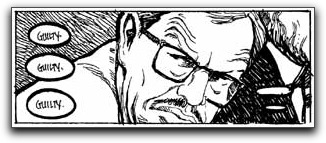
Supreme Court looks at Guantánamo

It’s about damn time.

Setting the stage for a historic clash between presidential and judicial authority in a time of military conflict, the Supreme Court agreed on Monday to decide whether prisoners at the United States naval base at Guantánamo Bay, Cuba, are entitled to access to civilian courts to challenge their open-ended detention.

The court said it would resolve only the jurisdictional question of whether the federal courts can hear such a challenge and not, at this stage, whether these detentions are in fact unconstitutional. Even so, the action was an unmistakable rebuff of the Bush administration’s insistence that the detainees’ status was a question “constitutionally committed to the executive branch” and not the business of the federal courts, as Solicitor General Theodore B. Olson argued in opposition to Supreme Court review.

And in what may be a good sign, it looks like the Supreme Court has decided to play hardball with this case, and make sure that their decision is final:

It was evident on Monday that this, too, was a question on which the justices want to have the final word. That conclusion emerged from a comparison of how the administration phrased the question presented by the two cases with how the justices phrased it in their order granting review. Solicitor General Olson said the question was whether the federal courts had jurisdiction to decide the legality of detaining “aliens captured abroad in connection with ongoing hostilities and held outside the sovereign territory of the United States at the Guantánamo Bay Naval Base, Cuba.”

The Supreme Court, by contrast, said it intended to decide the jurisdiction of the courts to hear challenges to “the legality of the detention of foreign nationals captured abroad in connection with hostilities and incarcerated at the Guantánamo Bay Naval Base, Cuba.” The court’s question incorporated no assumption about whether the base was or was not “outside the sovereign territory of the United States.”

These people have been locked up for over a year and a half, with no legal counsel, no recourse, no charges. With little more than an accusation, they were tossed into a prison out of the public eye where the US could take advantage of the unusual and unclear legal standing of the base to essentially do whatever they wanted without fear of recourse. It’s long past time for this to stop, and for Guantánamo’s prisoners to be given the basic rights that any other prisoner is guaranteed.

Theodicy survey

Dad sent me a link to an interesting survey asking how Christians deal with the question of theodicy.

In its simplest form Theodicy asks the question, “If there is a being, God, who is all powerful, everywhere present, all knowing, all good and loving, why is there so much evil, suffering and pain in the world.” The answers range from, “the existence of evil is proof that such a being does not exist,” to “there is no such thing as real evil.” The discussion fills the halls of academia, the corridors of seminaries and is occasionally addressed from the pulpit, particularly in response to tragedy.

Long-time readers of this site (yeah — all ten of you) will know that while I’m not very active in the church, and certainly have my own fair share of doubts and questions, my core beliefs stem from being brought up in the Episcopal church. While I’d not heard the term theodicy before this (or at least didn’t remember hearing it), the question has come up on occasion over the years, often during conversations when people have expressed surprise that a black-wearing, industrial-music-listening, goth-culture-loving, (ex-)drug-using, GLBT-supporting, open-minded person such as myself would still count their base beliefs as Christian.

Admittedly, the question of theodicy is one of the most difficult out there, and often one of the most difficult to counter when someone tosses it out as one reason that they can’t/don’t/won’t believe in God. As for myself, I’m a firm believer in free will (and, thus, no big fan of predestination theories), and have never believed that God (or the Devil, for that matter) intentionally causes tragedies to happen to people as any form of test. There’s a level of sadism to that belief that has never jibed with my notions of what God — should s/he exist (which as I mentioned above, I do sometimes struggle with) — would be like.

Rather, I believe that there’s a lot of things that happen in this world, both good and bad, natural and man-made, and how we deal with them is what’s important. From natural disasters to people doing horrid things, they don’t happen because “God willed it”, but (as trite as it sounds) simply because these things happen at times. And, in a certain sense, the bad things need to happen for us to appreciate the good, just as much as the good needs to happen for us to cope with and get through the bad. No light without dark, yadda yadda…I’m not explaining it well, and I’m afraid I’m veering frighteningly close to new-age mystic claptrap, but I think you get my overall point.

I’m often reminded of three stories I’ve come across over the years.

The first is one my dad tells about a priest and family friend in Alaska, Fr. Mark Boesser, who would be drawn into conversations with someone either expressing doubts in their faith, or lambasting him about his. At some point he would ask them what sort of God they didn’t believe in, and they would go off, describing a God that constantly wreaks havoc on the world, causes earthquakes that kill off thousands of people, kills babies in their cribs, tears families apart in accidents, gives people debilitating illnesses, and so on. After they wound down, Fr. Boesser would almost always in complete honesty be able to look at them and say, “I don’t blame you — I couldn’t believe in that sort of God either.”

The second is from a book I read a long time ago — unfortunately, I can’t remember which. Someone who has just lost someone close to them (a child, I believe) goes to a priest and demands to know why God would allow such a thing to happen. The priest says something along the lines of, “It is my belief that when your child died, the first tears to fall were God’s.”

The third — well, for the third, you’ll just have to bear with my sense of humor. In James Morrow’s book Only Begotten Daughter, Julie Katz (the daughter of God) is being taken on a tour of hell by Satan. They start debating the question of theodicy, and eventually Satan turns to Julie and says, “Well, just think about it this way. All power corrupts. And absolute power corrupts absolutely.”

iTMS = IotY

Apple’s iTunes Music Store has been named “Invention of the Year” by Time Magazine!

Other inventions this year may have more altruistic intentions (like Dean Kamen’s water purifier) or be more visible on street corners (like those ubiquitous camera cell phones). But for finally finding a middle ground between the foot-dragging record labels and the free-for-all digital pirates and for creating a bandwagon onto which its competitors immediately jumped, Apple’s iTunes Music Store is Time’s Coolest Invention of 2003.

Traditional Christian marriage

The consecration of Gene Robison as bishop of the New Hampshire Diocese of the Episcopal Church is an affront to Christians everywhere. I am just thankful that the church’s founder, Henry VIII, and his wife Catherine of Aragon, and his wife Anne Boleyn, and his wife Jane Seymour, and his wife Anne of Cleves, and his wife Katherine Howard, and his wife Catherine Parr are no longer here to suffer through this assault on traditional Christian marriage.

— Paul Emmons, West Chester University

(via Dori Smith)

Klienfelters Syndrome

While for most people these days, any discussion of men with breasts will immediately lead to quotes from Fight Club (“This is Bob. Bob had bitch tits.”), it’s a very real medical condition called Gynecomastia, sometimes developed as a result of Klienfelter Syndrome.

Klienfelters is a genetic condition, caused and characterized by having an extra bit of gene make up. Where most people have either a 36 YY or 26 XY Genetic make up depending if they are male or female, some people have variations of the standard. Klienfelters Syndrome people typically have a 37XXY Gene. Technically this makes them neither male or female. Klienfelters Syndrome people appear and are accepted as male. In many cases, people who have the condition may not realise they have it.

Some symptoms of Klienfelters include:

  • Slight outward turning of legs, similar to Downs Syndrome.
  • Slight to significant brain retardation and hence slow learning.
  • Problems with linguistics; reading and language skills.
  • Short attention spans.
  • Development of breasts at puberty.
  • Wider hips than normal.
  • Appear to be overweight from puberty (some Internet sites say the opposite).
  • Infertility.
  • Short life spans.

The best and most definitive way to work out if a person has Klienfelters is to have a test for the 37XXY genetic makeup from a blood sample.

I happened across one person’s website about their experiences growing up in a small town with Klienfelters Syndrome.

His story fascinated me. While you’d expect that someone in his position in a small town would be regarded as a “freak” of some sort, he actually was lucky enough to be very accepted by his (predominantly female) family and the community. Raised with three sisters and a mother who didn’t enforce the usual gender stereotypes, he lived mostly as a girl from an early age. At the onset of puberty, the development of his breasts enforced this, and while he knew he was a boy, he was able to spend most of his childhood comfortably, without being ostracized, harassed, or abused by the people around him.

As he grew older and moved out into the world, of course, things didn’t always go as smoothly, and he now lives most of his life in public appearing masculine, but still primarily self-identifying as feminine — though not homosexual — when he’s at home. Even in a society that is (slowly, but finally) becoming more tolerant of homosexuality, trans-gendered people, and the entire GLBT spectrum, it’s interesting to hear from people like this who still “fall through the cracks,” and don’t quite fit into any of the nice, neat little boxes that we’re forever trying to fit people into.

(via Something Positive)

[Update:]{.underline}

Sure, it’s possible that his story is a load of hooey. I still find the gender identity issues interesting.

Feed of the day

Nifty — I have no idea what the selection criteria is (quality? frequency? content? entirely random?) but it seems that I’m being highlighted as “Feed of the day” on Feedster. So…hello to all of you who wander my way!

Employment is a good thing

Oh, by the way…starting Tuesday, I’m working again.

Actually, I’ll be working tomorrow, too, on a one-day assignment from my temp agency. But Tuesday I start training for my new position.

It’s nothing overly glamourous — no dream job, no mind-bogglingly cool opportunities were dropped into my lap during my week of notoriety — but it’s a good steady job, which I’m quite satisfied with. I don’t want to get into too many details (for hopefully obvious reasons), but it’s another quick-print shop, running copiers, dealing with customers, etc. It will do quite nicely for the foreseeable future as I continue to work on getting enough bills paid to be able to investigate loans and grants to get me back into school, which I hope to accomplish in the coming year or so.

In any case, the main thing is that I only had to deal with two weeks of stressing about unemployment. I’m making a bit less than I was before, but not so much so that I have to worry overly much. I just won’t be able to splurge on another new computer anytime soon. ;)

Thanks again to everyone who provided support, through comments, e-mails, messages, phone calls, and everything else.

Taking cues from Reagan

Much as I may dislike Rumsfeld (along with the rest of the Bush administration), I always figured he at least had some amount of intelligence. But this latest “I didn’t say that” spiel is nothing short of ludicrous…

…on Feb. 20, a month before the invasion, Rumsfeld fielded a question about whether Americans would be greeted as liberators if they invaded Iraq.

“Do you expect the invasion, if it comes, to be welcomed by the majority of the civilian population of Iraq?” Jim Lehrer asked the defense secretary on PBS’ “The News Hour.”

“There is no question but that they would be welcomed,” Rumsfeld replied, referring to American forces. “Go back to Afghanistan, the people were in the streets playing music, cheering, flying kites, and doing all the things that the Taliban and the al-Qaeda would not let them do.”

[…]

But on Sept. 25, – a particularly bloody day in which one U.S. soldier was killed in an ambush, eight Iraqi civilians died in a mortar strike and a member of the U.S-appointed governing council died after an assassination attempt five days earlier – Rumsfeld was asked about the surging resistance.

“Before the war in Iraq, you stated the case very eloquently and you said . . . they would welcome us with open arms,” Sinclair Broadcasting anchor Morris Jones said to Rumsfeld as the prelude to a question.

The defense chief quickly cut him off. “Never said that,” he said. “Never did. You may remember it well, but you’re thinking of somebody else. You can’t find, anywhere, me saying anything like either of those two things you just said I said.”

Does Rummy really think he’ll be able to get away with claiming that he didn’t say these things? In today’s ‘net connected world, anything said on the public record is there for good once it propagates into news stories posted across the ‘net.

If Rummy’s memory is really that bad, perhaps Google could help him refresh it with results like this PBS transcript of the interview with Jim Lehrer that the quote comes from. Or this Department of Defense transcript of the same interview.

Let’s try that “You can’t find, anywhere, me saying anything like either of those two things you just said I said,” statement again, shall we?

(via Will)

I'm such an underachiever

Some days I think I’m doing okay in my life. I may not have a set career or a ton of money or anything along those lines, but I’m not doing too badly.

Then, I find things like this: Things Other People Accomplished When They Were Your Age

At age 30:

Mark Twain published his first short story, “Jim Smiley and His Jumping Frog.”

Danish novelist Hans Christian Andersen published his book of fairy tales.

Nat Turner led a slave rebellion.

U.S. mariner Moses Rogers made the first ocean steamboat voyage.

Donald Trump persuaded bankers to lend him \$80 million so he could buy the Commodore Hotel.

Samuel Morse’s assistant, Alfred Lewis Vail, devised Morse code.

Physicist Armand H. L. Fizeau measured the speed of light.

Dr. Narinder Kapany invented fiber optics and designed a glass gastroscope which can be snaked down the throat for a detailed view of the stomach.

Hank Williams overdosed on drugs and alcohol.

Bill Gates was the first person ever to become a billionaire by age 30.

Earl Vickers started the Dollar Project, in which dollar bills were rubber-stamped as being lost, with a reward offered for their safe return.

(via MeFi)

The Purity of the English Language

The problem with defending the purity of the English language is that English is about as pure as a cribhouse whore. We don’t just borrow words; on occasion, English has pursued other languages down alleyways to beat them unconscious and rifle their pockets for new vocabulary.

James D. Nicoll