No Olympics For Us

While it’s not quite to the point of being what I’d call a “boycott,” it’s looking like the chances are extremely slim that we’re going to be watching much of this year’s Olympic coverage. We’d like to, but NBC has done a marvelous job of ensuring that we either can’t watch, or when we can, we don’t want to.

We just tried to watch some of this afternoon’s coverage. In the roughly fifteen minutes before we couldn’t take it any longer, we saw three commercial breaks, four talking heads (with audio lagging about a second behind the video feed), a bit of an interview with the first medalist from this year’s games, and eight-year-old footage from that same athlete’s first win in 2002. We listened to Bob Costas tell us that he was in Vancouver and that there were sports going on. We heard — again — about the accidental death on the luge track. We heard an interviewer ask an athlete “how he did it” after winning (um, he practiced his ass off, you idiot — why are sports interviewers always at the very bottom of the “stupid interview question” scale?).

What we didn’t see was any actual sports footage.

Oh, how I miss watching the last Summer Olympics on CBC, the Canadian network that Comcast carries locally. Their coverage was leagues better than anything NBC had: fewer inane talking heads (which can be interpreted as fewer talking heads overall or less inanity from the talking heads they had, either of which is an acceptable and correct reading); less “we’re the only country that matters” mentality; comprehensive coverage of all sorts of sports, even those that are less massively popular; and coverage that wasn’t constantly cut into with edits, updates, promises of what’s to come, and commercials (we spent one afternoon watching an entire marathon nearly commercial free, in part because we could, and in part because it was far more interesting than we’d ever realized, simply by virtue of actually being able to watch it). The realization that CBC wouldn’t be broadcasting the Olympics this year — and, further, that the Canadian network that got the contract isn’t viewable locally — was a sad one indeed.

Lately, we’ve been enjoying my new computer’s ability to watch streaming video sites like Hulu and Netflix, so I went to the NBC Olympics site to see what was available there. They’re posting a number of videos of stuff that has already happened, but prominently displayed on the main page is a live video stream (only active at particular times and for particular events, however). I click that, and am asked to tell NBC who my cable or Internet provider is. Apparently, NBC will only serve the live video to customers of certain other companies that they have contracts with. Annoying, but hey, Comcast is right near the top of the list, and we have Comcast cable, so we should be good.

After choosing Comcast, I get directed to a Comcast login page. I log in to Comcast, and they direct me back to the video stream…which tells me I’m not eligible. What? I go through the process again, and this time, work my way through until I discover that even though NBC has a contract with Comcast, and even though I’m a Comcast cable subscriber, I’m not the right kind of Comcast cable subscriber.

See, Prairie and I don’t watch a ton of TV, don’t see the need to pay ridiculous amounts of money for hundreds of channels we’ll never watch, and don’t even have a digital TV — both of our TVs are old, square, analog sets. So, there’s no reason for us to subscribe to digital cable, and we’re quite happy with our $15/month bare bones, completely basic, plug-the-cable-into-the-back-of-the-TV-set package (and honestly, we wouldn’t even bother with that if we got decent over-the-air reception with a digital receiver box, but OTA digital TV is essentially nonexistent in the Kent Valley). However, it appears that Comcast has decided that people like us don’t count, and is only sending the video streams to customers who subscribe to a digital cable package.

Crappy.

Out of curiosity, I took a look at Comcast’s website — and after poking around there, I think that digital cable prices might be one of the biggest arguments against upgrading our TVs until we absolutely have to (when they die, that is). Right now, we’re paying $15/month for a bare-bones package that serves us more than adequately — in fact, we only pay attention to about 7 of the 30-some channels that are part of the package, so there’s an argument to be made that even now, we’re over paying. If we were to upgrade to a digital cable package, the least expensive package available is $60 a month! Of course, what the website says is $30/month, but that’s only for the first six months. I can’t think of any reason why I’d want to quadruple what I’m currently paying so that I can have more crap that I’m not interested in piped into my home, no matter how pretty it is or how much of it has surround sound.

Further down the page, they mention a “Digital Economy Package,” apparently aimed at people like us, that actually is $30/month — but, of course, you can only get that if you also get your phone and/or internet through Comcast, which we don’t. So, once again, that’s not an option.

(Heading off counter-arguments: satellite TV isn’t an option, our apartment faces the wrong direction; and outlying the money for a HTPC/Media Center of some sort isn’t a realistic option for both budgetary reasons and that nagging little fact that we’re still using “old school” TV sets. I’ve got a very nice Sony TV set that’s only eight years old, and my parents have a Sony TV set that’s in its 30s and still working, so we may well not be upgrading our hardware for a long time to come.)

The end result of all of this? NBC can bite me, Comcast can bite me, and the Olympics — well, it’s not really their fault, but come on.

Links for February 3rd through February 12th

Sometime between February 3rd and February 12th, I thought this stuff was interesting. You might think so too!

  • Now You Can Facebook Chat Through iChat: "The set-up is pretty easy. All you do is go to the iChat's 'Preferences', menu, click 'Accounts' add a new account, select 'Jabber' from the pull-down menu and then type in your screen name (username@chat.facebook.com) and password. You then edit your 'Server Options' to point to chat.facebook.com at port 5222, unticking SSL as you go. Click OK and you're all set to harass and be harassed by Facebook friends through iChat at any time."
  • How to Create a Google Buzz Desktop App: "If you've used Buzz in its two current versions, inside Gmail and on the iPhone, you've probably noticed (like me) that the iPhone web app version is much better. Here's a quick little howto to take advantage of the much less clunky mobile UI for Buzz — assuming you're on a Mac." I'm actually not sure if I'm going to run this much, but I'm experimenting with it.
  • Deckle Edge in the Age of Mechanical Reproduction: "The deckle edge dates back to a time when you used to need a knife to read a book. Those rough edges simulate the look of pages that have been sliced open by the reader. The printing happened on large sheets of paper which were then folded into rectangles the size of the finished pages and bound. The reader then sliced open the folds. Paper knives, variants of letter openers, were used for this purpose."
  • Pepsi Skips Super Bowl TV Advertising for Social Media: "Instead of pouring millions of dollars into a Super Bowl commercial, Pepsi has started a social-media campaign to promote its 'Pepsi Refresh' initiative. Pepsi plans to give away $20 million in grant money to fund projects in six categories: health, arts and culture, food and shelter, the planet, neighborhoods and education. People can go to the Pepsi website refresheverything.com — which can also be accessed through Facebook and Twitter — to both submit ideas and vote on others they find appealing. Among those on the site now: 'Help free healthcare clinic expand services to uninsured in rural TN' and 'Build a fitness center for all students in Hays, Kansas community.' Every month, the company will offer up to 32 grants to worthy projects."
  • Confused by the ‘Lost’ Premiere? Never Fear! Damon and Carlton Explain a Few Things About the Start of Season 6 (SPOILERS AHEAD): "Warning, SPOILERS ahead. If you haven't seen the season premiere of Lost yet, you might not want to continue past the jump yet. Lost fans who have now seen the premiere can read ahead for some explanation from Carlton Cuse and Damon Lindelof. (Comments are likely to be full of spoilers also, you've been warned again.)"

Seattle Metro Tunnel Beating

This is one of the most disturbing local stories I’ve seen in a long time. A 15-year old girl was targeted by a group of other teens at Westlake Center. She and her friend went down to the Metro Transit tunnel to try to get away from the group. Once on the tunnel platform, they approached the security guards to try to get some assistance or protection from the group that was following them.

The guards, however, did nothing — even when the group arrived and one of the teens was attacked, shoved off the platform (thankfully, no buses or trains were present), followed back onto the platform, knocked to the ground, and then repeatedly kicked in the head until she was left unconscious.

Here’s a local news report with security footage of the attack. This is not pleasant to watch.

There are so many things to be outraged at.

Apparently, the ‘security’ people are contract workers, authorized only to “observe and report” suspicious activity and attacks. This has been the standard party line from Olympic Security and from a number of other officials commenting on the incident, and their protestations of being “extremely disappointed” in the security guards just doesn’t compensate.

The girl approached the guards and requested assistance. Instead, they turned away from her. She tried to keep one of the guards between her and her attacker, and neither that guard nor either of his partners made any attempt to intervene or do anything except the contractually required radio call to the police. One guard actually walks away during the attack. Ten blows to the head and six kicks to the head later, they continue to watch as the attacker comes back for a final kick to the head.

There is no excuse, not even the “observe and report” language in the contract, that justifies the guards behavior in this instance.

They could have paid attention to the girl about to be attacked. They could have worked together to form a barrier between her and the group of teens. They could have surrounded her to keep her attacker away. They could have moved to block her attacker from coming back for that final kick. They could have made any number of non-aggressive attempts to intervene that would not have involved directly contacting any of the group of teens threatening the girl.

Futhermore, thanks to Washington’s “Good Samaritan” law, at the very least, they could have assisted her after the attack without fear of liability, instead of standing around her unconscious body. Even more importantly, according to this article, Washington has had a “Good Samaritan” law on the books since 2005 that “makes it a misdemeanor offense to fail to assist a person who has suffered substantial bodily harm, provided that the person could reasonably summon assistance without danger to himself or herself.” Unfortunately, I’m currently having trouble finding the exact language of the referenced statute.

Of course, that brings up a second point. The witness interviewed in the above video describes standing there, watching the attack, and wondering, “Why doesn’t anybody do something?” Well, lady? Why not? Why didn’t you do something? Why didn’t anyone else do something? Why didn’t any of the other people on the platform do something? I’m not even talking about physically restraining the attacker or accosting any of the rest of the group, just get close, surround the victim, get some sort of barrier between her and her attacker.

Don’t wait for someone else to do something, because they’re all doing the same thing.

This whole thing is just disgusting.

Another troubling aspect to this that I’d thought a little about, but was brought up in a comment on the LiveJournal mirror of this post (which, unfortunately, appears to have been eaten when I updated this post with the news reports below):

A bigger problem, however, is that this incident has shown to everyone just how powerless the security guards are, so I would imagine that if people are inclined to commit violence against someone else at the bus stop, they know they an do it now without ANY fear of retribution.

Exactly. Given what we’ve seen, just what is the function of the “security” guards? And what’s to prevent more frequent and more severe attacks from happening, now that it’s been made abundantly clear just how little protection these guards actually provide?

More reports:

Tunnel assault on girl sparks security debate:

King County Metro Transit will change its security policy in the Downtown Transit Tunnel after a surveillance video showed a 15-year-old girl beaten in front of three security guards who didn’t intervene to help her, an agency official said Wednesday.

In the meantime, county officials have called for a full review of tunnel security practices.

Four charged in transit tunnel beating:

On Wednesday, prosecutors filed first-degree robbery charges in King County Superior Court against Latroy Demarcus Hayman, 20, Tyrone Jamez Watson, 18, and Dominique Lee Whitaker, 18. A 15-year-old girl was also charged in juvenile court.

Speaking with detectives, the girl said she’d expected the guards to come to her aid.

“I thought the security guards would defend me if (the 15-year-old) tried anything,” the girl said, according to court documents.

Following the attack, the girl said the same Seattle police officers who’d contacted her previously refused to take action.

Admittedly agitated, the girl said she tried to tell the officers she’d been assaulted, according to court documents. When they did not assist her, she called her mother.

Her mother arrived at the scene, the girl told detectives, and contacted the officers on her daughter’s behalf.

“They told my mom that they were tired of all these kids downtown causing trouble,” the girl told police.

“It seemed like (one) officer put us all in one category,” the girl continued. “We were fed up with Seattle police but we wanted to press charges. It didn’t seem like the officers were (ever) interested in hearing my side of what happened.”

Managing Inbox Overload with Google Buzz

My Google account just got set up with Google Buzz, the new social networking addition to Google’s stable. One of the first things I noticed was that this could be a recipe for inbox overload, as every new reply to something I’ve posted or replied to ends up as a new message in my inbox.

Inbox Overload

Simple solution: set up a filter. Here’s the settings I used…

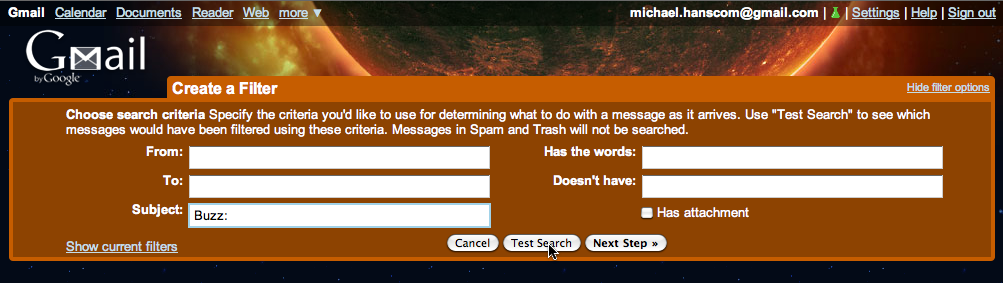
  1. Click the “Create a filter” option just to the right of the search box and related buttons towards the top of the screen.

    Create a Filter

  2. Enter “Buzz” in the “Subject” field of the filter options box, then run a test search. Unfortunately, this will catch any message that uses the word “buzz” in the subject line, and from my testing, neither adding a colon (“Buzz:”) or surrounding the word with quotation marks makes a difference. I can’t currently find a way to force the filter to grab only messages that begin with the word “Buzz” so caveat emptor. If your test search looks acceptable, click “Next Step”.

    As has been pointed out to me by a few people, and posted here: Enter “label:buzz” in the “Has the words:” field of the options box. Google will pop up a warning, but go ahead and ignore it.

    Filter Options Screen One

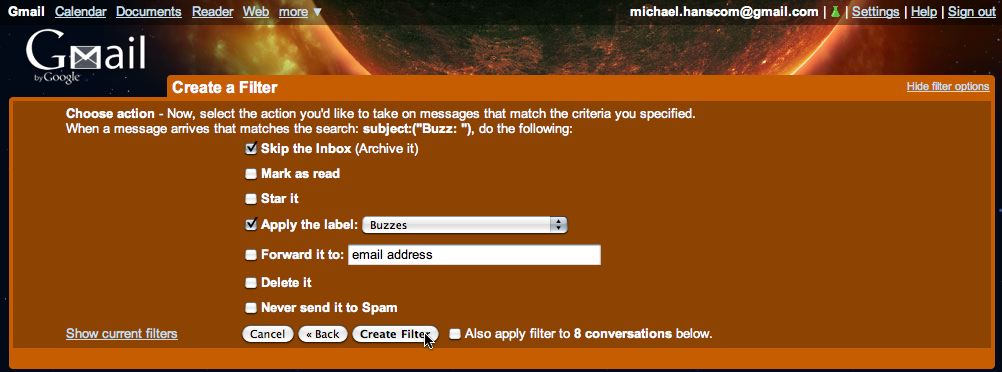
  3. In the next screen, activate “Skip the Inbox (Archive it)” and “Apply the label:”, then create a new label titled “Buzzes” (or whatever you want, but you can’t use “Buzz”). If you want, click the checkbox to apply the filter retroactively to the messages caught by the filter’s test run. Then click “Create Filter”.

    Filter Options Screen Two

  4. You’re done!

From now on, rather than getting flooded with inbox messages every time a new Buzz response pops up, you’ll have a little ‘Buzzes’ filter sitting to the left of your screen. If it’s bold, you’ve got a response waiting for you. And that’s it!

Comparisons

Countries that forbid gays in their military: Cuba, China, Egypt, Greece, Iran, Jamaica, North Korea, Pakistan, Russia, Saudi Arabia, Serbia, Singapore, South Korea, Syria, Turkey, Venezuela, Yemen, the USA.

Countries that allow gays to serve in their military: Argentina, Australia, Austria, Belgium, Bermuda, Brazil, Canada, Czech Republic, Denmark, Estonia, Finland, France, Germany, Ireland, Israel, Italy, Lithuania, Luxembourg, Netherlands, New Zealand, Norway, Peru, the Philippines, Romania, Slovenia, South Africa, Spain, Sweden, Switzerland, the UK, Uruguay.

Which list would you rather be associated with?

Fnarf, in a comment on the Slog

Links for January 26th through February 1st

Sometime between January 26th and February 1st, I thought this stuff was interesting. You might think so too!

  • Why Are You So Terribly Disappointing?: "Big f–ing deal. We just do not care. It's all a big disappointment. Hey, I was expecting to be blown away. I was expecting miracles and transformations and multiple twitching orgasms on sight. Do not come at me with tantalizing promises only to reveal that you can fulfill most of them to a fairly good degree, and not far exceed all of them in every imaginable way. We're Americans, goddammit. Ye shall know us by the tang of our bitter and untenable jadedness."
  • Many Successful Gay Marriages Share an Open Secret: "A study to be released next month is offering a rare glimpse inside gay relationships and reveals that monogamy is not a central feature for many. Some gay men and lesbians argue that, as a result, they have stronger, longer-lasting and more honest relationships. And while that may sound counterintuitive, some experts say boundary-challenging gay relationships represent an evolution in marriage — one that might point the way for the survival of the institution."
  • Mathematician Uses SETI Formula to Determine He Has a 0.00034% Chance of Getting Laid: "Backus has modeled his search for a human being on a planet coated with human beings by using an equation designed to locate communicative civilizations in the vast reaches of our galaxy. What does that mean? He's assuming that 'women I can have sex with' and 'communicative aliens' are roughly comparable values. If you consider the rest of the Drake Equation, that would make most women into the equivalent of dead planets, empty space, and alien life without intelligence. A tiny percentage of those women might not be dead or empty. An even tinier percentage could communicate intelligently, but possibly not during his lifetime."
  • Football Games Have 11 Minutes of Action: "According to a Wall Street Journal study of four recent broadcasts, and similar estimates by researchers, the average amount of time the ball is in play on the field during an NFL game is about 11 minutes. So what do the networks do with the other 174 minutes in a typical broadcast? Not surprisingly, commercials take up about an hour. As many as 75 minutes, or about 60% of the total air time, excluding commercials, is spent on shots of players huddling, standing at the line of scrimmage or just generally milling about between snaps." And people wonder why I have absolutely no interest in football. Yikes.
  • El Nino Helping Green River Valley Avoid Floods: "Cliff Mass, professor of atmospheric science at the University of Washington, said the current mild weather could lead to Seattle's warmest January on record. And in this region, he said, 'Once you get past the 20th of February, one month from now, I mean, winter's over.' For those living and working below the dam, 'I think they're home free at this point,' he said."

Thoughts on the iPad

I’ll admit it (not that it’ll be much of a surprise, as some have pointed out, I do occasionally bear some resemblance to this fine gentleman), I’ve got some serious Apple lust going on right now.

No, I’m not going to be lining up to be one of the first to get an iPad, for two primary reasons: one, experience has taught me that sometimes, it’s best to wait for the second generation of a new Apple device; two, I have a perfectly functional laptop (even if it is heavy, clunky, and Windows based). However, once that laptop goes away, I’ll likely be snapping up whatever the current generation of the iPad is at that point.

These concerns, originally posted on Facebook, about the iPad’s physical feature set…

bah…it’s not that impressive. With no ports, USB, HDMI, or a kick-stand; it’s just a gigantic iPod touch with an AT&T option.

I’ll wait for the next version. 1/2 the thickness, 1/3 more of everything, delivered by unicorns and doubles as a USB3 hub with a port every 2 mm around the shell.

…prompted the following response (though I’ll admit I would love to have my tech goodies delivered by unicorns).


See, for me, it looks to be about the perfect on-the-go machine.

For my main machine, I’ve always preferred a desktop. Laptops make acceptable secondary machines, but for me, they’ve always been overkill: too big, too heavy, too bulky and awkward, especially as their main purpose (for me) is simply to supplement my “real” computer. I’ve never needed a laptop that would do everything.

Up ’til now, netbooks have looked promising, but are only (officially) Windows-based (and I’m at a point where I’m less interested in jumping through the hoops to make a Hackintosh); Apple’s MacBook Air looked promising, but is too expensive; for carrying around and having access to information, my iPod Touch is nearly perfect, but is still more of an information viewer than something I can do things with. If I want to quickly check in with the world, look something up, or glance over notes for school, the iPod’s great, if I want to do much of anything more intensive than that, I have to lug around a big, clunky laptop.

The iPad looks to sit right in the sweet spot. A very focused device, doesn’t have a lot of unnecessary crap bulking it up, small and light enough that I’d be comfortable carrying it around in my bag, and with the combination of compatibility with existing iPhone apps and the new iPad versions of the iWork suite (I use the desktop version of iWork for all my work at home), I’d be able to take notes, work on schoolwork, and do everything I’d want to do while out and about.

Ports and a kickstand? The kickstand would likely be aesthetically questionable (especially from Jobs’ viewpoint), and take away a certain amount of space o the case that currently is being used for, oh, the guts of the thing. Obviously, as they’re introducing two docks and a case designed to support the iPad at introduction, they’re aware of the want and need to be able to prop it up, but (unsurprisingly for Apple), weren’t willing to sacrifice on the pretty. Besides, a flip-out/snap-in kickstand would be a potential point of physical failure.

Ports: really, how often do you use the ports on a mobile machine? And which ones? I’d bet the majority of laptops only ever use the USB port and/or the video-out port when connecting to projectors, both of which are accounted for in some way on the iPad. The rest just serve as receptors for things you could do, and might do, but don’t do, and hey, there’s a way for dirt, dust, grit, and liquid to get into your computer.

USB: I honestly don’t know what I’d want a dedicated USB port for. USB key for transferring documents? The iPad syncs with your computer and syncs its document folder that way, or use Dropbox and stop worrying about carrying around USB keys at all (my personal choice, Dropbox is incredibly handy). Keyboard input? Either use Apple’s keyboard stand, which also supports the iPad in a monitor-style configuration, or use any Bluetooth wireless keyboard with the iPad. Camera connection? I’m not going to be using the iPad for photo work, but for those who are, yeah, you’re going to have to spring for Apple’s dock connector-to-USB dongle, sorry…but adding a standard USB port would have made the iPad thicker than it is.

Video out/HDMI: It’s already been confirmed that the iPad will support 720p videos from iTunes, and that there will be video out (for projectors) through the dock connector. I’d assume that eventually, there will be an iPad-to-HDMI option. Once again, building in an HDMI port would have made the iPad thicker than it is.

If I didn’t already have a perfectly-functional-even-if-I-don’t-like-it-all-that-much Windows based laptop, I’d be preordering an iPad the first day they’re in the Apple Store. As it is, I’ll likely be grabbing whatever the current version is the day our laptop dies.

Microsoft Excel .xls and .xlsx weirdness

I’ve been attempting to troubleshoot some issues with sending Excel files back and forth between my Mac at home and a professor who uses a Mac at home and a Windows PC at school. Even though we’re both using current versions of Excel, and though the files opened fine on her Mac, she was having consistent problems on the Windows machine.

After a few days of back-and-forth and trying to narrow things down, here’s what I’ve come up with.

For some reason, though Excel:mac2008 (hey, that’s how the ‘About’ screen writes the product name, don’t blame me) uses the new XML-based file structure, when saving files, it uses the old standard .xls file extension. Oddly, at least on my machine, it is behaving like this even though Preferences… > Compatibility > Transition > Save files in this format: is set to “Excel Workbook (.xlsx)”.

(And as an aside, why must there be an open workbook to access Excel’s preferences dialog box?)

Current versions of Excel on the Windows side of the fence, however, use (and expect) the .xlsx extension. Same file types, but different extensions, and this causes confusion. When Excel (Windows) sees the .xls extension, it expects a different type of data than it does when opening a document with the .xlsx extension, and it chokes when attempting to open the file.

The solution? Manually change the extension to .xlsx before e-mailing the file.

Sigh.

Links for January 20th through January 26th

Sometime between January 20th and January 26th, I thought this stuff was interesting. You might think so too!

  • Here comes the new cell phone etiquette: "It's easy to be rude with a cell phone. A visitor from another planet might conclude that rudeness is a cell phone's main purpose. Random, annoying ring tones go off unexpectedly. People talk too loudly on cell phones in public because of the challenge of holding a conversation in a noisy environment with someone who's not present. Cell phones need their own rules of etiquette, or we'll descend into social barbarism. But cell phones — and the ways we use them — change. In the past three years, the whole world of cell phones has evolved so much that we need some additional rules of etiquette."
  • Menifee school officials remove dictionary over term ‘oral sex’: "After a parent complained about an elementary school student stumbling across 'oral sex' in a classroom dictionary, Menifee Union School District officials decided to pull Merriam Webster's 10th edition from all school shelves earlier this week. School officials will review the dictionary to decide if it should be permanently banned because of the 'sexually graphic' entry, said district spokeswoman Betti Cadmus. 'It's just not age appropriate,' said Cadmus, adding that this is the first time a book has been removed from classrooms throughout the district. 'It's hard to sit and read the dictionary, but we'll be looking to find other things of a graphic nature,' Cadmus said." Ugh. See also: the followup article, in which a committee will determine the curriculum applicability and educational appropriateness of the dictionary.
  • The Cost of Care: "The United States spends more on medical care per person than any country, yet life expectancy is shorter than in most other developed nations and many developing ones. Lack of health insurance is a factor in life span and contributes to an estimated 45,000 deaths a year. Why the high cost? The U.S. has a fee-for-service system–paying medical providers piecemeal for appointments, surgery, and the like. That can lead to unneeded treatment that doesn't reliably improve a patient's health. Says Gerard Anderson, a professor at Johns Hopkins Bloomberg School of Public Health who studies health insurance worldwide, 'More care does not necessarily mean better care.'"
  • The Science & the Fiction: "It is impossible to determine just how much science misinformation audiences retain, but it’s safe to say the minuscule amount of good science in the movies is entirely outgunned. After combing through a vast library of science fiction flicks both sublime and ridiculous, your intrepid Bad Astronomer sat down to explain the best and worst of movie science. So grab some popcorn, relax, and be glad that when the lights go back up, the real universe will still be out there for us to enjoy."
  • Christopher Hitchens on "Like": "The actual grammatical battle was probably lost as far back as 1954, when Winston announced that its latest smoke 'tasted good, like a cigarette should.' Complaints from sticklers that this should have been 'as a cigarette should' (or, in my view, 'as a cigarette ought to do') were met by a second ad in which a gray-bunned schoolmarm type was taunted by cheery consumers asking, 'What do you want, good grammar or good taste?' "