
West Side Story (2021): ⭐️⭐️⭐️⭐️: An excellent version. Some parts I like as much as or better than the original, other parts the original still wins out. And, unfortunately, Tony is where this one falters the most, and keeps it from equaling or surpassing the original.
 Michael Hanscom
Scaling Back Star Trek
Adapted from a Twitter thread:
My biggest hope for Star Trek going forward (Strange New Worlds, Discovery S5, whatever else comes out) is that the writers rediscover the ability to tell small stories.
Disco S1 was the Klingon/Federation war, with a half-season jaunt into the Mirror Universe that removed the Emperor of the Terran Empire, returning to a decimated Federation. S2 was the Red Angel and the battle against Section 31’s Control to save all life in the galaxy. S3 had a shattered Federation because of the Burn, which destroyed most of Starfleet and nearly entirely wiped out warp drive; the actual damage and death toll (both immediate and long-term from the lack of intersystem transportation) is never specified but likely isn’t small. And then S4 had the entire galaxy at risk from a randomly moving literally-planet-shattering device, with at least one inhabited planet destroyed and Ni’Var and Earth under threat (because, of course, Earth must be under threat of destruction fairly regularly).
Then in Star Trek Picard S1 we have synthetics on a mission to destroy all organic life before they can be destroyed. S2 ups the stakes from there with a timeline variant that has altered the course of the entire known galaxy.
It seems like every season of every show has to have some sort of Big Bad that is Bigger and Badder than the last Big Bad. The stakes are always so high that it’s become virtually meaningless. One death is a tragedy, millions are a statistic, billions are a plot device.
This is part of where the first season of Prodigy has been a bit of a breath of fresh air. So far, at least, it’s been relatively small-scale: One group of young adventurers finding a ship and trying to escape their captor. There are signs, of course, that this may change, with the Protostar apparently carrying some sort of viral doomsday weapon that could wipe out Starfleet. Which…well. Here we go again. Why must everything be super-sized?
Lower Decks is the sole entry that has been doing well at having a more focused, smaller scale. Whether intentional or a side effect of having lower deck crew for main characters, it hasn’t gone too large-scale (or when it has, it’s been in the background and we only get hints for comedic effect).
Maybe the stated goal of going back to a more “planet of the week” format for Strange New Worlds will also mean that not every event will be an EVENT. I really hope so. Because while yes, sometimes it can be fun to have a Big Bad that’s Very Big and Very Bad, if you do that every time, it ceases to be particularly interesting.
Big drama can come from small events. Not every threat has to be planet-, system-, galaxy-, or universe-spanning to be threatening.
None of this is to say that I haven’t been enjoying the modern reinvigoration of the Star Trek universe. I have, quite a bit! I just find myself wishing that the stakes weren’t always turned up to 11. That’s good for Spinal Tap. Less so for Star Trek.
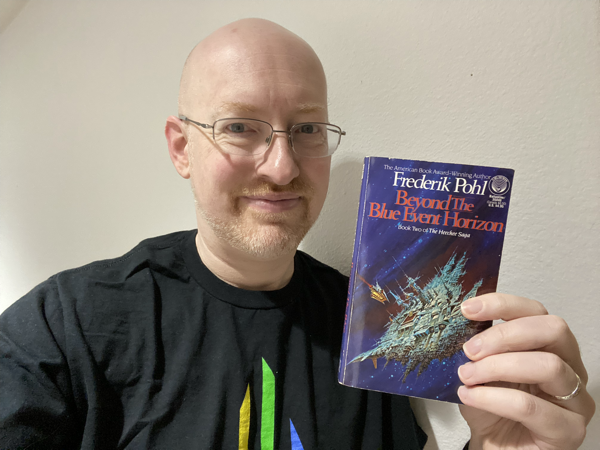
📚 Beyond the Blue Event Horizon by Frederik Pohl
17/2022 – ⭐️⭐️⭐️
Much like Gateway, the prior book in the series, there’s a lot of really neat hard SF worldbuilding. Unfortunately, there’s also a lot of uncomfortable-by-today’s-standards focus on whether the 14-year-old girl is going to jump in bed with her brother-in-law or the raised-by-horny-computers orphan. Gateway had a little bit of this sort of thing — the main character at one point in that book is in a relationship with a woman who is described as said-she-was-18, looked 16, but even that was questionable — but here it’s a fairly major thread for the first half of this book. Thankfully, it more or less fades away in the latter half, but it was rather painfully obvious that Pohl (who was in his early 60s when he wrote this book) was absolutely part of the “old white men indulging their puerile fantasies” crowd of mid-century SF. In the end, the interesting SF parts kept me invested and I’m proceeding to the next book in the series.
Change is Good
Thanks to the latest horrible thing to fall out of Bill Maher’s mouth, I’ve just added a disclaimer to my On This Day page and to the top of every post that is more than two years old noting that the post may not reflect my current beliefs.
I sincerely believe that learning, growing, examining, and often changing beliefs is an integral part of being a responsible human being. My personal journey socially and politically has been ever leftwards, and there are many posts in the archives that I would not write the same way today, if at all.
Things I know exist in my archives that I would not write today:
- General mockery of Britney Spears for no real reason other than being a pop queen. (Which, honestly, she’s very good at.)
- Very suburban-white-background “I listen to all kinds of music except country and rap” sentiments. Lots of at-the-time unexamined racism and classism in those statements, plus they were never really all that true (classic country and “acceptable” rap were always part of my listening habits).
- Probably a fair amount of other statements with then-unexamined ableism, classism, racism, sexism, homophobic, or transphobic aspects or roots.
I’m sure there is a lot more; those are just the ones that pop into my head because I’ve come across them at one point or another recently while digging into my archives.
I’ve always considered myself to be open-minded and politically liberal, and while that’s true, the older I get, the more I have realized how many ingrained societal biases still exist within that basic framework. Working through those biases, recognizing them, and endeavoring to change them is an ongoing process, and one I hope I never give up on. It’s not always comfortable; it is always necessary.
📚 Becoming a Student-Ready College: A New Culture of Leadership for Student Success by Susan Albertine, Michelle Asha Cooper, Tia Brown McNair, Nicole McDonald, and Thomas Major, Jr.
16/2022 – ⭐️⭐️⭐️
The basic concept and ideas are good (flipping “college-ready students” to “student-ready colleges”), but at times really needed a stricter editorial eye (the point where a sentence begins “In short…”, but then goes on for nine lines, and is already three sentences into a page-and-a-half paragraph being a prime example).

Happy Plagueiversary II
Today marks the end of our second year of the Covid pandemic (counting from my own personal starting point, the last in-person Norwescon ConCom meeting, in March of 2020).
Last year on this day I posted a rundown of the last times I’d done something before going into lockdown.
Today, we’re not quite as much in lockdown as we were then, but we’re by no means back to a pre-pandemic concept of normal. Since this time last year:
We still haven’t gone out to any indoor performances. We went to a couple outdoor performances in parks last summer, but we weren’t yet entirely comfortable with that, and it didn’t last long.
We’ve had one brief trip to Portland to visit my mom, during the time when Delta was decreasing and Omicron hadn’t hit yet, a brief unplanned stopover with Prairie’s family in Olympia on the way back from that, and we’ve had one big family gathering for Prairie’s side of the family in Olympia. Other than that, still no travel or family visits.
I still haven’t been back to the Mercury, though it’s been open for a couple months now.
We did one weekend travel of “cabin camping” over the summer.
Neither of us has been in a big crowd.
I went to a small weekend gathering with the Norwescon Executive Team for our annual retreat to plan this year’s convention, but that’s been the extent of my external socializing.
We’re still staying home most of the time. All of our groceries are delivered or curbside pickup. We don’t go to restaurants; any food not cooked here is either drive-through or Door Dash.
Two years down. Mask and vaccine check requirements are being dropped, but it’s not at all clear that we’re “safe” yet, and we’re all still figuring out what the new normal is going to be.
I just hope the more optimistic assessments of where we’re heading are correct. I’m generally a pretty naturally optimistic person, and two years of the pessimists being proved correct at nearly every turn has been rather difficult. We’ll see what happens from here….
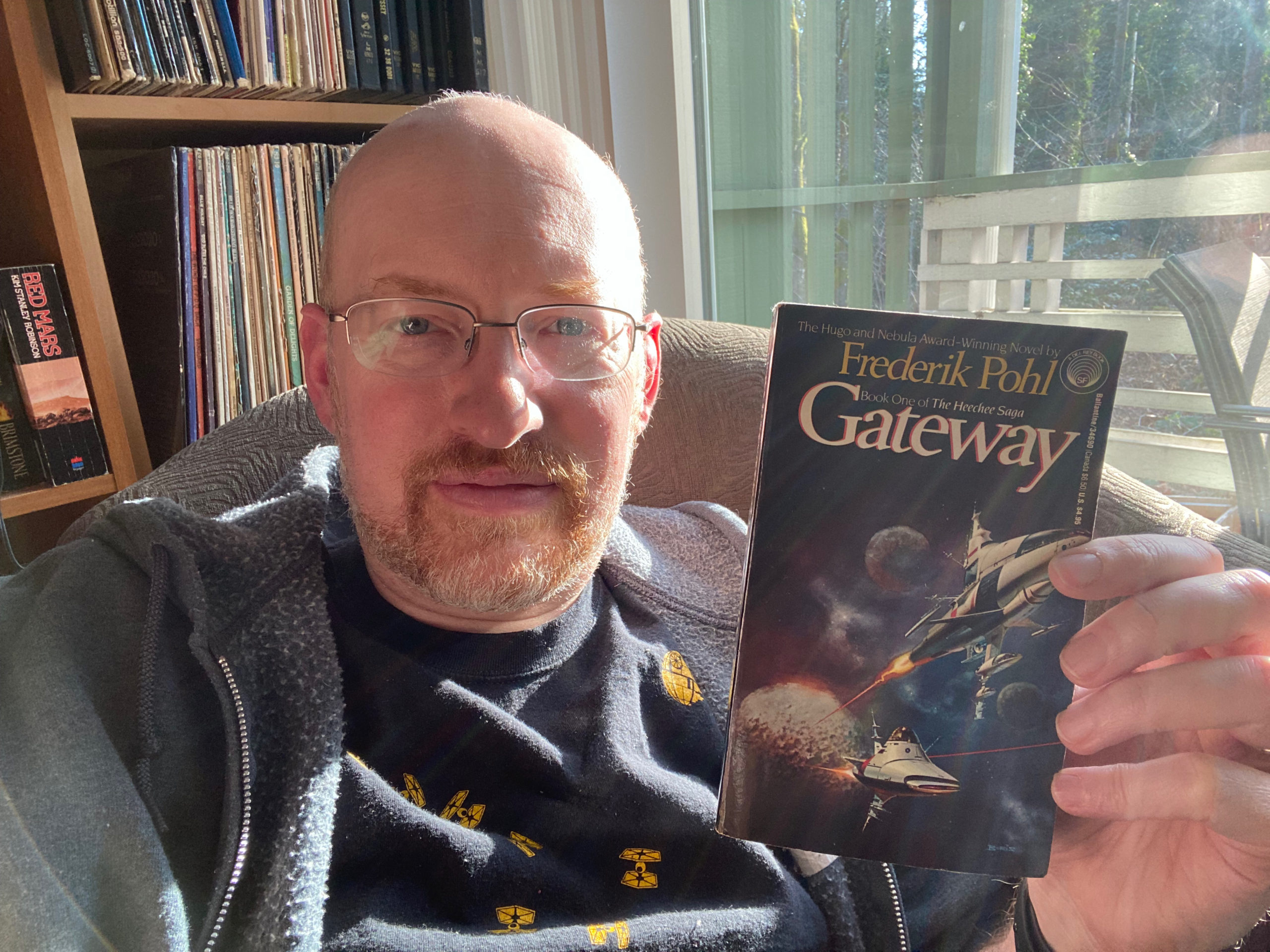
📚 Gateway by Frederik Pohl
15/2022 – ⭐️⭐️⭐️ 1978 Hugo Best Novel
The main character’s something of an ass (admittedly, this is part of the story, so at least he’s not an ass for no reason), but the general conceit and worldbuilding is fascinating. Humanity has found the remnants of an alien race, including a fleet of FTL ships…but nobody really knows how to work them. Take one out and you might come back with treasures worth millions, you might come back with nothing, you might come back dead, you might not come back at all…and the odds aren’t in your favor.
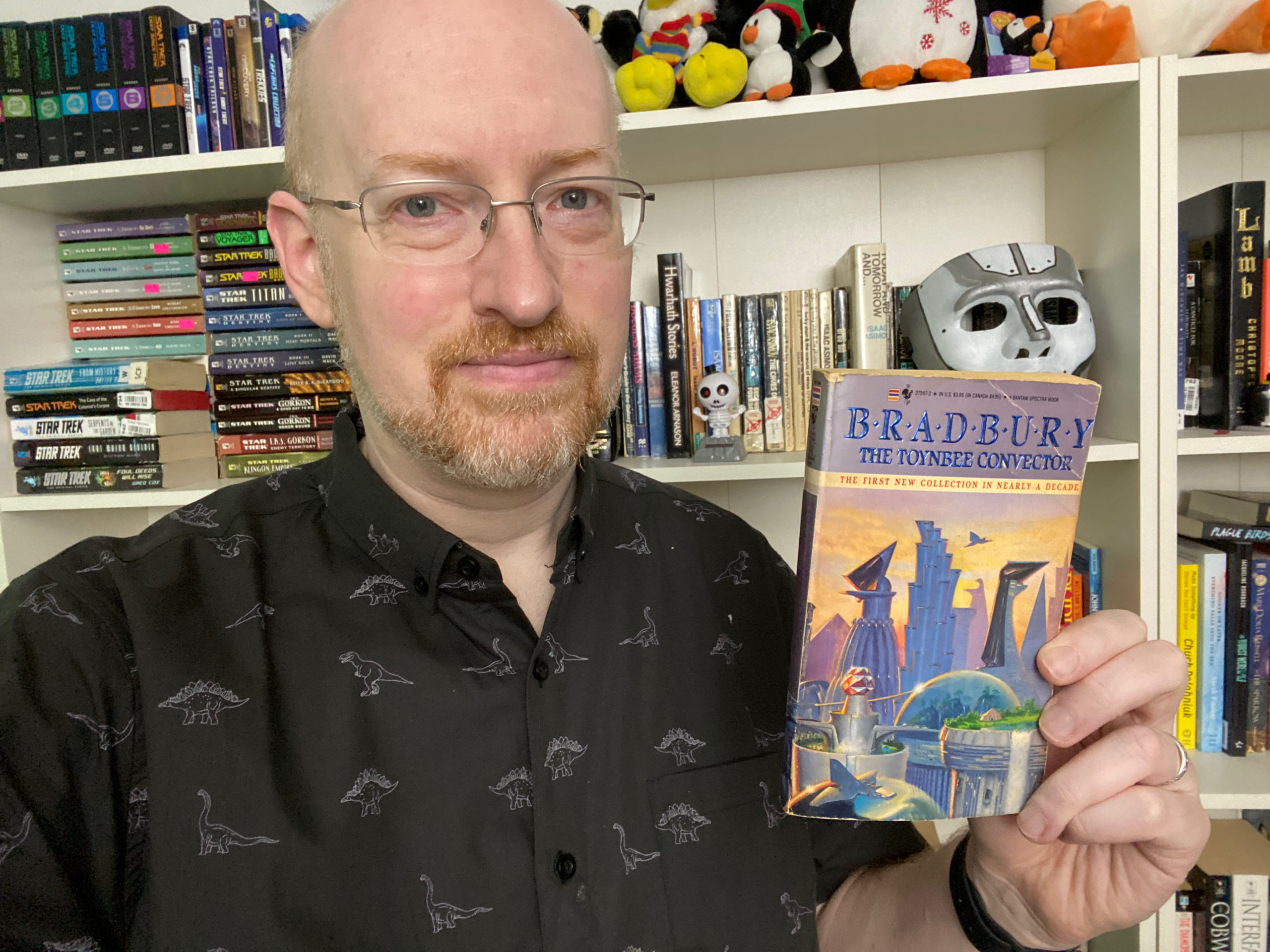
📚 The Toynbee Convector by Ray Bradbury
14/2022 – ⭐️⭐️⭐️⭐️
Overall, there was a more melancholy feel to this collection, but bookended with two very enjoyable and hopeful stories (the first, one that I’d even qualify as hopepunk). Bradbury continues to be a lifelong favorite of mine.
📚 From History’s Shadow by Dayton Ward
13/2022 – ⭐️⭐️⭐️
A clever attempt at tying together virtually all of the “travel back in time to 20th century Earth” episodes into a single adventure. Enjoyable, though I did end up getting a bit confused about timelines towards the end, but not enough to be a major bother.

2022 PKD Award Thoughts 📚
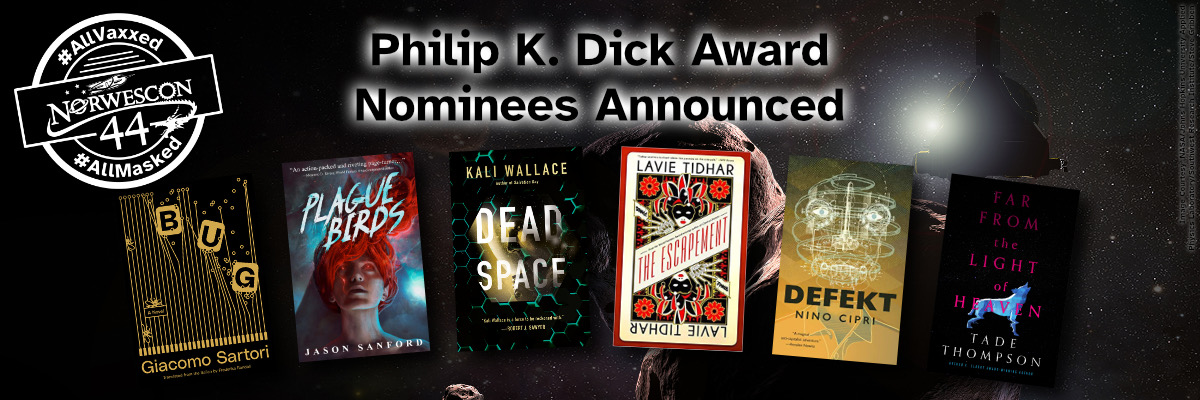
As I have for the past several years, I’ve read all of this year’s Philip K. Dick Award nominated works.
This year had a nice strong slate, I’ve actually had a hard time picking which I’d choose for the top spot. Top three is pretty easy, but top spot…that’s more difficult.
My picks for top three: Nino Cipri’s Defekt, Tade Thompson’s Far From the Light of Heaven, and Lavie Tidhar’s The Escapement. All of them were the kind of stories that took up residence in my brain and poked me for a few days afterwards, which is always a good sign.
If I had to pick a top choice (and I don’t have to, but then, what would be the point of this post), I think I’d go with Far From the Light of Heaven by Tade Thompson. Amusingly, it was one of two “murder mystery in space involving an investigator dealing with misbehaving AIs” stories (the other being Kali Wallace’s Dead Space); both were good, but I found Thompson’s to be my preference — admittedly, possibly somewhat influenced by my prior enjoyment of Thompson’s earlier Wormwood trilogy.
Of the books I haven’t mentioned yet, Jason Sanford’s Plague Birds was an enjoyable adventure and well worthy of being nominated; and Giacomo Satori’s Bug was the only one of this year’s picks that just didn’t work for me.
As noted, though, another strong slate, and I’m looking forward to seeing who wins this year (and my tongue-in-cheek advance apologies to Tade Thompson; as his book is my favorite, if historical trends hold true, another book will take the top spot…but hey, maybe this year is the year to change that)!