The Brother Always Dies First

The Brother Always Dies First: on sex, death, and cinematic depictions of race is an excellent essay by author Steven Barnes, exploring two propositions regarding race in American cinema:

Proposed: Black men cannot have sex in movies without it hurting the box office.

Evidence: No non-white male is able to have sex in a movie and have that film cross $100 million at the domestic box office.

Exception: After thirty years of observation, there are now actually THREE movies that contradict this! Huzzah! (Do you know what they are? Answers at the end.)

Proposition #2: It is NOT true that “the black guy always dies first.” This is easily proven as far back as Night of the Living Dead. The reality is rather more difficult to wrap minds around. It is this: there are countless films in which ALL the black characters die, or all the black males die. And there are NO American films in which all the white characters die, if anyone else at all survives. Not one.

I have compiled a list of over ONE HUNDRED such films, which appears at the end of this article.

Explanation: A “character” is someone with at least one line of dialogue.

Exception: On January 17, 2020, I finally saw a movie that contradicts this, the very first American film I’ve ever seen or heard of where black people survive while all the white people die. Not a bad movie, either. The name is in the footnotes.

Some of this I was semi-conscious of, at least in the “the black guy always dies first” sense. But I certainly hadn’t taken as deep a dive into it as Steven has (and, gee, I wonder why, as I look at my nearly-translucent white skin…).

Short Treks E10: “Children of Mars”: A curious and moody prequel that sets up a bit of backstory, but mostly won’t really fall into place until Picard starts. Guessing that “synths” might be androids based on Romulan experiments with Borg technology? 🖖

📚 two of 2020: Encounter at Farpoint, by David Gerrold ⭐️⭐️⭐️

A fairly straight adaptation, only a few notable differences from the broadcast episode. As a friend noted, quite amused by the descriptions of men (competence, personality) and women (they’re hot!). 🖖

📚 sixty-two of 2019: Enterprise, by Vonda N. McIntyre. ⭐️⭐️⭐️

An earlier look at Kirk’s first mission after talking command of the Enterprise. Very different characterizations of the crew—and the Klingons—than what we now know…but then, it was 1986. 🖖

The Rise of Skywalker

A few more brief non-spoilery thoughts on The Rise of Skywalker, while it’s still fairly fresh in my mind.

I thought the first hour or so of the movie was far too rushed. There was no time to breath, to take anything in, and it felt like Abrams was concerned that if he gave the audience time to actually think about what we were watching, instead of just reacting, the film would fall apart. Which, in a lot of ways, it would.

This Twitter thread by @ZenOfDesign raises a lot of good points and questions about The Rise of Skywalker, many (but not all) of which came to my mind as I was watching it. Obviously, spoilers all through the thread, and if you absolutely loved the film, maybe you don’t want to click through.

It was very pretty, of course, and I was generally entertained. However, there were so many moments (like many of those in the above-linked Twitter thread) that pulled me out of the film that I never really got truly invested. I’ve seen other people comment on how fanservice-heavy the film was, and I’m very much in agreement; I think it was so concerned with trying to 1) touch on as many pieces of the saga as possible, and 2) satisfy as many fans as possible (unfortunately, particularly those most vocal about not liking The Last Jedi) that it hindered more than helped.

I also think it shares some DNA with Avengers: Endgame in that it was so wrapped up in being the end of a saga that there’s simply no way the film can stand on its own. Neither of these films are comprehensible at all without having watched some (and, preferably, all) of the films that came before them, and as such, suffer when thought of as single entities rather than as chapters in a larger work. These certainly aren’t the only films to be in such a position, of course, but it seems particularly the case for these.

Of course, that saga theoretically stretches over nine films, but I was very amused that everything about the end of TRoS calls back to the original trilogy, and there’s actually very little at all in the film that is a direct or even offhand reference to the prequel trilogy (one line about Gungans is all I’m immediately remembering). It’s very possible to ignore the prequels entirely, and just view episodes IV-IX as a complete story.

In the end, as I noted just after seeing it, it is an entertaining film, and an acceptable, though not incredible, end to the Skywalker saga. But it’s definitely the weakest of the three new films (with The Last Jedi being the strongest).

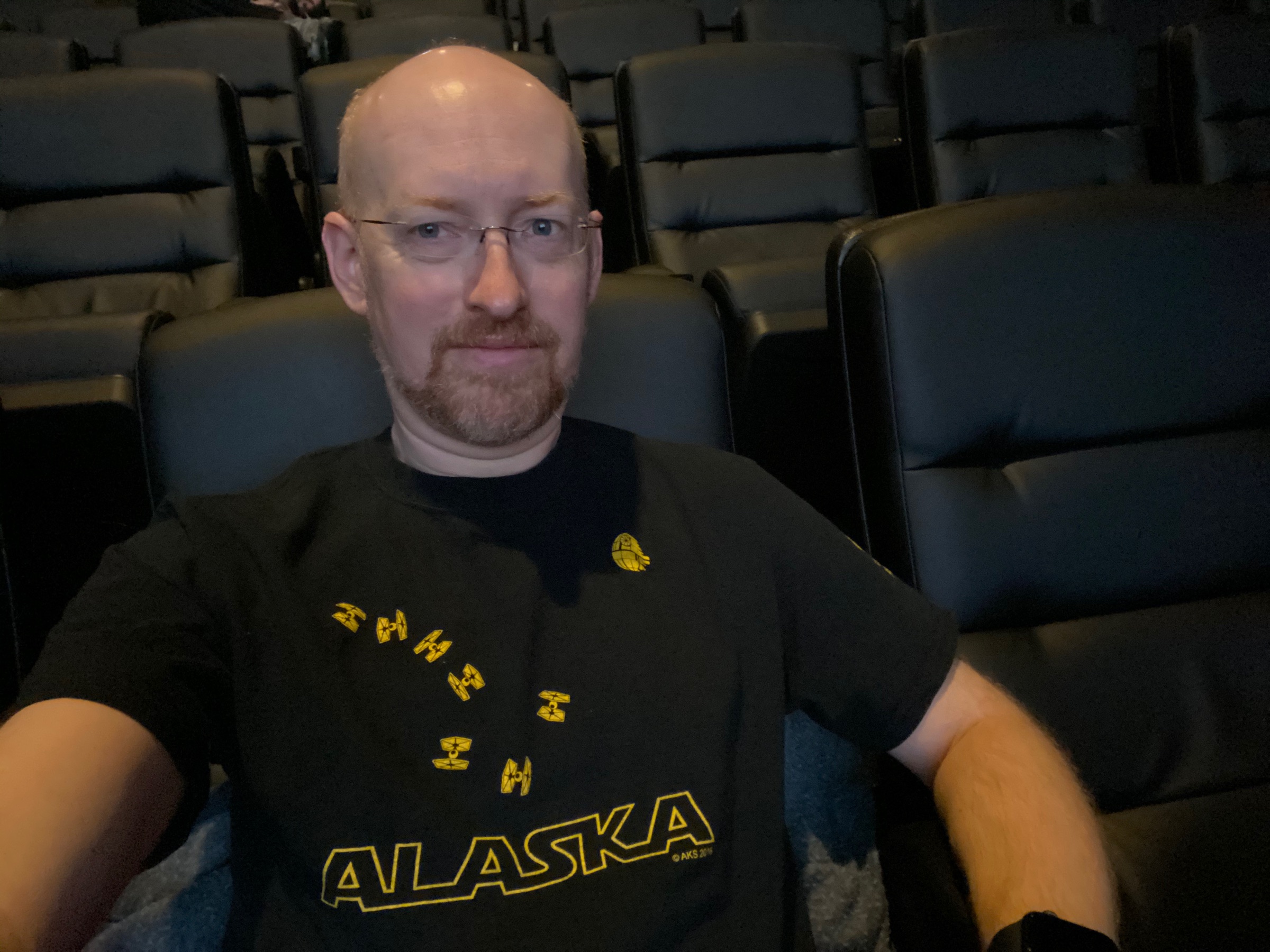
Well, now. That was definitely a movie!

Spoiler-free mini-review: It’ll do as an acceptable end to the Skywalker saga (and rather amusingly, you really don’t need the prequels at all; this could easily be a six-movie story), but also the weakest of the latter three films. 🎬