Saw the @trekmovie #trekselfie tag today. Here’s a gem I found this weekend at an antique store!


Enthusiastically Ambiverted Hopepunk
The shows and movies I like (or don’t).
Saw the @trekmovie #trekselfie tag today. Here’s a gem I found this weekend at an antique store!
I know what I’m reading next! 638 pages, all covering Season Two of TOS. I’m such a Star Trek nerd. :D

Seven short tales, all based off of Disney tales, but far darker than what you’re used to….
She was always kind, but she was no longer good.
Snow White didn’t remember how she ended up in the forest. She remembered her stepmother’s huntsman leading her into the forest to gather flowers, and setting the flowers aside so she could speak with a lost bird. The next thing she knew, she was wandering alone, feeling colder than she had ever felt before.
Yesterday, I posted this to my Google+ account:
Just watched the red band trailer for the new Evil Dead remake/reboot. That is so not for me. I like the original with and because of its crazy low-budget camp, and love that they just ran with that for the rest of the series and went completely goofy. This new, ultra-realistic, ultra-violent, ultra-bloody take, even if it’s more in line with what they originally wanted to do, doesn’t appeal to me in the least.
I like my horror creepy and/or with a good dose of humor mixed in. Today’s trend towards ultra-violent torture porn just makes me feel ill.
Then, earlier today, I tweeted this:
Watched The Cabin in the Woods today. Crazy, and really good. Glad I hadn’t read any spoilers beforehand. http://t.co/rIngl2A3 #IMDb
Then just a few minutes ago, Prairie and I finished watching the fourth season of Dexter, and while the ending cliffhanger was upsetting, it was upsetting in the way a good TV cliffhanger should be, and we’ll definitely continue watching the series.
There seems to be some possible irony in all of that.
Honestly, I’m not entirely sure just where the boundary between “acceptable” and “unacceptable” violence lies for me. There were definite moments in The Cabin in the Woods that were more violent than I was really comfortable with, and Dexter occasionally pushes right up to the edge, but in both cases, I think there are three things that make the difference and keep me watching:
They don’t dwell on the violence. The acts, while necessary to the story, aren’t the point of the story, and as such, even when they’re shown on screen, it’s generally not a huge, long, drawn-out scene. It happens, there’s that moment of shock, and then they move on.
The violence is a part, but isn’t the point. I’ve seen other films (the first Saw film, for instance, which was two hours of my life whose only useful purpose was to convince me that I have no need to ever waste time on any of the rest of the series) that are truly deserving of the “torture porn” designation. The violence is the point of the film, and any bare minimum of plot is there only to move from one violent act to the next. Even films that aren’t part of the modern “torture porn” style of horror can fall victim to this kind of approach: For instance, part of why I didn’t think much of Tim Burton’s take on Sweeny Todd (which I’ve enjoyed on stage) was his insistence on showing every slit throat in loving closeup. Once would have been quite forgivable in order to get the point across, but I found the repeated shots of gaping bloody throats to be quite unnecessary.
Of course, there’s a lot of grey area in all of this, and the boundary between what works for me and what doesn’t is definitely very, very blurry. Sometimes it just boils down to the old cliché about the difference between erotic art and pornography: I know it when I see it.
One of the gifts I got for Christmas was the 50th anniversary James Bond collection on Blu-ray. Prairie and I have started watching our way through the series, and while it will take a while to get through them all, I figured I’d start ranking the films as we watch. Here’s where we’re at so far, in order by how I like them:
I’ll continue updating this list over the upcoming months as we continue through the series.
Unless, well, I didn’t actually do that.
So I noticed something that amused me while watching Big Bang Theory the other night — apparently Sheldon has a holographic display on his laptop.
Obviously, some evidence in the form of screenshots is in order (all from Season 4, Episode 15, “The Benefactor Factor”, though I noticed this in Episode 14, “The Thespian Catalyst”, as well).
First up, a shot of Sheldon videoconferencing with Amy. This is mostly to set the scene, there’s nothing much to see here.

Next, a POV shot of what Sheldon sees while sitting directly in front of the computer.

Finally, here’s the shot that caught my eye — a shot over Sheldon’s shoulder.
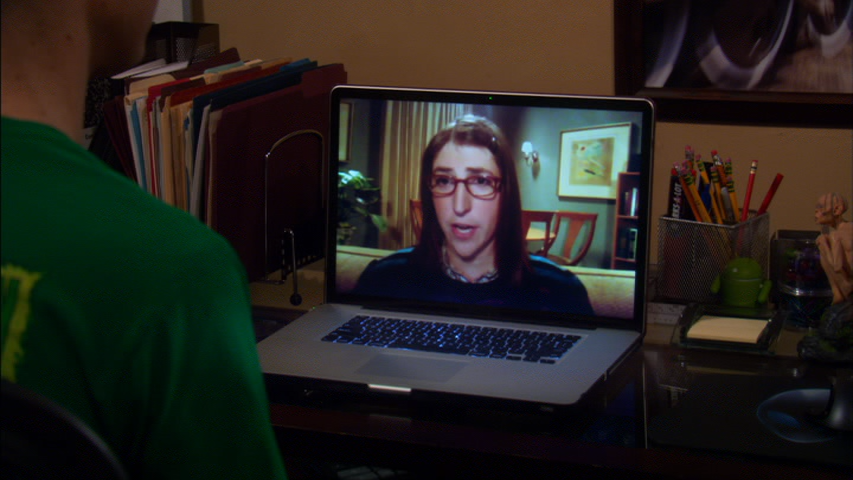
Compare those last two shots. In the first shot, from Sheldon’s POV, we see Amy from directly ahead. She’s looking directly into the camera, as would be expected. However, in the second shot, she’s turned slightly to her right, giving us a slight profile shot (and while it doesn’t really translate in still shots, this isn’t because she was shaking her head or momentarily turned her head for some reason — she holds her head in this position through the entire shot).
The final impression is that as the camera switched from Sheldon’s POV to the over-the-shoulder shot, the perspective changed in our view of Amy, so that we see her from the same angle as if the two characters were speaking face-to-face rather than over video chat…but the only way that could happen would be if Sheldon’s computer had a holographic display!
With our normal, flat, non-holographic computer screens, of course, even when moving to the side of a computer screen, we would still see the other party looking straight into the camera…so we’d see the image something like this:

Of course, in the visual language of television, that looks odd. We expect characters to look at each other, and we know that Sheldon and Amy are looking at each other, so the technically correct shot seems a little odd, as Amy is still looking directly out of the screen, apparently at the viewer instead of at Sheldon. The solution, then, is to have her turned slightly to her right when filming those sequences so it still appears that she’s looking directly at Sheldon, even though it gives the somewhat amusing impression that Sheldon has a laptop far more advanced than any currently on the market (as does Amy, as she’d have to have a laptop that can both film and broadcast 3D video chat streams) — but then, would we really expect anything less from Sheldon Cooper? ;)
I have no idea how often this technique is used on other shows, as this is one of the few times I’ve noticed it. In fact, the only other time I can think of that I noticed this technique being used was in Star Trek (TNG comes to mind, though I can be relatively sure that it was also done this way in DS9, VOY, and ENT). However, in the Star Trek universe, it’s known (at least to the more geeky technobabble obsessed fans) that the main display screen on the bridge of the Enterprise is a holographic display, and it’s not that far-fetched to believe that the smaller displays might be as well, so the conceit was never as jarring when I noticed it there.
So…there’s my ridiculously over-analyzed geek moment of the day.
First off, the gorgeous new trailer for the first part of The Hobbit has just been released:
Now, a slight digression. Back when the internet was new (and I’m not entirely exaggerating with that), the Jargon File was created as a living encyclopedia of words, phrases, terms, and events common to the geek communities of the day. In that document are the original definitions for the term “troll” as used in the electronic world.
- v.,n. [From the Usenet group
alt.folklore.urban] To utter a posting on Usenet designed to attract predictable responses or flames; or, the post itself. Derives from the phrase “trolling for newbies” which in turn comes from mainstream “trolling”, a style of fishing in which one trails bait through a likely spot hoping for a bite. The well-constructed troll is a post that induces lots of newbies and flamers to make themselves look even more clueless than they already do, while subtly conveying to the more savvy and experienced that it is in fact a deliberate troll. If you don’t fall for the joke, you get to be in on it. See also YHBT.n. An individual who chronically trolls in sense 1; regularly posts specious arguments, flames or personal attacks to a newsgroup, discussion list, or in email for no other purpose than to annoy someone or disrupt a discussion. Trolls are recognizable by the fact that they have no real interest in learning about the topic at hand – they simply want to utter flame bait. Like the ugly creatures they are named after, they exhibit no redeeming characteristics, and as such, they are recognized as a lower form of life on the net, as in, “Oh, ignore him, he’s just a troll.” Compare kook.
Where today, “troll” is almost universally understood as the second of the above quoted definitions — a person solely out to provoke annoyance — I’ve always preferred the first definition. In that sense, a properly constructed troll is something I’ve always respected.
The comments for yesterday evening’s io9 post about the Hobbit trailer contain a beautiful example of trolling in the old sense (“…a post that induces lots of newbies and flamers to make themselves look even more clueless than they already do, while subtly conveying to the more savvy and experienced that it is in fact a deliberate troll. If you don’t fall for the joke, you get to be in on it.”). This comment gave me a good laugh this morning:
Yawwwn, sequelitis strikes again.
Hey Hollywood, how long’d it take you to come up with yet another unnecessary backstory?! Do we really need to go with Frodo’s dad on his quest to find the ring?
I bet they’ll dumb it down and make it all kiddy too. Hard R or I ain’t watchin!
How much you wanna bet they’ll figure out a way to shoehorn half-a-dozen giant spiders to compete with the one they had in LOTR2.
Now that, ladies and gentlemen, is how a troll is supposed to be done.
If you’re at all interested in movies, Stanley Kubrick, Kubrick’s version of Stephen King’s The Shining, set design, psychology, or any combination of the above, you really should take twenty minutes to watch both of the following videos.
The Shining: Spatial Awareness and Set Design Part One:
The Shining: Spatial Awareness and Set Design Part Two:
(via Daring Fireball)
From On the Origin of Transformers:
The advocates of ID, who are arguing that their belief should be included in science classes in Texas, Tennessee and other states, say that if a living organism has a design that cannot be explained by the theory of natural selection, it is proof of an Intelligent Designer. If you consider a Camaro, for example, wouldn’t it obviously have had a Designer? Could its parts have been assembled by a hurricane (or a trillion hurricanes) blowing through a junkyard?
Certainly not. Therefore, this is proof that Autobots were not assembled on Cybertron by hurricanes or any other means envisioned by Darwin, and were Intelligently Designed. That makes the Transformers series a compelling parable for ID, and I expect several of this year’s Republican presidential candidates to recommend the movies on that basis alone.
Roger Ebert, making the case for Intelligent Design…at least within the universe of the Transformers.