Disney turning Bloom County 3-D

You know, much as I’d like to get excited about the prospect of a Bloom County feature film, given Disney‘s track record over the past few years (nearly anything without Pixar‘s involvement is a waste of time — Pirates of the Caribbean and Lilo and Stitch are the only exceptions I can think of, and even Lilo, while enjoyable, isn’t quite up to the standards Disney used to have), the news that their first foray into 3-D animation without Pixar’s involvement will be a Bloom County film doesn’t thrill me.

Miramax Films will co-finance and distribute computer-animated family films starting with “Opus,” adapted from the popular “Bloom County” comic strip, the company said Thursday.

Miramax will release some of the films under its Dimension banner and produce them in conjunction with Wild Brain Inc., a San Francisco-based animated film company perhaps best known for creating the nasty toe fungus in commercials for the prescription drug Lamisil.

Now, while I don’t know anything about Wild Brain (or their nasty toe fungus), the fact that the movie will be under the Disney subsidiary Miramax does give some hope that the end result won’t be as Disney-fied as might otherwise be the case (after all, Miramax does distribute a lot of movies I enjoy, including many of Kevin Smith‘s works). So maybe it won’t be all bad, right? But then the article goes on…

The deal envisions lower budget feature films consistent with Miramax’s independent studio status. Films will cost about half of the bigger budget movies produced by Pixar Animation Studios or DreamWorks SKG.

“What you spend doesn’t necessarily reflect on how good the movie is,” said Jim Miller, Wild Brain chairman.

Well, sure Jim, that’s quite true — there are many, many examples of low-budget films whose quality far outshines the big-budget extravaganzas foisted upon us by the movie studios each summer. However, that said, “low-budget” isn’t really a term I tend to associate with CGI. Still, I will easily admit that I know jack squat about the costs involved in CGI. Maybe it is possible to create a quality feature length CGI film on 1/2 the budget of a Pixar film (though given how good Pixar’s films are, and how successful, I’d hesitate to consider calling their work too expensive).

I’m also having a little difficulty trying to envision the Bloom County universe as a fully three-dimensional rendered world. I keep trying to picture Opus, Bill, and the rest of the critters as 3-D models, and stumbling. On top of that, there are the human characters — Milo, Binkley, Steve, Cutter John, Oliver — and human animation is getting better, but will it be good enough to actually realize the characters I’ve grown up with?

But beyond the quality of the animation and the talent of the animators, there’s this little thing called the script that someone’s got to worry about, and when dealing with a property as well-known and loved as Bloom County, that’s got to be very important consideration.

The choice of subject for the first film reflects Miramax’s eclectic tastes and could prove to be a hard sell, especially to younger audiences.

The character of Opus is a rotund penguin with a cynical world view – far from the heartwarming characters at the center of such films as “Finding Nemo.”

“We agree that it’s a challenge,” Miller said. “How do you take the essence of those characters, who are a little cynical, and move them into a story that can reach adults at the ‘Bloom County’ level and children at their level? We think we have a terrific story.”

The challenge has been given to screenwriter Craig Mazin, whose credits include “Scary Movie 3.” “Bloom County” is written by Berkeley Breathed.

And therein lies my real fear.

So far, I’ve only ever seen two properties that I ever felt could really bridge the gap between children’s entertainment and adult entertainment in a way that successfully appealed to both age groups without pandering to either: The Muppets (with the original television show and the first movie being the high points) and Animaniacs. All too often, either something ends up being watered down too much in order to aim at the children, and the adults have to sit through mind-numbingly asinine shows to appease their children, or the humor is aimed so much at the adult level that parents aren’t comfortable allowing younger children to watch.

Combining the two is a very tricky business, often requiring a level of subtlety that I just don’t see much these days. Rather than going for obvious “adult” or “juvenile” humor (which, admittedly, these days seems all too similar, usually revolving around toilet humor, with the only real difference being whether or not there’s a sexual overtone), it seems to require more thought to the humor — more intelligent jokes, more puns, veiled references…done well (as both the Muppets and Animaniacs did), it can be incredibly enjoyable for both age groups. Done poorly, and nobody enjoys it as much as they should.

Of course, as with all things, there will be no real way to know until it comes out, which should be sometime in 2006. Until then, though…well, I won’t be holding my breath. And if all else fails, there is a lot of Bloom County in print that is just as funny to me now as it was when it came out (sometimes funnier, as I’ve grown older and more able to understand some of the humor).

iTunesAttached” by Orbital from the album Snivilisation (1994, 12:25).

Once More, With Feeling

As I’ve mentioned on here every so often, I’ve been working my way through the Buffy the Vampire Slayer series from beginning to end by renting the DVDs from NetFlix. I’m up to season six now (which means I’m going to have to take a break pretty soon, as season seven isn’t out for a little while yet), and I’m still thoroughly enjoying the show.

Season four had what is so far my all-time favorite episode — ‘Hush‘ — but last night I watched what’s now a very close second: ‘Once More, With Feeling‘.

In deference to friends who are also working their way through Buffy for the first time, the rest of these ramblings is behind the cut… Now, I’d heard about ‘Once More With Feeling’ (a.k.a. “Buffy — The Musical”) before hand, but I knew nothing about it beyond that it was a musical episode, so I was really looking forward to seeing it. I didn’t know how they were going to present it (music and spoken word, like a true musical; purely music, operetta-style; possibly something else), or how they were going to make it work within the confines of the show — though, admittedly, with a show like Buffy it’s easy enough to explain nearly anything away with a little creative work.

I knew I was going to be in for a treat when the show opened to a widescreen ratio and old movie style credits. Obviously they weren’t going to go about this halfway! I spent the rest of the next hour with a goofy grin on my face, often laughing out loud as the trademark wordplay worked its way into the songs.

Musically, while it’s not perfect — the cast are actors, after all, and not professional singers (though Anthony Stewart Head and Amber Benson both do quite well) — it is a lot of fun, with styles bouncing all over the place, from soft-shoe jazz to rock power ballads, and even a few reprises of earlier themes popping up later on in the show. Whedon is obviously a fan of musicals, and that shows throughout the show, not just in the music, but also in his framing of the shots and the choreography of the dances.

While it’s definitely something that could only be done as a one-off concept episode, I had a blast with it. Enough of a blast that when I found out that the soundtrack is on iTMS, it was downloading to my computer just a few moments later. My favorite track from the show? Definitely Spike’s showcase number, Rest in Peace. Not only does it do a wonderful job of expressing Spike’s frustration in his non-relationship with Buffy, but it’s a fun power rock pseudo-ballad, and James Marsters does a credible job with it (even if his accent does slip a bit from time to time).

While ‘Hush’ still takes the prize as my all-time favorite episode that I’ve seen so far, ‘Once More With Feeling’ is a very, very close second. If only there were more television shows like this, I might actually bother to watch TV more often.

iTunesMain Title (from ”Once More with Feeling“)” by Orchestra from the album Buffy the Vampire Slayer – Once More, With Feeling (2002, 0:27).

Sky Captain and the World of Tomorrow

In the midst of watching all of the recently-released Star Wars films (okay, sure, they’re not quite what they were when I first saw them, but they’re still a lot of fun), Prairie and I took a break on Saturday to wander down the hill to see Sky Captain and the World of Tomorrow.

In short, it was exactly what I was hoping it would be: check your cynicism at the door and have fun.

Visually, it’s astounding — the stylized noir-ish world is beautiful to watch, and I had quite a few moments of simple geek glee at what I was seeing on screen. From the sepia tone of the entire film to the art-deco stylings of late 30’s New York to the giant marauding robots straight out of old pulp science fiction covers, I’m sure I had a goofy grin on my face from beginning to end.

It looks like Mike Whybark also enjoyed the film, and his comments are well worth reading — as he has a fascination with many of the elements that make up the film already (“…the thirties, aviation technology and pulp fiction, lighter-than-air aviation, the cinema of the thirties…”), he’s a bit more critical of some aspects of the film than I am. He does bring up one thing that I noticed right off, though: the similarity of Gwyneth Paltrow‘s Polly Perkins to Rosalind Russell‘s Hildy Johnson in His Girl Friday, one of my favorite movies of all time — and the fact that Paltrow doesn’t hold a candle to Jennifer Jason Leigh‘s homage to Hildy Johnson in the Cohen Brothers’ Hudsucker Proxy as Amy Archer.

But Gwyneth Paltrow’s Polly Perkins, a reporter, is clearly an homage to Rosalind Russell’s Hildy Johnson from the 1940 His Girl Friday. That’s all to the good. Yet, Jennifer Jason Leigh’s Amy Archer, another Russell homage (from The Hudsucker Proxy) captures the stacatto vocal rythms that are crucial to the thirties mise-en-scene. Alas, Paltrow’s dialog and interplay with Jude Law’s mercenary aviator, while lazily amusing, has nowhere near the verbal power of her character’s forebears.

Not that Paltrow does a bad job at all, I just kept thinking that it could be just that much better, if only…. Nice to know that I wasn’t alone in picking up on that.

Anyway, for me, a wonderful film. Definite keeper once it’s out on DVD, and I’m looking forward to getting to see it again.

iTunes “Happy Rave ’95 (full mix)” by Various Artists from the album Happy Rave ’95 (full mix) (1995, 1:10:03).

The new me

I don’t think these pictures really do them justice, but I got my new glasses today.

My old glasses

My old glasses — I’ve had these for years now. They worked well when I was younger and needed something to give my face some depth, but as I’ve aged, they’ve come to dominate my face rather than accent it. So, on the advice of a few people and the assistance of Prairie, I found something smaller and less domineering.

My new glasses

So here’s the new pair. Much smaller, lighter, and totally rimless — with the anti-glare coating they’ve got, they’re almost invisible. Incredibly light, too, I’m still marveling at how much heavier the old ones feel now.

My new glasses, with shades

Even better, these come with little clip-on shades that match the shape of the lenses perfectly. For the first time in ages, I’ll actually have sunglasses — we occasionally tried to get me prescription glasses when I was younger, but they’d invariably disappear after only a few weeks, and it quickly became apparent that that was just an unfortunate waste of money. It’s going to be very nice to be able to go outside without squinting.

So, that’s my excitement for the day — that, and picking up Star Wars on DVD. Okay, yeah, I’m still a little miffed at Lucas for not releasing the original Original Trilogy, but I — along with many other people — grew up on these films. I just couldn’t talk myself out of picking them up.

Ten Tech Items Inspired by Science Fiction

(Originally posted on Google Answers, I’ve taken the liberty of reformatting this fascinating look at past visions of the future that influenced the technology of today. Note that I am not the author of this piece.)

Question:

I WAS going to ask you to research whether or not there have been any women in Sci-Fi but I have answered that myself, having found Flash Gordon’s moll.

However it is a Sci-Fi question.

Can you list 10 real technological ‘things’ that have reputedly come out of Sci-Fi stuff written in the 20th Century?

Here’s an example, computer viruses were reputedly inspired by ‘When Harlie Was One’ by David Gerrold.

Answer:

I have chosen ten outstanding technological concepts which had their
popular origins in the world of sci-fi. It is debatable, in some
cases, whether the science fiction source was the actual originator,
but it’s certainly true that each of these ideas was given a boost
into reality by an SF writer.

THE GEOSTATIONARY SATELLITE: Arthur C. Clarke

Although this concept was not described in a work of fiction, it was popularized by a man primarily known for his flights of fancy, Arthur C. Clarke:

A geostationary orbit (abbreviated GSO) is a circular orbit in the Earth’s equatorial plane, any point on which revolves about the Earth in the same direction and with the same period as the Earth’s rotation. It is a special case of the geosynchronous orbit, and the one which is of most interest to artificial satellite operators.

Geosynchronous orbits and geostationary orbits were first popularised by science fiction author Arthur C. Clarke Sir Arthur C. Clarke in 1945 as useful orbits for communications satellites. As a result they are sometimes referred to as Clarke orbits. Similarly, the ‘Clarke Belt’ is the part of space approximately 35,790 km above mean sea level in the plane of the equator where near-geostationary orbits may be achieved.

The Free Dictionary: Clarke Orbit

THE COMPUTER WORM: John Brunner

1975…John Shoch and Jon Hupp at the Xerox Palo Alto Research Center discover the computer ‘worm,’ a short program that searches a network for idle processors. Initially designed to provide more efficient use of computers and for testing, the worm had the unintended effect of invading networked computers, creating a security threat.

Shoch took the term ‘worm’ from the book ‘The Shockwave Rider,’ by John Brunner, in which an omnipotent ‘tapeworm’ program runs loose through a network of computers. Brunner wrote: ‘No, Mr. Sullivan, we can’t stop it! There’s never been a worm with that tough a head or that long a tail! It’s building itself, don’t you understand? Already it’s passed a billion bits and it’s still growing. It’s the exact inverse of a phage – whatever it takes in, it adds to itself instead of wiping… Yes, sir! I’m quite aware that a worm of that type is theoretically impossible! But the fact stands, he’s done it, and now it’s so goddamn comprehensive that it can’t be killed. Not short of demolishing the net!’ (247, Ballantine Books, 1975).

Computer History Museum: Timeline

ORGANLEGGING: Larry Niven

A few organ transplants were being performed in the 1970s, but author Larry Niven was one of the first to write about some of the social problems that might accompany widespread use of this life-extending technology. Niven wrote several stories which involved huge “organ banks,” some of which were kept stocked by unwilling “donations” from prisoners who had committed petty crimes. A lucrative black market of human organ trafficking, which many believe exists today, was foreseen by Niven:

Organlegging is the removal of human organs by a means of theft for resale for profit. Larry [Niven] coined the phrase in his Gil the ARM Stories. The main character and detective of the future police force or ARM tracks down many of the ‘Organleggers’ and their crime syndicates and brings them to justice. Gil Hamilton’s most astonishing special ability is his telepathic psychic arm – but read the stories! The original Long ARM of Gil Hamilton collection was published in 1976.

Today the practice of selling organs for profit is becoming commonplace in the third world and increasingly these organs are being removed without the donor’s consent.

Nivenisms in the News

THE WALDO: Robert A. Heinlein

Robert A. Heinlein, one of science fiction’s greatest visionaries, is credited with creating the name (and popularizing the concept) of the Waldo, a device with which a human can manipulate objects by remote. In Heinlein’s tale, titled “Waldo,” a wealthy genius who is enfeebled by disease uses mechanical hands to interact with the world:

Afflicted with myasthenia gravis from earliest childhood, Waldo lacks the muscular strength to walk or lift things with his arms. By living in the weightlessness of space he is able to move freely. His primary invention is a system of remote-controlled mechanical hands which the world has nicknamed waldoes.

We Grok It: Waldo & Magic, Inc., 1942

Before their application in motion pictures and television, ‘Waldos’ primarily referred to the mechanical arms, telemetry, and other anthropomorphic gadgetry aboard the NASA spacefleet. NASA engineers in turn took the name from a 1940 Robert A. Heinlein novella about a disabled scientist named Waldo who built a robot to amplify his limited abilities.

Character Shop: What’s a Waldo, Anyway?

GYRO-STABILIZED PERSONAL CONVEYANCE: Robert A. Heinlein

Robert A. Heinlein again. In a 1940 short story, “The Roads Must Roll,” RAH described the “Tumblebug,” a one-person vehicle that is stabilized gyroscopically, much like the Segway Human Transporter (now available) or the Bombardier Embrio (which is still in development). The same story described a public transport system, the “rolling road,” that is similar to mass people-moving devices now in use at large airports.

A tumblebug does not give a man dignity, since it is about the size and shape of a kitchen stool, gyro-stabilized on a singe wheel…. It can go through an opening the width of a man’s shoulders, is easily controlled, and will stand patiently upright, waiting, should its rider dismount.

Danny’s Blog Cabin: Sci-fi authors predict the future (kind of)

THE WATERBED: Robert A. Heinlein

I’m not finished with Heinlein yet. ;-)

The modern waterbed was created by Charles Hall in 1968, while he was design student at San Francisco State University in California. Hall originally wanted to make an innovative chair. His first prototype was a vinyl bag with 300 pounds of cornstarch, but the result was uncomfortable. He next attempted to fill it with Jell-O, but this too was a failure. Ultimately, he abandoned working on a chair, and settled on perfecting a bed. He succeeded. His timing could not have been more perfect: the Sexual Revolution was under way, and Hall’s waterbed became enormously popular, making it one of the most notable icons of the 1970s. However, because a waterbed is described in the novel Stranger in a Strange Land… by Robert A. Heinlein, which was first published in 1961, Hall was unable to obtain a patent on his creation.

The Free Dictionary: Waterbed

Heinlein described the mechanical details of the waterbed in Stranger [in a Strange Land], which is where the rest of the world learned about it. But what’s more interesting, and less known, is why he came up with the idea: Heinlein, a man of chronically poor health, was trying to create the perfect hospital bed.

TSAT: Predicting the Future

HOME THEATER & WALL-MOUNTED TV: Ray Bradbury

Ray Bradbury is associated more with “soft” SF or fantasy than with “hard” science fiction. Nevertheless, there are several high-tech devices in Bradbury’s classic 1953 dystopian novel Fahrenheit 451 (which is absolutely unrelated to Michael Moore’s recent filmic diatribe). Most notable is Bradbury’s description of huge, photorealistic flat-screen televisions with elaborate sound systems in home entertainment rooms called “parlours,” which provide an array of soap operas and other mind-numbing diversions in a future society which has banned most books.

This may sound unremarkable to younger readers, but those of us who remember the tiny, indistinct black-and-white TV sets of the early 1950s were (and are) duly impressed by Mr. Bradbury’s vision.

THE FLIP-PHONE: Gene Roddenberry et al.

I’ve got to get my “Star Trek” plug in here somehow. The original, ’60s Trek looks extremely dated today; although it’s set hundreds of
years in the future, technology has caught up with it (and in some
cases surpassed it in ways that the creators could not have
anticipated). One thing that I find quite striking is the resemblance,
both in appearance and function, between the flip-open communicator
devices used by the crew of the Starship Enterprise and today’s
wireless flip-phones.

Star Trek communicatorHere’s a photo of a communicator, circa 1967.
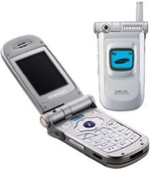
Samsung v200 Flip PhoneAnd here’s a Samsung flip-phone.

When “Star Trek: The Next Generation” replaced the flip-style communicators with a “com badge” in the late 1980s, the future was again prefigured. Today, wireless LAN-based lapel communicators are commonly used in hospitals.

THE TASER: “Victor Appleton”

Author Victor Appleton (the pseudonym of Howard Garis, also known for the “Uncle Wiggily” books) provided inspiration for the modern personal protection device, the taser (or “stun gun.”) The word “TASER” is an acronym for “Thomas A. Swift’s Electrical Rifle,” so named because the inventor was an admirer of Tom Swift when he was a child. The book “Tom Swift and His Electric Rifle” was published in 1911. Tom Swift was the adolescent hero of a series of books aimed at juvenile readers. Tom was the Harry Potter of his day. The books typically told of Tom’s adventures involving high-tech equipment such as a “sky train” or an “electric runabout.” Monorails and hybrid cars, anyone?

The Taser was developed in the late 1960’s by Jack Cover, who came up with the idea as a result of hearing about a U.S. commission which was looking into non-lethal ways police could deal with violent offenders. Cover based the Taser on a kind of stun gun he had read about in the Tom Swift fantasy stories of his childhood, thus the acronym, ‘Thomas A. Swift Electrical Rifle’.

First used by the Los Angeles Police Department in 1976, the Taser is now used by hundreds of police departments in the U.S.

Smith Secretarial: High-Tech Non-Lethal Weapon New Option for Police!

MULTI-USER DOMAINS IN CYBERSPACE: Vernor Vinge

While many fans attribute numerous important details of cyberspace to author William Gibson, I’d like to look a bit farther back, to the seminal novella “True Names,” by Vernor Vinge. In this striking work of fiction (written in 1979 and published in 1981, long before personal computers and the Web became part of our daily lives), Vinge offers vividly imagined depictions of many concepts which are everyday Internet realities today. Vinge’s online communities presage chatrooms and multi-user domains in an uncannily accurate fashion (complete with a few disagreeable and destructive individuals who take pleasure in wreaking havoc). Vinge was, as far as I can tell, the first writer to use the term “avatar” to describe a digital image that represents an anonymous computer user. Vinge called the online access point a “portal.” As you read this 25-year-old story, it seems totally contemporary: much of what was fictional in 1979 is factual today.

True Names is about Roger Pollack, a well-to-do individual living in the early 21st century. In this wired world, Pollack is known on the ‘Other Plane’ of the computer net as Mr. Slippery, a top-flight warlock (hacker) and member of one of the foremost covens of such. Unfortunately, the government have figured out Mr. Slippery’s True Name, and captures him. But it’s not him they want: They want his assistance in finding and stopping another warlock, the Mailman, who they suspect of far worse plots than anything the garden-variety warlocks have concocted. With no choice, Pollack agrees.

Pollack contacts the rest of his coven, which the Mailman – who only communicates through time delay – has recently joined. The Other Plane is perceived by most as a fantasy world, and the details of the network are mapped to concepts familiar to that milieu. Individuals on the Other Plane adopt new identities, but keep their true names secret, since – as Roger has found out – blackmail is all too easy when someone knows who you are in the real world…

True Names was prescient in its day, foreseeing cyberspace and virtual reality in all its glory several years before William Gibson’s Neuromancer, and building on 70s stories like John Brunner’s The Shockwave Rider. Vinge correctly understood the importance of secrecy and cryptography, the coming pervasiveness of computer networks, and how the personal computer would open up the world of computing to the everyman.

Pages of Michael Rawdon: Vernor Vinge

Read it! You’ll be entertained and amazed.

A personal note: I regard this novella so highly that, when choosing my Google Answers screen name in 2002, I very nearly went with the name “Erythrina,” a major character from “True Names.” I decided not to use this name after I told a friend about my plans, and she said “Erythrina??? Isn’t that a disease?”

Others…

A wonderful site called Technovelgy.com has a list of 652 science fiction devices and concepts, some of which have “come true.” I’ve selected a few of the most interesting items:

Thanks

Many thanks for a truly fascinating question. I shall sign off by borrowing a charming phrase from my friend and colleague Denco-ga:

Looking Forward,

Pink

Just stop already!

Okay, okay, okay.

I’m a fan of the Nightmare on Elm Street series (conditionally — films one, three, and seven are good, the others range from just silly to downright bad).

I’ve only seen the first of the Friday the Thirteenth series, and I enjoyed it (though my only jump was right at the end).

I was even pleasantly surprised by the Freddy vs. Jason crossover film — it was silly and dumb, but very enjoyably so, and not nearly as bad as I’d expected it to be.

I’m also a big fan of Sam Raimi’s Evil Dead series.

But come on people.

Freddy vs. Jason…vs. Ash?!?!?

This is just ridiculous — and not a good kind of ridiculous.

If this actually gets made, I just hope they all die. No resurrections. No sequels. There obviously isn’t anything more that can actually be done with any of the characters that actually involves any amount of creativity, so just let them die already.

Ugh.

(via Ryan)

iTunes: “Swim” by Spahn Ranch from the album Virgin Voices: A Tribute to Madonna Vol. 1 (1999, 4:36).

M. Night Shyamalan’s The Village

A few weeks ago, Prairie and I went out to see M. Night Shyamalan‘s latest, The Village. I’ve been holding off on writing about it for a bit, as I wanted to let it rumble around in my head for a bit — I knew what my first impression was, but as I’ve had something of an on-again, off-again opinion of Shyamalan’s films, I didn’t want to rush into a review fresh after seeing the film.

(Honestly, I don’t know how professional film reviewers do it. When I go into a film for the first time, I tend to turn my brain off, letting myself sink into the world the film creates, not bothering to pick it apart or watch for inconsistencies. Most of the time, this works pretty well, and I thoroughly enjoy myself while watching the movie — and, as a consequence, I’ve come out of some royal stinkers thinking that they were pretty darn fun right off the bat. Once I’ve had a few hours or days to actually process what I’d watched, I’ll start re-evaluating on a more critical level. But right after that first viewing? It’s probably not best to trust my first impressions…)

However, after turning it over in my head for a while, and discussing it with Prairie and her sister this weekend, I’m pretty sure that I can stand by my first impression — The Village is by far my favorite of Shyamalan’s films.

Probably the primary thing that Shyamalan has become famous for is the “twist” in his films — the final revelation that either helps to explain what’s been happening in the film (The Sixth Sense) or simply wraps everything up in a less-than-expected manner (Signs) — Unbreakable fell somewhere in between, from what I remember.

The strength of The Village is that unlike his prior films, where the story sometimes seemed to exist solely as an excuse to get to the final revelation, it instead focuses far more on the situations and interactions of the characters in the body of the film. When the film’s “secret” is finally revealed, I wasn’t surprised in the least — I had been fairly sure of the gimmick for a good portion of the movie by this point — but in a pleasant contrast to his earlier films, this didn’t lessen my appreciation of the film at all. Where the prior films in Shyamalan’s oeuvre all walked us step-by-step to the inevitable (in retrospect) ending, The Village could have existed quite well as a character study if the gimmick was known beforehand.

As the movie’s been out for a while, I’m going to go ahead and continue rambling — if you haven’t seen it yet, you may want to avoid the rest of this post. Here, of course, the gimmick is that what’s been presented as a mid-1800’s Quaker-ish society is in actuality a modern community, living an isolated existence on a private sanctuary, presented to the outside world as a wildlife preserve. Only the village elders know of the outside modern world, and they use a combination of boogyman stories and frightening costumes to keep the younger members of the community from straying into the woods and discovering the world outside the sanctuary’s walls.

As I mentioned earlier, the final revelation wasn’t a surprise for me at all. I’d had an odd feeling throughout the film that there was something “off” about the community, and I’d become fairly certain that we weren’t actually dealing with the pre-technological world that was being presented to us. Prairie and I spent some time discussing what it was that tipped us off, and we both think that it was the use of language that did it. All of the dialogue felt a little stilted, especially when any of the village elders were speaking, as if there was a little too much conscious thought behind their conversation — as if they weren’t entirely comfortable speaking as they were (slightly odd phrasing, and a very noticeable lack of any contractions at all).

To some, this may have come off as stiff acting, and I really can’t argue with that conclusion at all. However, it’s my feeling that it wasn’t the actors who were stiff, but that it was the characters — that one of the decisions made when the community was first established was to revert to a perceived earlier usage of the English language. As the founding members already had many years of “normal”, 60’s- and 70’s- era English usage behind them, they weren’t able to ever entirely familiarize themselves with the more formal usage they adopted. The younger members of the community, having grown up with this usage, were more comfortable with the speech patterns, and didn’t show the same slight hesitation in their conversation.

What was far more interesting to me, though, and the reason that I enjoyed the film as much as I did, was the interactions between the elders as their carefully constructed Utopia starts to crack. They had set up their community in an effort to escape the evils that they had dealt with in their prior lives — the abuses, violence, and murders of the modern world — but evil is never so easily escaped. Just as the eternal optimist will point out that no matter how bad, everyone has the potential to do good with their life, the opposite is also true: we all have the potential to do evil, be it to ourselves or to others. While the community in The Village managed to avoid the heartache of violence for a time, it was bound to reappear eventually.

As often happens, of course, the very technique that the elders devised to keep their village isolated — the fictitious dangerous creatures in the woods beyond the village’s borders — was a key part of the eventual threat to their adopted way of life. In creating their private Utopia free of any internal evil, they enforced their edict to stay within the village’s borders by creating an external evil. With the same hubris that haunts so many of mankind’s attempts to mold the universe to an ideal, they assumed that they could control this evil — after all, at its heart it was no more than scary bedtime stories and a few frightening-looking costumes.

The borders between an imaginary evil and an actual evil are often far more permeable than is comfortable to admit, however, and by introducing that concept into the community — no matter how safely they thought they did so — it was inevitable that eventually, something would happen to cause those borders to start slipping away. Within the context of the film, it was the jealous love of a mentally disabled member of the community, spurred on by his discovery of one of the creature costumes hidden underneath the floorboards of one of the buildings. Had that not been the situation, however, at some point some other situation would have arisen to threaten the stability of the village. To attempt to create an environment free of evil is a worthy enough endeavor — but to then introduce the very concept of evil as a controlling factor makes the experiment nothing more than extremely foolish idealism at best.

I was impressed that when push came to shove, it was the founder of the community who finally made the decision to risk the community’s exposure by allowing his daughter to travel through the woods to seek help (a risk admittedly tempered by her blindness — but a risk none the less). All too often, the creators of such schemes are shown to be so wrapped up in the idealism of their creation that they steadfastly refuse to entertain any idea that might risk toppling the house of cards they’ve so carefully assembled. Instead, while the rest of the village elders continued to hem and haw, afraid to face the possibility of contact with the world they had left behind, the very man who’d brought them all together and enabled them to create their own private little world was willing and able to put his love for his daughter and his family above his ideals.

All in all, I’m quite impressed with Shyamalan’s work in The Village. Here’s hoping that he’s learned that a movie that exists solely to set up a gag may be enjoyable once or twice, but one that has an actual story to tell beyond the gag will be far more satisfying all around.

iTunes: “We Are Back” by LFO from the album Best of Rave, The Vol. 1 (1991, 4:48).

Whoever Wins…We Lose

No, I haven’t seen it yet, but it appears that as much as I was hoping this wouldn’t happen, it has: Alien vs. Predator is a dud.

Surprised? Not in the least. Disappointed, though — there was a lot of potential here.

Too bad that when they came up with the “Whoever wins, we lose,” tagline, they were apparently referring to the fans.

iTunes: “House on Fire” by Arkarna from the album Dr. Martens Music Sampler (1997, 3:25).

Ebert’s obsession with Brittany Murphy

Mike pointed to Ebert’s review of “Little Black Book” today, pointing out an entertaining anecdote about actress Brittany Murphy.

As for Brittany Murphy, for me it goes back to the 2003 Independent Spirit Awards, held the day before the Oscars in a big tent on the beach at Santa Monica. Murphy was assigned to present one of the awards. Her task was to read the names of the five nominees, open an envelope and reveal the name of the winner. This she turned into an opportunity for screwball improvisational comedy, by pretending she could not follow this sequence, not even after the audience shouted instructions and the stage manager came out to whisper in her ear not once but twice. There were those in the audience who were dumbfounded by her stupidity. I was dumbfounded by her brilliance. I had a front-row seat, and was convinced her timing was too good, her double-takes too perfect, her pauses too wicked, to even possibly be authentic. She was taking a routine task and turning it into the opportunity to steal a scene and leave everybody in the tent chattering about her performance. You can’t screw up that entertainingly by accident. You have to know exactly what you’re doing.

After reading it, I was a little curious as to whether any video footage of the event might be floating around the ‘net, and started Googling for ‘brittany murphy independent spirit awards’. As it turns out, this is at least the third time Ebert has mentioned Brittany’s pseudo-stumble.

From his April 4, 2003 review of “Spun”:

Murphy made quite an impact at the Independent Spirit Awards by being unable to master the concept of reading the five nominees before opening the envelope, despite two helpful visits from the stage manager and lots of suggestions from the audience, but with Murphy, you always kind of wonder if she doesn’t know exactly what she’s doing.

And from his August 15, 2003 review of “Updown Girls”:

The theory is that Brittany Murphy is trying to channel Marilyn Monroe, but as I watched “Uptown Girls,” another name came to mind: Lucille Ball. Murphy has a kind of divine ineptitude that moves beyond Marilyn’s helplessness into Lucy’s dizzy lovability. She is like a magnet for whoops! moments.

I remember her as a presenter at the 2003 Independent Spirit Awards, where her assignment was to read the names of five nominees, open an envelope and read the winner. This she was unable to do, despite two visits by a stage manager who whispered helpful suggestions into her ear. She kept trying to read every nominee as the winner, and when she finally arrived triumphantly at the real winner, she inspired no confidence that she had it right.

Some thought she was completely clueless, or worse. I studied her timing and speculated that she knew exactly what she was doing, and that while it took no skill at all to get it right, it took a certain genius to get it so perfectly wrong. She succeeded in capturing the attention of every person in that distracted and chattering crowd, and I recalled “Lucy” shows where everyone in a restaurant would suddenly be looking at her.

Something tells me she made an impression on Ebert. ;)

I’d still like to see a video clip of this at some point, though I had no luck digging one up. I’m also a bit more curious about Brittany, who I’d never (to my memory) actually heard of before now.

iTunes: “Nighttrain” by Public Enemy from the album Apocalypse 91…The Enemy Strikes Black (1991, 3:27).

Do-be-do-be-do me

This was going to go into the linklog, but it’s so wonderfully bizarre that I figured it deserved a little more visibility.

Debbie Does Dallas — The Musical!

WATCHING a porn film with your colleagues is not the usual workplace practice.

But for a group of Sydney actors rehearsing a new musical, a viewing of the classic 1978 X-rated flick Debbie Does Dallas on Thursday night was all in the name of research.

“There was a lot of fast-forwarding going on and quite a few toilet and drink breaks,” actor Lisa Adam said yesterday.

“But I think we can justify it for character development – and I’ve got to say, it’s the most interesting research I’ve ever done.”

Adam stars as Debbie in Debbie Does Dallas – The Musical, a spoof based on the classic porn film that featured Bambi Woods as a cheerleader who needs to make money through, ahem, sweat and tears to join the pom-pom squad of the Texas football team.

[…]

\”There’s no hardcore sex, instead when there’s a sex scene in the movie that’s when we do a musical number.

“So an orgy scene is done to a tango and a threesome is like a Spanish-style flamenco. The choreographer has tried to make it very stylised and comical, rather than just having people rooting on stage.”

I knew I should have stuck to theatre…

iTunes: “Related Vortex” by X-Dream from the album Spirit Zone Vol. 2 (1996, 8:48).