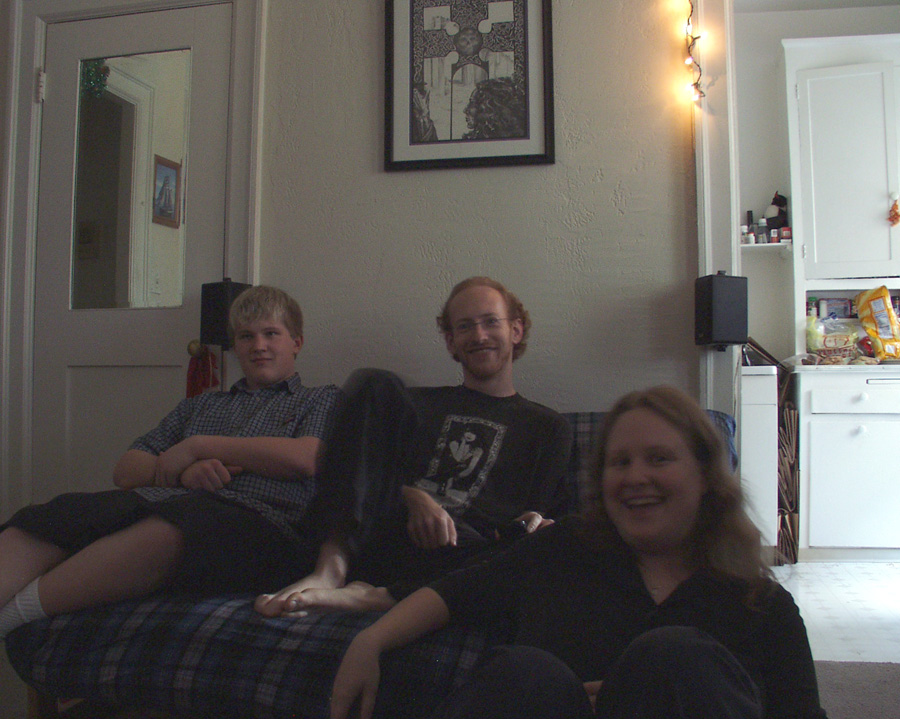
Howdy, Wired readers!

Over a year after the incident, I’m getting another few seconds added to my fifteen minutes of fame: last week I was interviewed by phone by Wired, and their article hit the ‘net today:

What do a flight attendant in Texas, a temporary employee in Washington and a web designer in Utah have in common? They were all fired for posting content on their blogs that their companies disapproved of.

Aside from that leader being a wee bit misleading (I was let go by my previous employer, not the copy company I currently work for), it’s not a bad article.

Update: Wired was kind enough to slightly edit the introductory paragraph to clear up the wording a touch. Thanks much!

If there are any visitors hitting my site for the first time who might be curious about just what happened to me, I can direct you to my fifteen minutes of fame archives, and specifically, the photo, the day I was let go, and my wrapup and responses on the whole shebang.

And, of course, feel free to kick around and poke around the rest of the site. Nice to see you here!

A Book of Blogs

Thanks to Alicia, I just found out about this project of Tvindy’s:

With all the phenomenal writing that has appeared on our various blogs over the past several months, wouldn’t it be cool for us to get together and publish a physical anthology of our greatest posts?

The way I envision it is that several of us agree to participate and have a couple of their entries published in the anthology. Since most people (myself included) find it hard to evaluate their own work, we can make suggestions as to what the best entries of our fellow bloggers are and urge them to choose those. That should make for some interesting debates.

The final product would be a paperback, containing hopefully as many as fifty entries in no particular order. Each entry would identify the name (or pseudonym) of the author and the URL of her/his blog. We’d make a nice cover using combined artwork from various blogs, and there would be an introduction at the beginning explaining what the book was.

He’s got more thoughts on how to approach the project in his next three posts (make that four).

I think this sounds really good, and would love to contribute, if anything I have is deemed worthy of inclusion.

Taking a quick look at my recent Four Years post where I pulled out a lot of highlights, I’m thinking that the following posts would be most likely to work well:

If anyone else has any other nominations, though, I’d be glad to see them. Your views on the “best” posts as readers might be quite different than mine as author.

Panoramic Experiments

Yesterday afternoon I decided to go for a bit of a wander through the weekend downtown shoppers to work on an experiment I’ve had in mind for a bit.

I’ve found over the months that I’ve been using it that the camera I’m currently borrowing does really well at evening, low-light photography, dropping the shutter speed down to do so. I’ve been curious at how panoramic shots would turn out if I took them in the evening, where the long exposures would blur any cars and passing shoppers.

After some experimenting yesterday, I’m somewhat pleased by the results, though I definitely still have some tweaking to do before I come up with something I really like. The issues I’m running into are twofold.

First, I need to try to track down some information on this camera and how to use the manual mode. Last night I left the camera on fully automatic, which works well for single shots. However, as it’s metering separately for each shot, I’m ending up with brightness and color shifts when I stitch the panoramas together. I think I should be able to compensate for this by noting the settings the camera chooses for the first shot on automatic mode, then switch to manual mode to duplicate those settings for the rest of the shots.

Secondly, I’m still figuring out the settings for the stitching software I’m using. I’ve been taking the shots with the camera positioned for portrait (vertical) shots — it takes more shots to create a full 360° panorama, but there’s more vertical image in the final panorama. However, this also means that there’s more distortion at the top and bottom of each image, so while the final panoramas are close to seamless across the middle of the shot, there are occasional artifacts (such as buildings or poles suddenly splitting in two) at the top and bottom of each panoramic.

Still, I like the direction that these are going, and each time I try, I’m getting a bit closer to what I’m aiming for in my head.

Here’s the best of my experiments from last night:

4th and Pine, kitty-corner from the Bon

4th and Pine

This is actually pretty close to what I had in my head, aside from the color shifts. One thing I didn’t think about ahead of time that amuses me in the final image is that of the four stoplights in the shot, two are green, one is yellow, and one is red. Seems a wee bit confusing for the drivers!

Here’s a Quicktime VR panoramic movie of the image (3.7Mb): westlake2.mov.

Pike Place Market Main Entrance

Pike Place Market Main Entrance

Standing in front of the famous fish market, surrounded by Christmas shoppers. Lots of movement in this one.

Here’s a Quicktime VR panoramic movie of the image (2.5Mb): pikeplace2.mov.

Pike Place Market Flower Stands

Pike Place Flower Stands

In one of the side entrances to the market, right between two of the flower vendors. I like the sudden switch between the bright bustle of the market itself and the darker outside world.

Here’s a Quicktime VR panoramic movie of the image (3.4Mb): pikeplace4.mov.

Pike Place Market and Waterfront

Pike Place and Waterfront

Outside the far end of the Market, looking over the waterfront. I think this one’s probably my favorite of the batch (of course, it’s also probably the one with the least amount of odd artifacts).

Here’s a Quicktime VR panoramic movie of the image (3.5Mb): pikeplace5.mov.

Waterfront and Seattle skyline

Waterfront and skyline

Standing on top of a picnic table in the park directly behind the Market, overlooking the waterfront, the Alaska Way Viaduct, and catching part of the downtown Seattle skyline.

Here’s a Quicktime VR panoramic movie of the image (3.6Mb): waterfront2.mov.

And that’s it for this round of experiments. More (and hopefully better quality images) will follow later on, I’m sure.

iTunesHard Day Blues” by Waters, Muddy from the album Folk, Gospel and Blues: Will the Circle Be Unbroken (1946, 2:51).

Raise the roof!

Random silliness over IM tonight…

walkingoctopus: Shit, I’m such a technowhore.

Me: it’s a good thing in my world

walkingoctopus: Cam, digicam, mic, five consoles and a handheld…

Me: yikes
Me: hmm

walkingoctopus: And none of my consoles are online.
walkingoctopus: Haha.

Me: 3 ‘puters, webcam, digital camera, scanner, iPod

walkingoctopus: Hmm.
walkingoctopus: One computer.
walkingoctopus: /me looks around her room.
walkingoctopus: i’ll HAVE a sewing machine, that’s sort of electroncsy.

Me: “old skool” electronic…sorta

walkingoctopus: o/
walkingoctopus: I’m so Amish.

Me: ain’t no party like an Amish party ’cause an Amish party don’t stop
Me: and when they raise the roof, they really raise the roof
Me: barn roof, even

iTunesAll the Way Down” by Voltaire from the album Devil’s Bris, The (1998, 3:45).

E=1/2CV^2 (Hanscom’s Law)

While wandering through /., I stumbled upon this comment, which contained the equation E=1/2CV\^2.

Not having a background in electrical components (the context of this equation), my brain immediately translated ‘CV’ as ‘Curriculum Vitae’.

Logically, it followed that ‘E’ was something related to employment…’Employability’ works.

The end result was that I ended up reading the equation as “Employability = 1/2(Curriculum Vitae)\^2” — or, in layman’s terms, any given job will only require half of what you know, but will require proportionately more experience than you have.

Sounds about right to me. I’ll call it “Hanscom’s Law”. ;)

MSN Spaces reactions

Robert Scoble is collecting reactions to MSN Spaces, including mine:

Michael Hanscom: “Power users and web standards geeks (who are probably not the target market anyway) will definitely want to look somewhere else.” (Scoble’s note to Michael: hey, did you see the Macintosh in the video?)

I actually haven’t taken the time yet to watch either of the two introductory videos that Scoble posted, so no, I hadn’t seen that yet. :) I’ll try to get a look at them later today, maybe this evening.

iTunesGet to Know Ya” by Johnson, Jesse from the album Pretty In Pink (1986, 3:35).

Switch to VoIP?

On the off chance anyone noticed, my site (along with all other sites I host) had about two hours of downtime earlier today. Sorry about that — as it turns out, the DSL modem had frozen up, probably from overheating thanks to the poor ventilation in my apartment. Once it was reset it was fine. Sorry ’bout that.

While I was bouncing around Speakeasy‘s site during the initial round of “what’s going on?” troubleshooting, I ran into some interesting information that may lead to me ditching my current phone service with Qwest.

Item One: Speakeasy OneLink — DSL service that doesn’t require a phone line.

Item Two: Speakeasy Voice — VoIP service.

Item Three: Nice savings when you order both packages.

I already use Speakeasy as my broadband provider, and I’ve been very happy with the service I get from them. I have a good package for a reasonable price, and the few times I’ve had to call tech support, they’ve been quick, friendly, and very friendly (and occasionally just a little bit silly).

I currently use Qwest for my phone service, and have very intentionally been getting the bare minimum necessary package. For me, that means about \$30/month for basic phone service plus voice mail, and nothing else. No caller ID, no call waiting, no other fancy features — and no long distance.

According to Speakeasy’s site, if I were to switch over to their VoIP service, I’d get unlimited long distance in the US and Canada, voice mail, caller ID, call waiting, three-way calling, last call return, do not disturb, and I’d even get to keep the same phone number I’d have now — all for the same price as my current basic service from Qwest.

If I switched over to both OneLink and VoIP, my final cost would be about \$6/month more than what I’m paying now, but the first three months would be cheaper, as you get a “free three months” for signing up (some of which are offset by the setup costs, but that’s expected). All in all, this sounds like a pretty damn good deal to me.

Giving this one some serious thought.

iTunesPredator (Final)” by Collide from the album Vortex (2004, 6:32).

ADD, Hyperactivity, and Ritalin

Jacqueline is curious about using drugs to offset the effects of ADD:

It’s been 13 years since I’ve taken anything for my attention deficit disorder — my childhood experience with Ritalin was awful. But things haven’t been going so well in school lately and I may have to relax my “no drugs, no way” position if I want to get it together and actually do the grad school thing.

Now, before I go any further, I need to put a big disclaimer on what follows: I am not a doctor — I don’t even play one on TV. I don’t have children. I don’t have ADD. I have never been on any prescription medication for anything other than antibiotics. I did go through a period of time when I was playing with recreational drug use, but that was confined to three drugs: a few instances of getting stoned (boring), three attempts at ‘shrooming (two of which times I went to sleep before they kicked in), and about two years of dropping acid on a fairly regular basis (fun for a while, then it was time to stop).

In other words, the following is opinion, and opinion only. Take it as such.

Now.

I have serious issues with the current obsession with ADD and the associated pharmaceutical treatments. My personal belief is that it’s an incredibly overblown and overmedicated issue. This does not mean that I don’t “believe” in ADD, or that I don’t believe that there are people who are affected by it and can benefit from treatment. What it means is that I believe that it’s often diagnosed too quickly, and that the current trend is too quick to depend on chemical treatments that are likely more detrimental in the long run.

My little brother Kevin was an unusually active baby. He had problems paying attention for more than a few minutes at a time, and was rarely still — even in his sleep, he was so constantly wired that he would bruise himself in his sleep thrashing around in his crib. Eventually, it got to the point where my parents were concerned enough that they decided to take him to a doctor and see if there was any medical explanation.

Now, this was back in the late 70’s, long before ADD/ADHD became the catchphrase of the decade. My brother was diagnosed with hyperactivity — an overabundance of energy and inability to focus, brought on by a chemical imbalance within his system. My parents were given a few choices on how to combat this. I don’t know if there were more options given than the two I’m about to mention, but I believe these were the primary options.

The first was Ritalin, a drug that is actually a central nervous system stimulant that has a calming effect on hyperactive individuals because of their unusual body chemistry.

The second was a more natural remedy — dealing with the hyperactivity by monitoring and adjusting Kevin’s diet. The chemical imbalance that triggered Kevin’s hyperactivity was brought on by excessive amounts of certain types of sugars in his system. The hyperactivity was believed to be an allergic reaction to sucrose and a few other compounds: essentially, he was allergic to cane sugar (sucrose), artificial flavors and colors, and honey. It was thought that by eliminating those elements as much as possible from his diet, it should be possible to regulate the imbalance and allow Kevin to lead a calmer, more normal life.

A little bit of Googling has turned up a few pages on the subject of hyperactivity and diet, leading me to this Q and A page that pinpoints this approach to treating hyperactivity as the Feingold Diet (further searching for “finegold diet” returned that same page as the top result). It’s apparently a somewhat controversial approach, as testing Dr. Finegold’s theories resulted in “mixed and inconsistent results” — see paragraph eight of the “20th Century History” section of Wikipedia’s ADD page for more information.

I don’t know how much was known about the Finegold Diet at the time that my parents were investigating Kevin’s unusual behavior, or how it was viewed at the time. Whatever the situation was, my parents decided that it was at least worth trying before resorting to drugs, and so Kevin’s diet was changed (along with the rest of us, of course — something that I’ve always half-believed is responsible for why I have such a sweet tooth: until the age of about four or five, I had a normal little-kid diet high in sugars; suddenly, nearly all sugars and sweets were removed from the house, and I missed them — but I digress…). We found that he could process fructose (fruit sugars) normally, and so that became the sweetener of choice in our family.

And it worked. It worked quite well, in fact. Suddenly, Kevin was manageable — at least, no more hyper than any other young child. And, in case there were ever any doubts as to whether it was the diet making the difference, the changes in his behavior when he did manage to get ahold of anything with high amounts of sugar were staggering (I remember one instance where after getting into a stash of Oreos I had hidden in my room he got to the point of physically attacking our dad — a rather scary situation for all of us). When his sugar levels did start to get a little high, all it took was a couple cups of coffee to calm him down, as the caffeine worked with his body chemistry in a similar way to how the Ritalin works: what’s a stimulant to a normal person acts as a depressant to a hyperactive person.

Now, obviously, no two people are going to have the same body chemistry, and a solution for one person isn’t necessarily a solution for all. Even when one solution does present itself, something as simple as time can make a huge difference — as my brother aged, he became less and less adversely affected by the sugars that sent him into fits as a child, and to my knowledge, he hasn’t had to worry about any medical dietary restrictions for quite a few years now. According to the above referenced Wikipedia article, testing on Dr. Finegold’s methods resulted in wildly inconclusive results, with success rates reported as anywhere from as much as 60% to as little as 5% of the test subjects.

So no, it’s not a catch-all, and I harbor no wild beliefs that because it worked for my brother, it will work for everyone else. However, I know it helped my brother, and even working with the low end of the reported success rate — five percent — if four million children are diagnosed with ADHD each year, then that’s around 200,000 that could see a substantial difference simply by experimenting with their diet (and I’d bet that choosing your foods wisely is a lot cheaper than filling a Ritalin prescription for years).

It just seems to me that if there’s a possibility of being able to help someone with something as simple as a little attention to their diet, than shouldn’t that be one of the first things investigated? It may not work — there may even be a 95% chance that it won’t — but if it does, than it’s easier, healthier, cheaper, and it would probably take no more than a few weeks or a few months to be certain as to whether a different diet is making the difference. Why start with the howitzer when a slingshot might be all you need?

What concerns me are two things: firstly, that I rarely (if ever) hear of people who know about the potential benefits of the dietary approach; and secondly (and more importantly), I really wonder sometimes if people these days are overly quick to assign their children the label of ADHD.

<soapbox>

Quite simply, children are supposed to be hyper! Yes, if it’s excessive, get it checked — but please don’t jump to the conclusion that a child is hyperactive simply because you’re having troubles controlling them. Children need to be active and interested in everything around them, it’s how they learn. They’re plopped down in the middle of this huge world, with all sorts of stuff to explore and investigate and taste and pound on and break and put together and figure out how it all works — and it really worries me when it seems to me that some parents are in far too much of a hurry to drug their children into insensibility because it would make their life easier.

Okay, I think I’m done.

</soapbox>

A Seattle-centric blonde joke

A blonde was feeling so depressed that she decided to end her life by throwing herself into Puget Sound. She went down to the docks and was about to leap into the frigid water when a handsome young sailor saw her teetering on the edge of the pier crying.

He took pity on her and said, “Listen, you’ve got a lot to live for. I’m off to Europe in the morning and if you like, I can stow you away on my ship. I’ll take good care of you and bring you food every day.”Moving closer, he slipped his arm around her shoulder and added with a wink, “I’ll make you happy, and you can make me happy.” The blonde nodded yes through her tears. After all, what did she have to lose?

That night, the sailor brought her aboard and hid her in a lifeboat, along with blankets and food. From then on, every night he brought her sandwiches, water, wine and fruit and they would make mad, passionate love until dawn.

Three weeks later, during a routine inspection, she was discovered by the Captain. “What the hell are you doing here?” the Captain demanded angrily. I have an arrangement with one of the sailors,” she explained. “I get free food and a trip to Europe. Meanwhile (she says coyly) he’s taking advantage of me so to speak (wink, wink).”

“He sure as hell is, lady,” the Captain said, “this is the Bremerton ferry.”

(via LJ Seattle)

iTunesGabrielles Party“ by Mason, Steve from the album Goa Rave (1994, 7:20).