Believe it or not — and these days, many people likely wouldn’t — Anchorage used to have a pretty active underground scene. I spent many, many years as part of it, both as a spectator and as a participant, and it went a long way to shaping the person I am today. I’ve got a lot of fond memories of those times.
Yesterday in my post about Symphony #2 for Dot Matrix Printers, I mentioned Anchorage industrial/noise band Fsunjibleableje (eff-sun-jib-lee-ah-ble-juh). Phil asked if I had any .mp3s of their work, and unfortunately, I don’t — to my knowledge, they never recorded anything. I was prompted to do a quick Google search of their name to see what I could find.
There weren’t a lot of results (though, amusingly enough, the third result was for my old DJ Wüdi propaganda page), but one of the results I got sent me on a long, fun trip down memory lane. Back in October 2000, the Anchorage Press (Anchorage’s version of Seattle’s Stranger or Seattle Weekly) published a retrospective of the Anchorage scene by Josh Medsker — [The Decline of Northern Civilization].
The article is a great look back at the rise and fall of the punk/band scene in Anchorage. Josh is a year older than I am and discovered the scene a bit earlier than I did, so the first few paragraphs are good historical information, but aside from knowing many of the names, I wasn’t around for much of the early events. By the time Josh gets to the early ’90’s, though, I had started to get out of the house and explore the world around me.
Another venue that opened in 1990 was the Ragin’ Cage, a dive across Spenard from the Fly-By-Night Club. The sound at the Ragin’ Cage was bad, and the decor was non-existent, except for the neon paint splattered on the black concrete floor, and dilapidated couches in the corners.
The Cage — home to regular shows by Hessian (featuring lead singer Brock Lindow) and Ted “Theo” Spitler of Heavy Season — quickly became infamous for it’s violent patrons. The owners eventually put a chain link fence up around the stage to protect bands from their audience.
Ragin’ Cage became a hang-out for skinheads. Vox Populli, a local underground publication, started out as a straight-up punk ‘zine before gradually turning into a platform for editor Mark Watson’s white-power views, and a rallying cry for Anchorage skinheads.
“There have never been many SHARP skins (Skin Heads Against Racial Prejudice) in this town,” said Jennifer Morris, who was host of “Amber Waves of Ska” on KRUA. “It’s mostly been nazis.”
I never made it into the Cage, though I went by it a couple of times. Unfortunately (well, possibly fortunately), every time I drove by, there were fights going on just outside the front door — often skinheads pounding some person that had ticked them off in one way or another — and I and my friends always decided we’d go somewhere else for the night. The skinhead clientele of the Cage was so well known of around town that I heard more people refer to the club as the “Racist Cage” than by its proper name.
As for the skinheads…I’ve had a few run-ins with them, which I’ll probably go into more detail about in a separate post later on. Briefly, though, I was fortunate enough to meet a couple very intelligent, well-spoken skinheads that I had some very interesting conversations with, and I was unfortunate enough to be threatened (though not beaten) by a group of them, so my experiences ran to either extreme. I ended up with a slight fascination with the subculture, though, and while I’ve never invested a lot of time or research into that particular scene, I’ll often keep an eye out for movies that explore that side of the underground culture (John Singleton’s Higher Learning, Russell Crowe’s early film Romper Stomper, and American History X are all worth watching).
The above-quoted Jen Morris, by the way, was a friend of mine at Bartlett High School. A few years older than me, I got to know her while on tech crew for the theater department there, and kept up with her off and on over the years before I left town. I also had quite the crush on her for a while, though I certainly never told her that (though, me being the oh-so-subtle type I was back then, I wouldn’t be at all surprised if she knew).
The article soon turns to the Anchorage warehouse scene, which dominated the underground scene for quite a few years, usually in spaces run by Trey Wolf and Rex Ray. Amusingly enough, the very show that I mentioned in my post yesterday — Fsun’s car demolition performance — is mentioned, along with another performance I attended which culminated in Trey’s crucifixion on a cross made up of circuit boards.
One early FSUN show at Spatula City sticks out in Wolf’s mind. The band took an abandoned car off the street, and they and the audience members took turns wailing on it with saws and hammers.
…at one show, Wolf suspended himself by halibut hooks through his hands to a cross made of old computer parts. With Wolf dangling above the crowd, the rest of the band created a violent soundscape behind him using electronics and found metal objects.
I truly think that I have Rex, Trey, and Fsun to thank for my fascination with early industrial, “noise” and experimental bands like Einstürzende Neubauten. While even at that age I’d never been much of one for the pop scene, and had started searching out some of the lesser-known, darker, “alternative” bands (ranging from Violent Femmes to The Cure to Shriekback, Bauhaus, and many, many others), here was something so bizarre, so unstructured, so primal, and totally unlike anything I’d heard before that it blew me away.
Nineteen-ninety-two was also the year the rave scene broke in Anchorage. DJ Fuzzy Wuzzy began spinning techno at Sharky’s on Fifth Avenue, and DJ Drewcifer was spinning grooves from Bauhaus, Ministry and Throbbing Gristle at the Mirage in Spenard.
Both the Mirage and Sharkey’s were all-ages, non-alcoholic clubs. I hit the Mirage from time to time, but I practically lived at Sharkey’s during the time it was open. Originally a top-40/hip-hop club, word started to spread around town that the owners of Sharkey’s were considering opening their basement to the alternative scene. I, along with many other of the kids in town, started dropping by on random weekend nights asking about the rumors, and was always given a “We’re thinking about it…” response — until one weekend, another door was open. I went in, sparing only a quick glance at the upstairs, headed down the stairs, around a corner…and found my home from that night until the club closed.
In some ways, there wasn’t really much to Sharkey’s. The owners had done little to nothing to prepare the basement for use outside of clearing it out and installing a DJ booth and speakers. There was one main room with the dance floor (that had a concrete support pillar smack-dab in the middle of the floor) and space around the side for standing and watching, and two smaller rooms towards the back with a small selection of ratty couches and counter space for kicking back and hanging out. Over time, people brought in paints and decorated the walls, the floor, and the entire space, and as it was all unplanned and uncontrolled by the owners, the decor tended to change from week to week as new paintings went up, stayed for a while, and then were covered by the next round of artistic outpouring.
Steve Kessler, who I’d gone to high school with, got his start as DJ Fuzzy Wuzzy at Sharkey’s. He was one of two or three regular DJs there (unfortunately, I don’t remember the others), and eventually went on to form a promotion company that kept the Anchorage rave scene going well into the early 2000’s (though my fondest memories of that particular scene all stem from its first few years in the late 1990’s, before ‘raves’ started becoming reported as the latest evil to befall the youth of today).
I’d be at Sharkey’s every Wednesday, Friday, and Saturday night, hanging out with friends, dancing, and at that time, going a long way towards exploring who I was outside of the manufactured “trying to please everyone” anti-personality that I’d been saddled with for many, if not most, of my younger years. Eventually, of course, Sharkey’s closed down, but it will always be one of the clubs that I have the fondest memories of.
[1992] was also the year KRUA 88.1 came on the air. KRUA was born a few years earlier as KMPS, a campus-only radio station, but on Valentine’s Day KRUA went FM.
Another watershed event in my life. Suddenly, there was a station in town playing music that I liked, not just the pablum of top-40! I was a constant listener of KRUA for years, from the day they went FM on. At one point, one of the shows was asking for dedications. Being terminally single at that point, and not particularly happy about it, I called up and dedicated Depeche Mode‘s ‘Somebody‘ “to all the single people in Anchorage.” Years later, while talking with a friend, I found out that not only did they remember that show, but they still had a tape of the show itself, and I got to hear my dedication going out all over again.
In the fall of 1992, in a small art gallery next to Spatula City, several blocks away from the old Wherehouse, a group of artists and scenesters gathered, forming the core group that would dominate Anchorage for most of the coming decade. The B.A.U. (Business As Usual) Gallery was run by Brian MacMillan, a transplant from Boston known to most as just “BMac.”
While I never got to know BMac well, he and I ran into each other many, many times over the years, either at shows, or through work. As I’d been working evening/night shifts in copy shops for much of this time (first Kinko’s, then a local shop called TimeFrame), I was quite used to helping run of flyers for shows or articles for ‘zines, and along with Rex, BMac was one of the constant (and more successful) ‘zine publishers in town.
Eventually various monetary problems forced the various warehouses into obscurity, and things moved into other venues. Various coffee joints sprung up around town catering to the alternative scene, with the two most known likely being The Java Joint and Mea Culpa. Given the strong punk contingent of the scene, however, things at the coffeehouses didn’t always go over spectacularly well…
Some bands had a few things to say about Mea Culpa, however. “It was kind of yuppie to us,” says singer Sam Calhoun. One night, at the end of a sweaty, rockin’ set, Calhoun and members of her band, Phillipino Haircut, purposely threw up on stage and in the bathroom. They were kicked out of Mea Culpa indefinitely. “We actually tried to projectile vomit on stage,” Calhoun recalls. “It was just [us] being young and being punk.”
That’s a show I missed. I think I’m okay with that, though. ;)
Of course, all of this has been for the all-ages set, either at warehouses where there wasn’t much in the way of rules, or non-alcoholic clubs. The over-21 set had had a good thing going for quite a few years with the Underground bar, which became something of a local legend among those of us not quite old enough to get in. Unfortunately, the Underground died a fairly quick and very sad death after one of its regular patrons, Duane Monson of local band Broke, accidentally knocked over the beer of another patron — who proceeded to pull out a knife and stab and kill Monson. I turned 21 just a couple months after this event, and was able to get into the Underground before it closed on my birthday, but it was obvious that the bar wouldn’t be open for much longer, as there were only eight or ten other people in the bar (including all on-duty staff) the entire night.
However, the Underground did have one last blowout show before they shut the doors that I was lucky enough to attend — twice even, as they had a 21-and over show on Friday night, and then an all-ages show Saturday evening — when the Washington-based Black Happy came through town. Great show, great music, and the place was packed, giving me probably my only taste of what the Underground must have been like in its heyday.
Nature abhors a vacuum, though, and soon, another club opened for the band scene that would also play a big part in my life for the next few years: Gig’s Music Theatre.
Gigs was owned and run by Mike Sidon, Scott Emery, and later Mark Romick. Gigs, along with the Java Joint and the UAA Pub, were pillars in the local music scene for the next several years, though Gigs intended to be more mainstream than it turned out to be. “It kind of gravitated toward being a punk rock place,” says Emery.
Gigs thrived at first, with shows from the sloppy, classic punk band Phillipino Haircut, the hardcore Beefadelphia, Hopscotch, 36 Crazyfists, the ska/punk band McSpic, the unclassifiable, insanely loud Contour Chair, the rap-rockin’ Freedom ’49, and the punk trio Liquid Bandade.
My brother Kevin was one of the members of Beefadelphia (named after a Denny’s menu item). 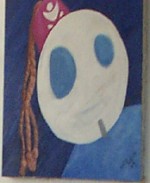 Beefadelphia’s logo was a stylized man wearing a fez, which at one point was turned into a painting by band member Aaron Morgan. The painting was given to Gig’s and hung in the office for years. When Gig’s finally closed down and we were emptying the place out, I was able to get ahold of the painting, and it’s been hanging on my wall ever since then. Not long before I left Anchorage, Aaron came by my apartment and saw the painting. Laughing, as he’d not realized that I’d ended up with it, he whipped out a Sharpie and signed it for me on the spot.
Gig’s, of course, along with the Lost Abbey, was where I spent the majority of my years DJing for the Anchorage scene. Each night, we’d generally open around 8pm, I’d play music for a while, then we’d have one to three bands playing with me providing between-set music, then I’d DJ until we closed down (generally around 3am or whenever we ran out of customers, whichever came first).
By 1997 and 1998, though, the scene finally seemed to be on its last legs. Many of the bands had split up, moved out of state, or both. Gig’s closed, and there were few other places providing spaces for bands to play. The rise of the hip-hop scene was in full swing in Anchorage, and I, along with many other friends, came to the sad conclusion that the “glory years” had finally passed us by.
I bided my time in town for the next few years, catching the occasional show here and there, but eventually decided that it was time to find something else, and in the summer of 2001, I joined the ever present exodus out of Anchorage.
Still, with as little interest as I have in living there again, I have many, many fond memories of my years there. Lots of good people, friends, bands, parties, and shows.
Sometimes it can be a lot of fun to go wandering down memory lane.