♿️ I spent all week in Spokane for the annual linked spring conferences for DSSC (Disability Support Services Council) and WAPED (Washington Association on Postsecondary Education and Disability), two disability in higher education groups I’m part of. Both conference were good, with a good mix of networking, support, and information; many of these are people I see regularly via Zoom and on listservs, and it’s always good to get a chance to connect in person.
😷 Unfortunately, it appears that I let my masking game slip at an inopportune point, and came home from the conference with a cold. So our weekend was a lot of rest, fluids, and trying to kick this out of my system.
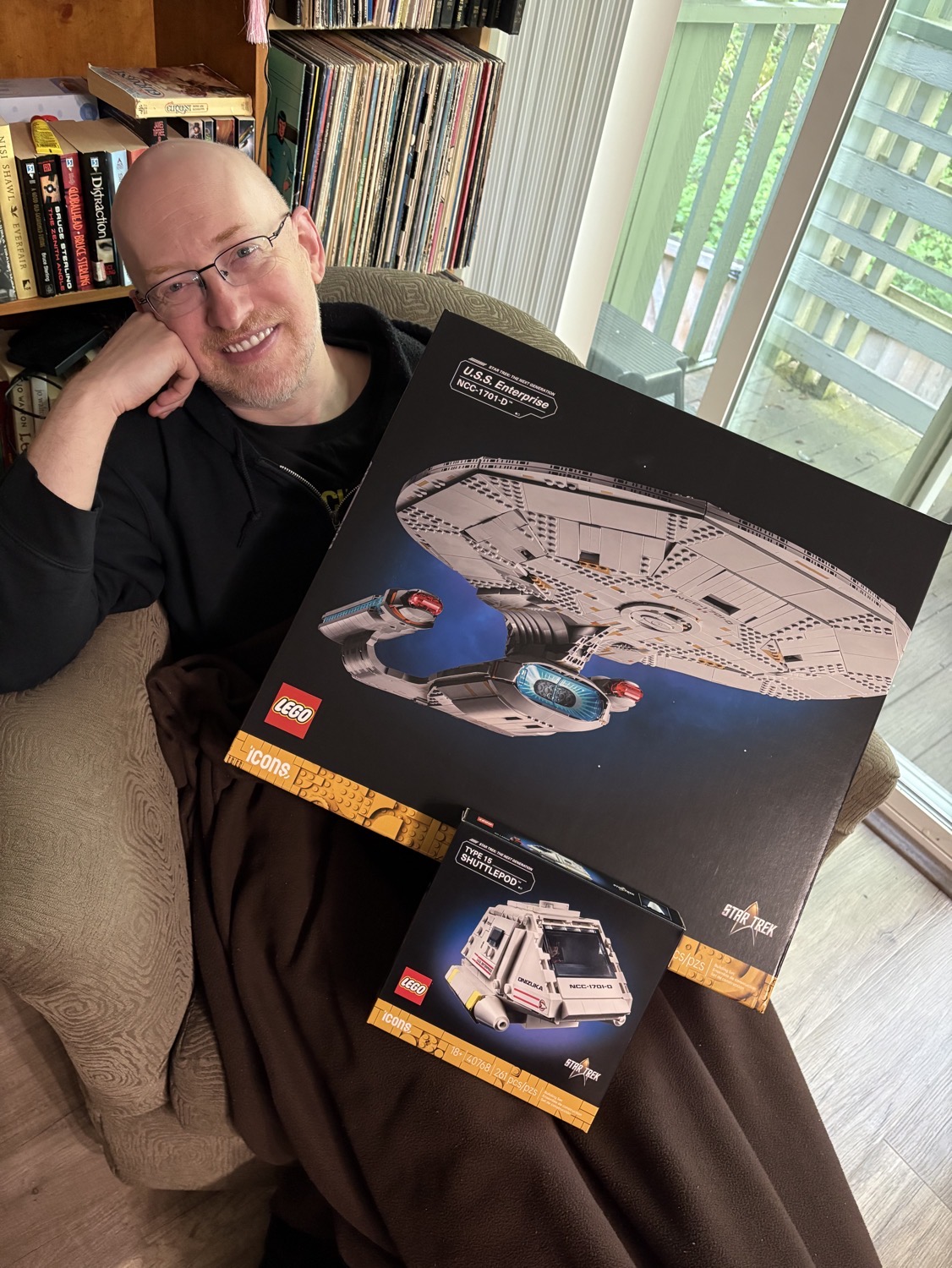
🎂 Sunday was my birthday – I’ve successfully made it to 53! This was a pretty low-key birthday (in part due to the aforementioned cold, but also planned that way, as we knew I’d be coming off of a week of travel and conference), but it wasn’t a bad one. Lots of naps, some cake, and a few presents…including the Enterprise-D Lego set that’s been sitting in our basement since it arrived in December!
📸 Photos
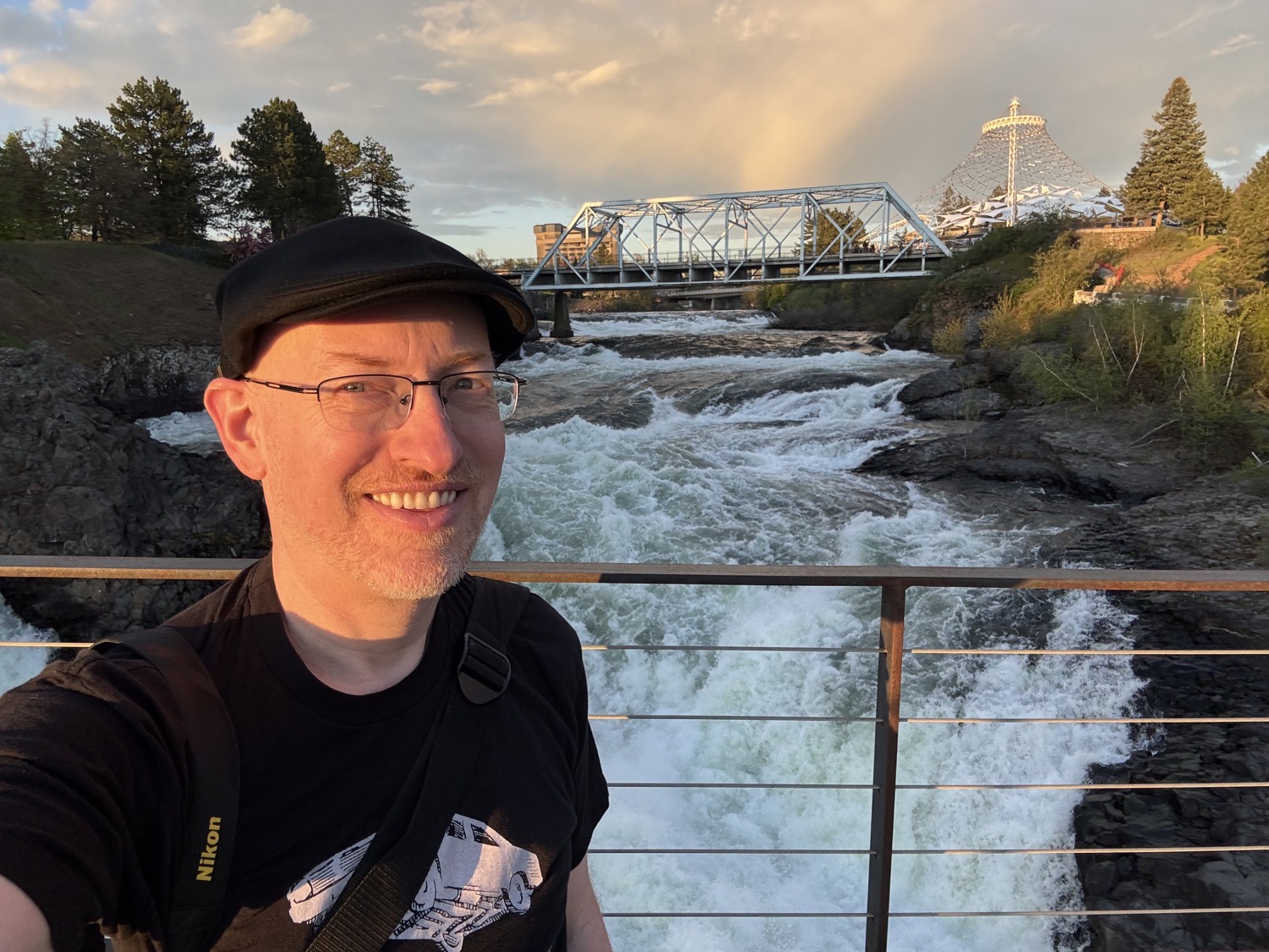
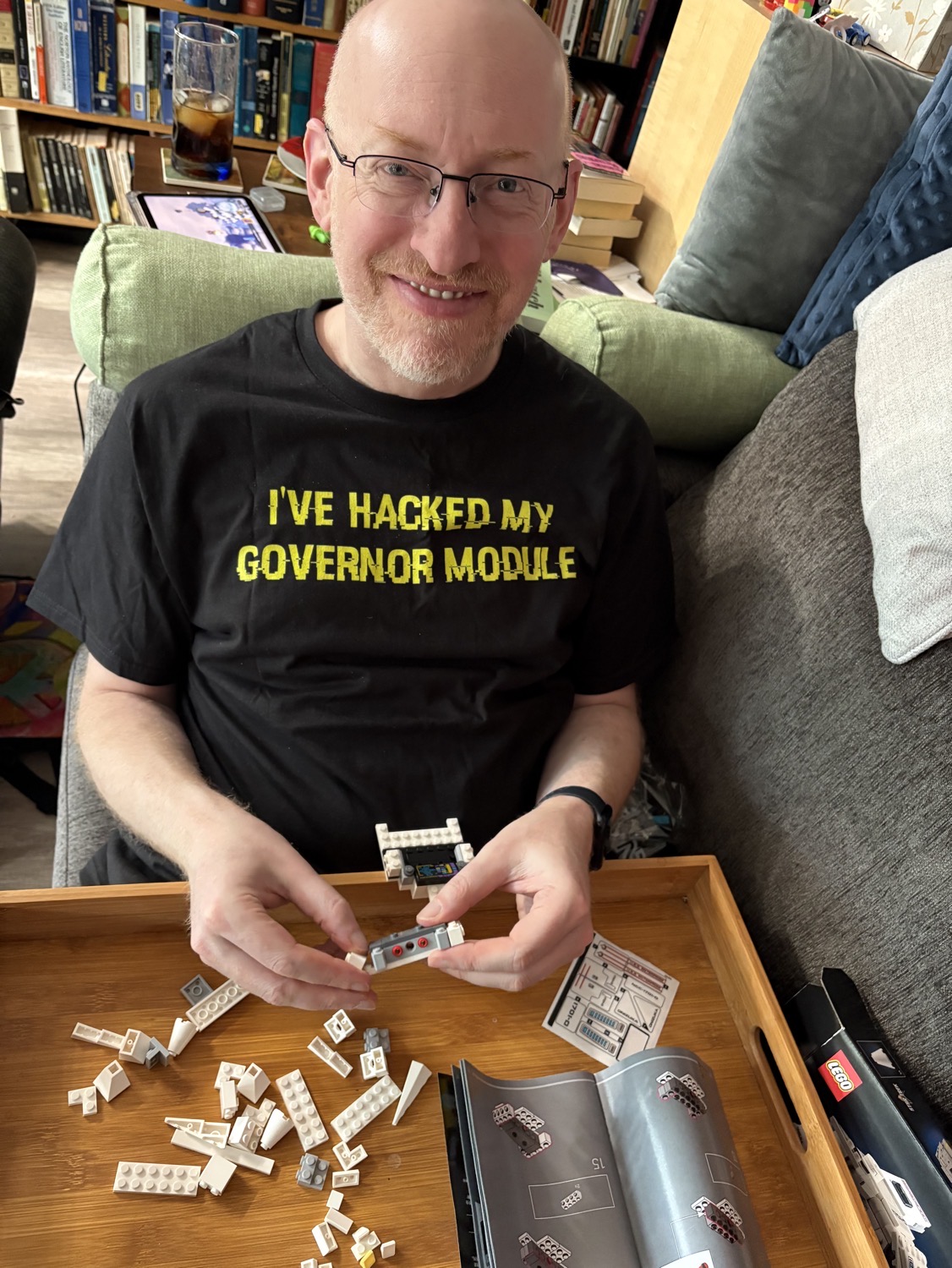
I spent one of my evenings in Spokane having a very pleasant walk along the river. I took a bunch of photos, but concentrating on taking care of the cold means that they’re not processed and online yet. I’ll get there….Me at 53 with two of my most-anticipated birthday presents.The shirt was another of my presents. Become ungovernable!
📚 Reading
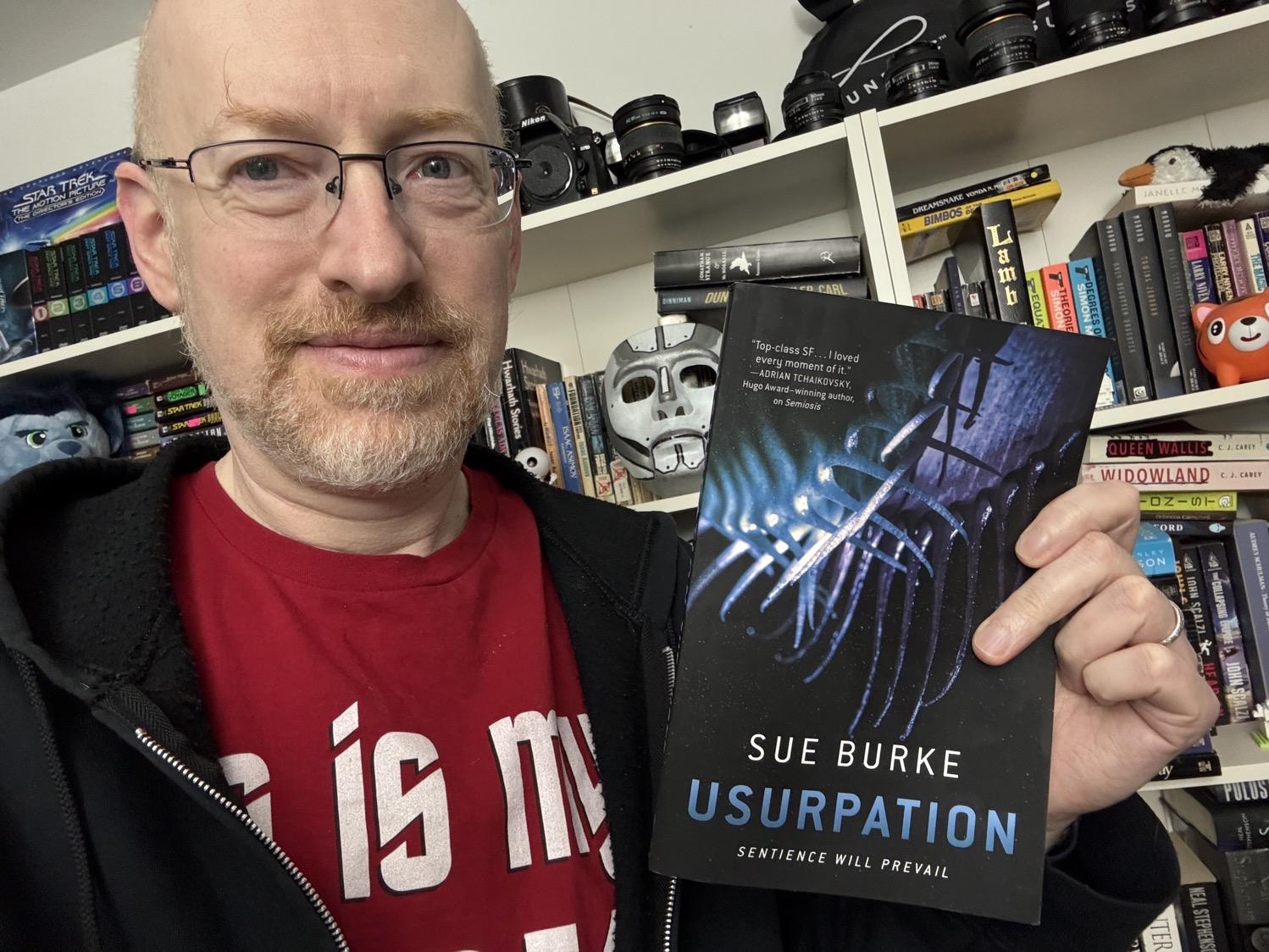
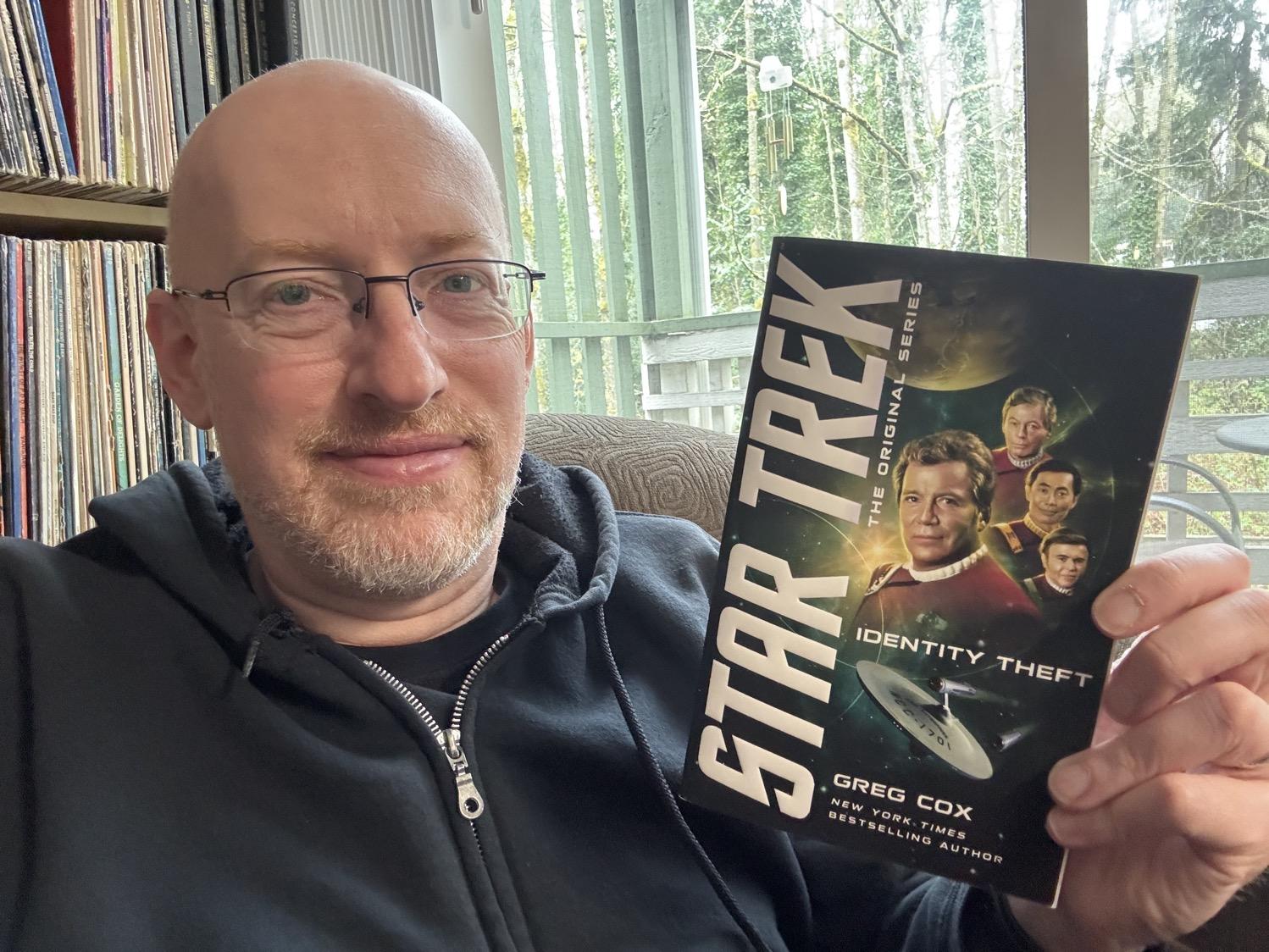
Two books finished this week, the final two books in a TOS Star Trek trilogy that I started last week:
I’ve been on a bit of a Front Line Assembly (and associated projects) kick this week, in part due to the release of the nine-disk Excursions 1992-1998 anthology, focusing on various FLA side projects (Noise Unit, Synæsthesia, Pro>Tech, Equinox, and Delerium).
🔗 Linking
Joshua Solorzano at the Kent Reporter: Federal Way man’s Lego legacy includes model of Space Needle: “Hussey said his acme is the 14-foot-tall Lego Space Needle that now sits in the Space Needle gift shop in Seattle for visitors from around the globe to see.”
Mike Carson: I Bought Friendster for $30k — Here’s What I’m Doing With It: “…I created an iOS app for Friendster, and I made it so that in order to connect with someone as a friend, you have to actually tap phones together in real life. […] If two friends go a full year without tapping phones, the link between them softens. Not a punishment — a gentle nudge that real friendships are kept alive in person, not online. […] All of this is built around the simple idea that real friendships happen when you actually meet in person.” It’s an interesting idea, but I have more than a few quibbles with the assumption that I don’t have “real friendships” with the many, many people whom I have rarely, if ever, interacted with in person. Or that the friend I’ve had since third grade isn’t a “real” friend because we live 3,000 miles apart and don’t arrange for annual get togethers. It’s a interesting, but for me, somewhat flawed concept.
Anil Dash: Why are the Artemis II photos on Flickr?: “If you followed along with the recent joyful celebrations of the Artemis cruise around the moon, and took a moment to dive into the photographic archives of the mission, you might have noticed that all of the original images were shared by NASA on the venerable photo sharing service Flickr. What you might not know is… why?” I remember so much of this history — I joined Flickr in September 2004 (here’s my first photo), when it was just seven months old (according to Wikipedia), and while never a “big name”, was around for all of that history. 22 years and 22,192 photos later, I’m glad Flickr’s still doing its thing.
Jaron Schneider at PetaPixel: Adobe Has Run Out of Allies: “It is hard to imagine a more widely detested brand among its own users than Adobe. ¶ Adobe is alone, and it has only itself to blame. ¶ Those who once would have thrown themselves in front of oncoming fire to protect the software they loved — loved because of what it allowed them to do — will now do nothing but point and laugh as the company suffers.”
Artemis II Photo Timeline: What it says on the tin. Great way to browse through the Artemis II mission.
Tom Nardi at Hackaday: The GPS III Rollout is Almost Complete, But What Is It?: “Just last week, the tenth GPS III satellite was placed in orbit by a SpaceX Falcon 9 rocket. Once it’s properly configured and operational, it will join its peers to form the first complete “block” of third-generation GPS satellites. Over the next decade, as many as 22 revised GPS III satellites are slated to take their position over the Earth, eventually replacing all of the aging satellites that billions of people currently rely on.”
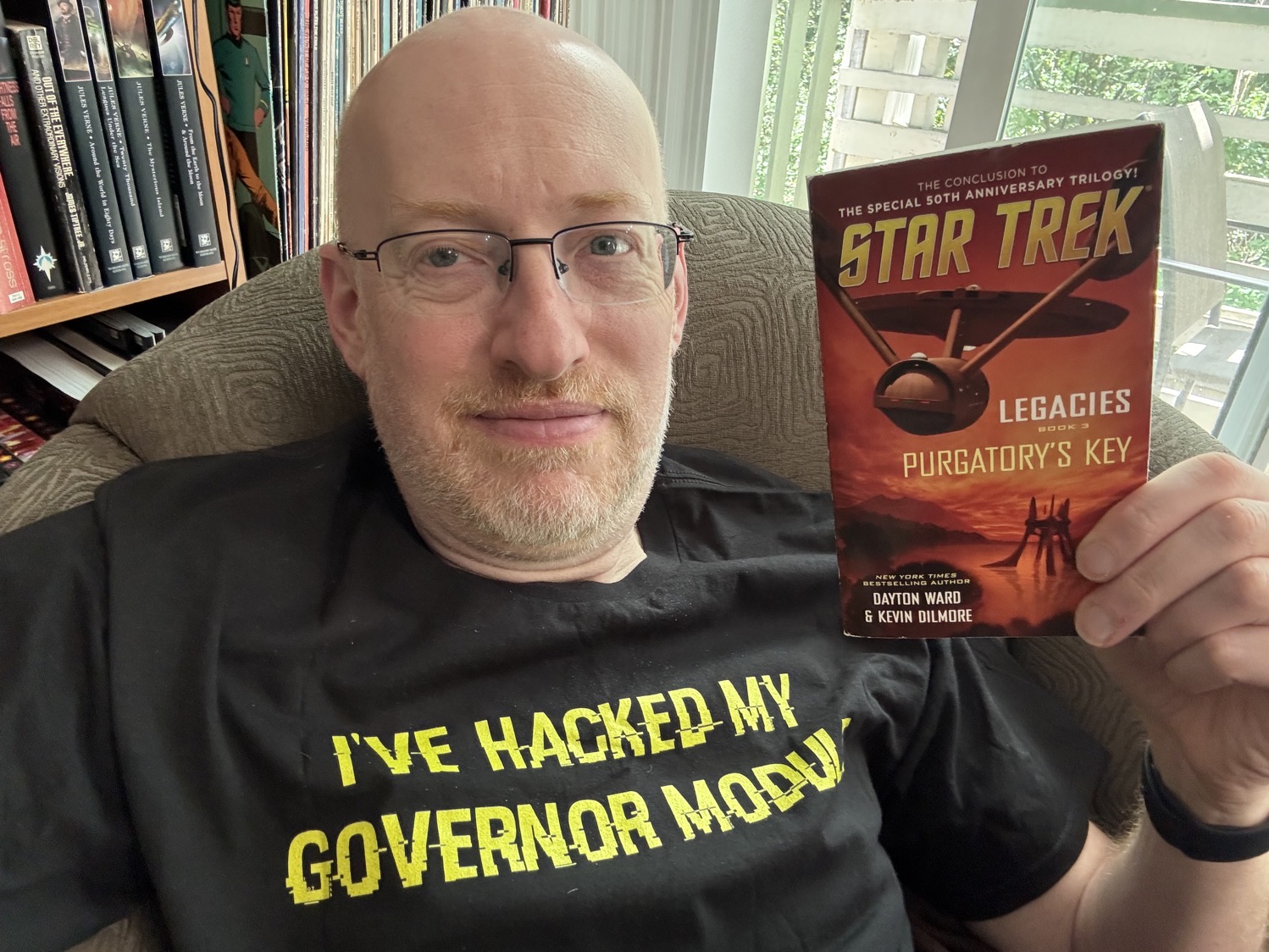
Book 16 of 2026: Purgatory’s Key by Dayton Ward and Kevin Dilmore.
⭐️⭐️⭐️: Good wrap up to this 50th anniversary trilogy. A bit of a bummer that one of the villains was so similar to one in the prior book (a woman so obsessed with a particular goal that she makes increasingly irrational and ill-considered decisions), but otherwise does a good job tying things up with the rest of the books. Overall, the trilogy does well in touching on a lot of TOS and incorporating hints of things to come.
Well, it’s been a busy month. I kept meaning to come back to this “Weekly Notes” series and get caught up, and then there were more things to do, and here we are! So let’s just do a quick catch up.
March 30–April 5: Norwescon week! I have a half-written post-con wrap-up in progress, but who knows if it will ever get finished, so I’ll just say that it was a really good year. Had a lot of fun with friends, DJ’d a good dance on Thursday, the Philip K. Dick Award ceremony on Friday went well, and my accessibility presentation on Saturday was lightly attended, but everyone who was there was very engaged and expressed how much they appreciated the information they got.
April 6–12: A quiet week, somewhat intentionally so, as this was between Things Going On.
April 13–19: A busy work week, with a weekend jaunt down to Vancouver, WA for a work conference for my wife, while I took a day to explore the Vancouver area and bounce down into the Portland area to visit my mom.
April 20–26: Another busy work week, a lot of which was concerned with the sudden (if not entirely unexpected) delay of the ADA Title II update implementation deadline from this Friday the 24th to a year from now. It could have been a lot worse than a one-year delay, but there are a lot of us wondering what else is going to happen over the next year….
📸 Photos
Each of the following photos is linked to a larger photo album on Flickr. Click on through for more!
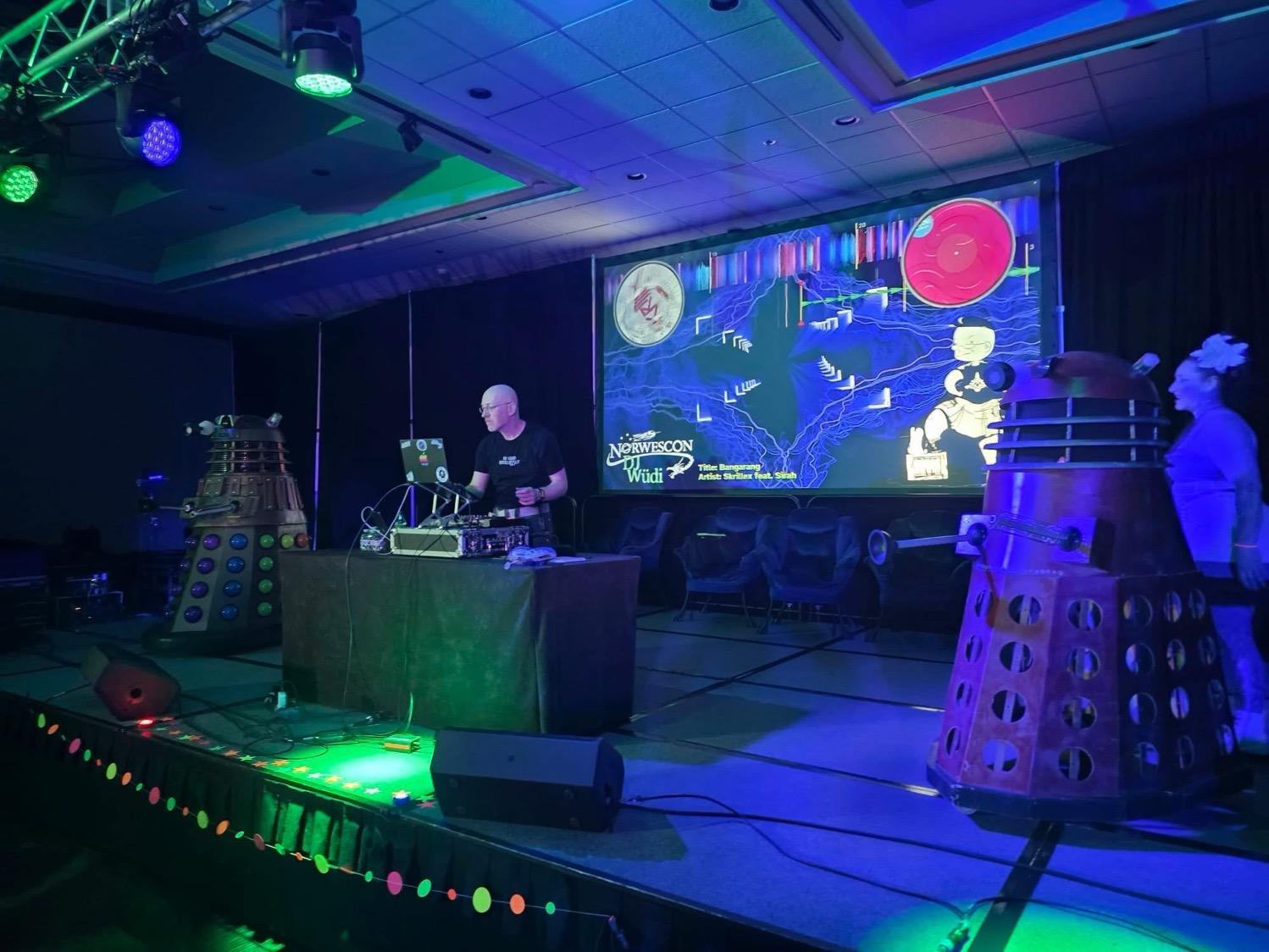
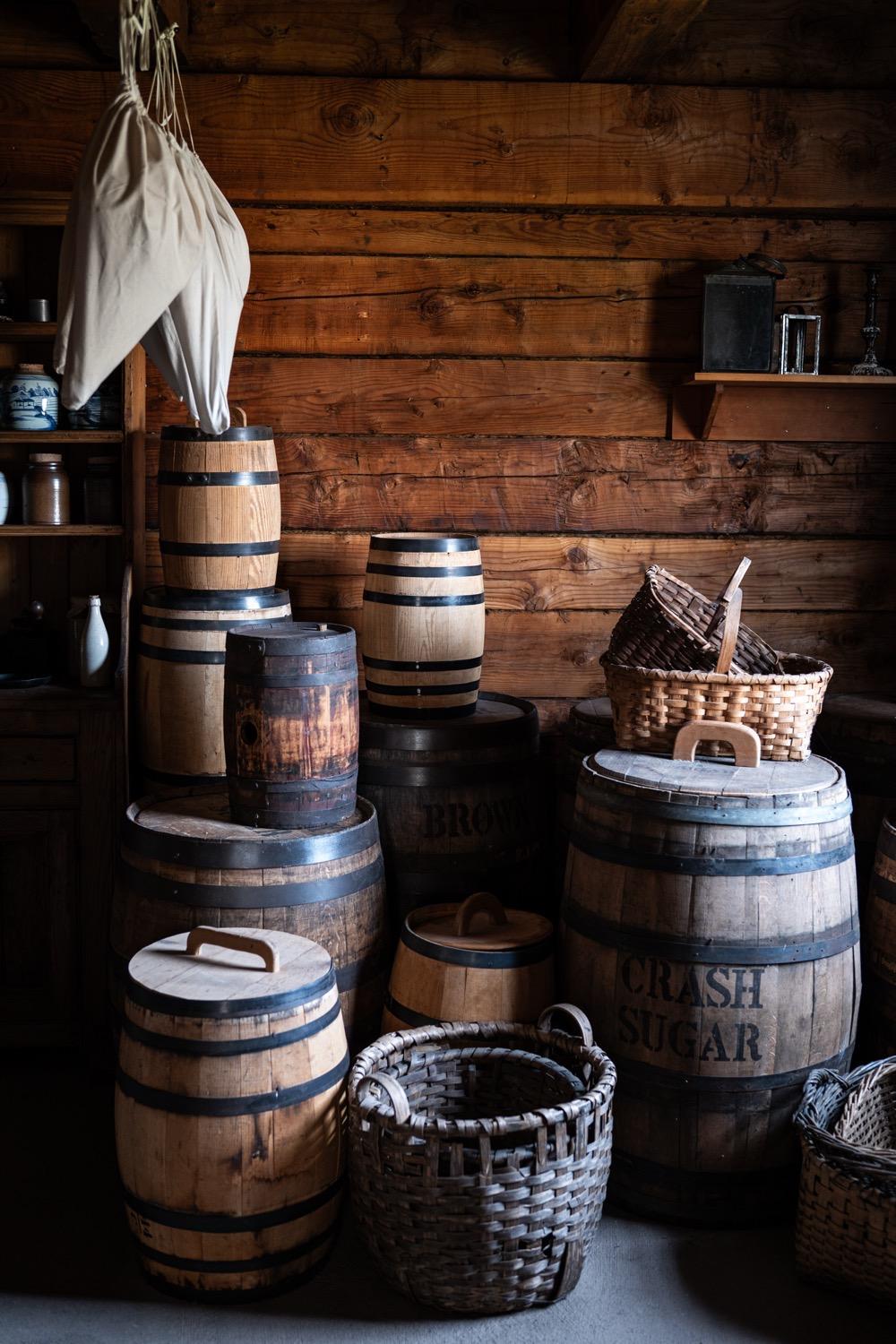
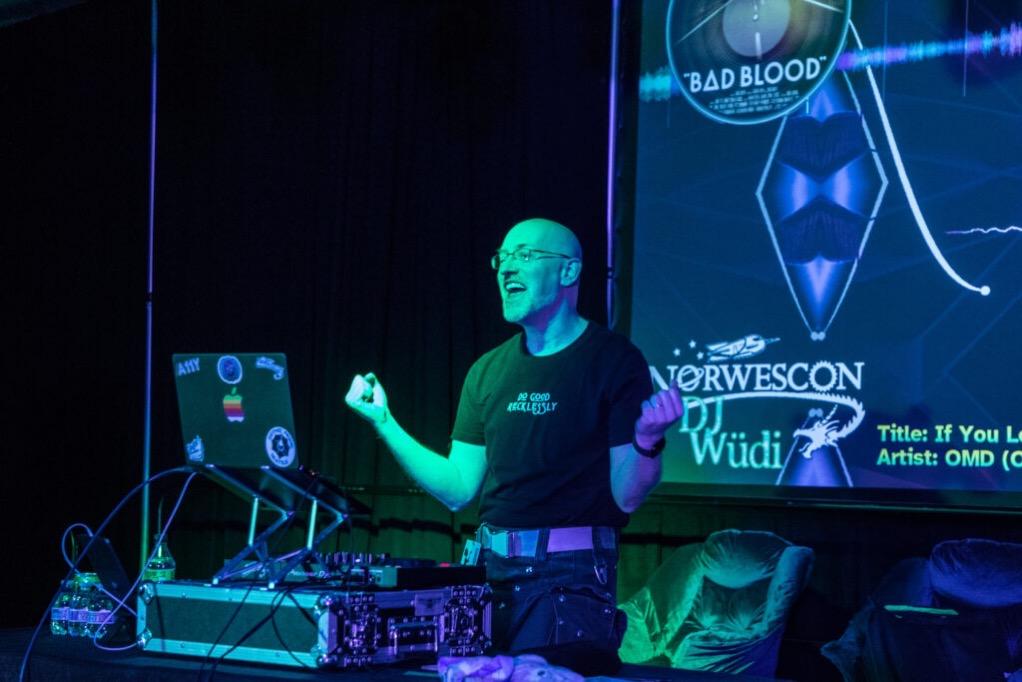
DJing on Thursday night at Norwescon as our security team keeps their eye(stalk)s out. Photo courtesy of Pascale.A favorite shot from when I was exploring Fort Vancouver.
📚 Reading
I’ve finished four books over the past four weeks:
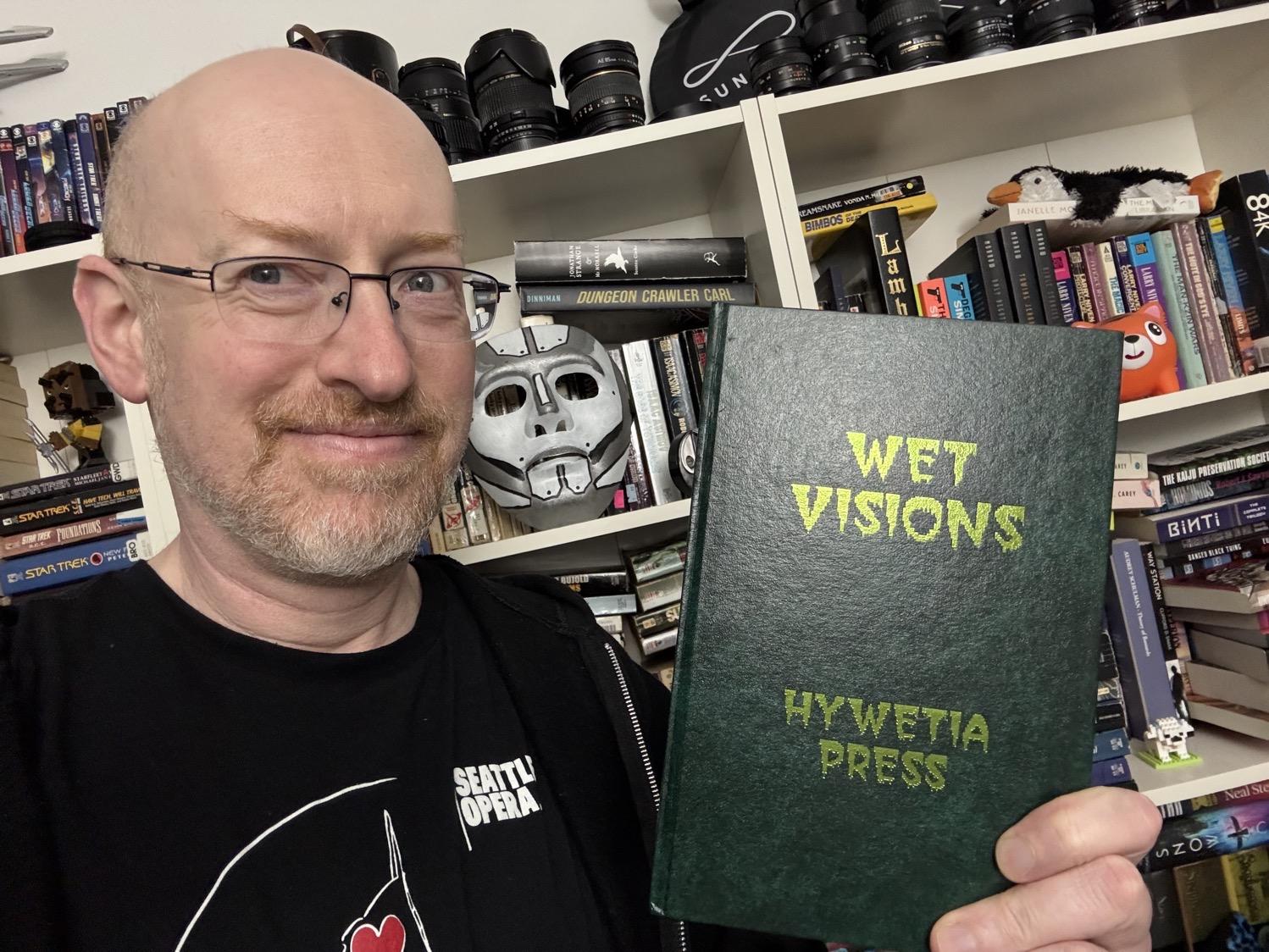
Wet Visions edited by Cyn Mason; an anthology from 1988 of stories by Pacific Northwest authors that I discovered because it was regularly mentioned in old Norwescon program books.
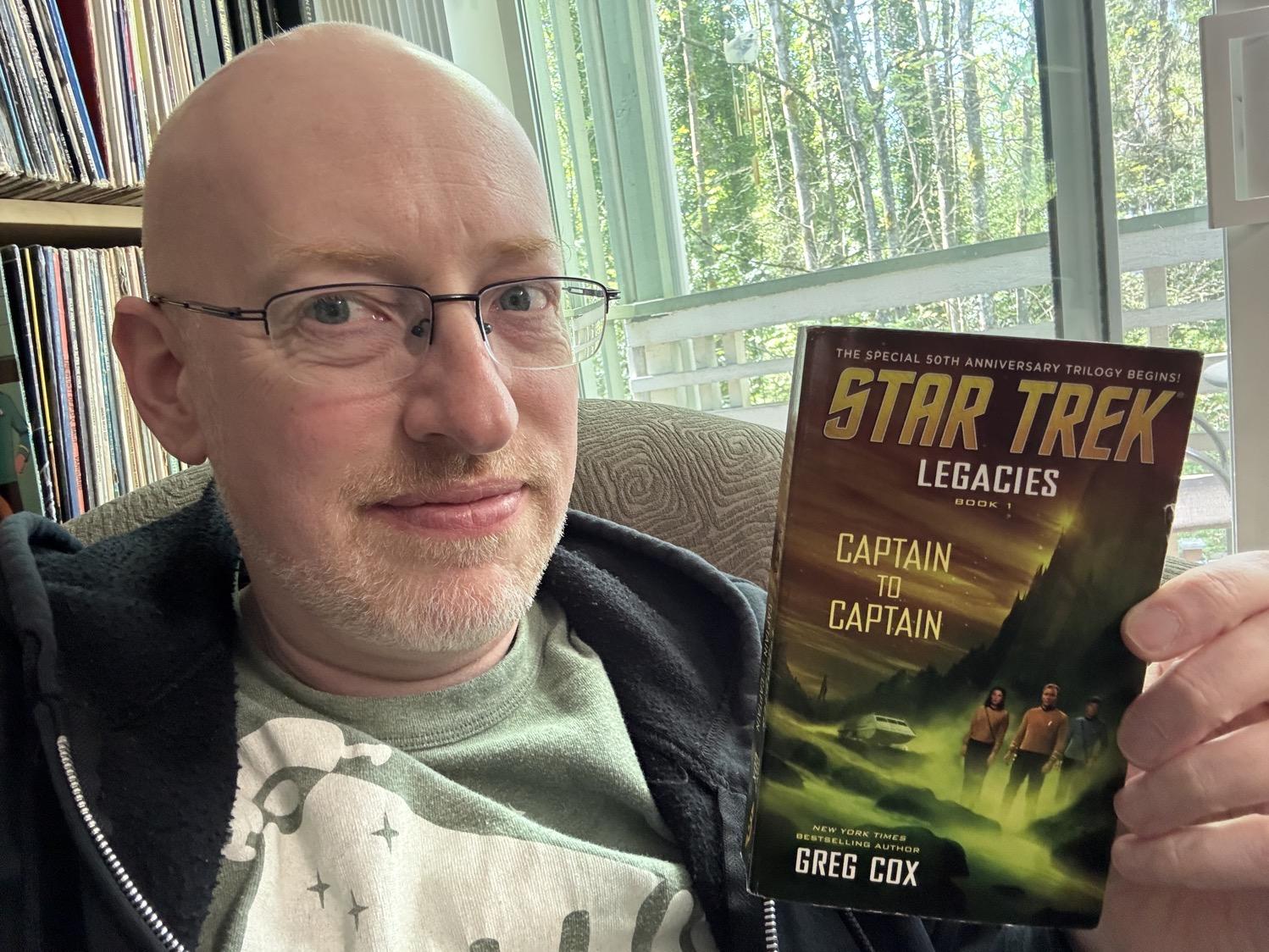
Captain to Captain by Greg Cox; the first of a Star Trek TOS-era trilogy. I’m a bit behind on my book-a-week goal for the year, and diving into Trek books is generally a good way to get caught up.
📺 Watching
We’ve been enjoying History’s Greatest Mysteries from the History channel. It’s about 85% really interesting history, 10% crackpot conspiracy theories, and 5% “ALIENS!!!”
🎧 Listening
As usual, I recorded my set at Norwescon. If you’re looking for some background music to listen to during your day, you could (hopefully) do worse than this! Here’s my First Contact Galactic Gala, three and a half hours of music recorded live at Norwescon 48!
Foz Meadows: Politics in SFF: Arguing With Andy Weir: “…just as baffled, angry transphobes can successfully use a variety of pronouns in everyday life without realizing that’s what they’re called, so too can authors like Andy Weir include politics and social commentary in their works without realizing that’s what they’ve done.”
Catherynne M. Valente: Blood Money: The Anthropic Settlement: “They took the best work of my mind and used it to build the very thing that is actively ruining just about everything all the time. They took the books I wrote for children and used them to make it possible for children to not bother with reading ever again. They took the books I wrote about love to create chatbots that isolate people and prevent them from finding human love in the real world, that make it difficult for them to even stand real love, which is not always agreeable, not always positive, not always focused on end-user engagement. They took the books I wrote about hope and glitter in the face of despair and oppression and used it to make a Despair-and-Oppression generator. ¶ They took my heart and used it to replace me and everyone else.”
Eric Eggert: Screen readers are not testing tools: “Screen readers show the symptoms of bad code, but not the actual problems. They are an indirect way to test.”
Jonaki Mehta at NPR: These blind students say their college blocked their education. A new rule could help: “Digital accessibility is a major concern for students with blindness and other disabilities — an ever-changing landscape that often isn’t designed with disabilities in mind. ¶ Now, that could change: An update to regulations in the Americans with Disabilities Act (ADA), set to take effect at the end of April, will require public institutions to meet new standards that dictate what accessibility should look like.”
Ben Andrews at Digital Camera World: NASA chose an old DSLR as its primary Artemis II camera – here’s why: “There are plenty of premium cameras that could potentially work well for such a special task, but NASA has a long history of trusting Nikon for its photographic requirements, so it’s of little surprise NASA has again picked Nikon for Artemis II. What’s more surprising is the particular Nikon camera bodies you’ll find on board.”
Sophie Hardach at the BBC: Wit, unker, git: The lost medieval pronouns of English intimacy: “Tales of love and adventure from 1,000 years ago reveal a dazzling range of now-extinct English pronouns. They capture something unique about how people once thought about “two-ness”. But why did they die out in the first place?”
Clifford Winston at the New York Times: Where Did All the Affordable Cars Go?: “While politicians and economists scratch their heads at voters upset about affordability in a decent economy, they seem to somehow miss the fact that for most Americans, the purchase of a car has become a debt sentence.”
Spencer Mortensen: Email address obfuscation: What works in 2026?: “Here are some of the best techniques for keeping email addresses hidden from spammers—along with the statistics on how likely they are to be broken.”
Maggie Harrison Dupré at Futurism: AI Use Appears to Have a “Boiling Frog” Effect on Human Cognition, New Study Warns: “In a new study, researchers claim to provide the first causal evidence that leaning on AI to assist with ‘reasoning-intensive’ cognitive labor — mental tasks ranging from writing to studying to coding to simply brainstorming new ideas — can rapidly impair users’ intellectual ability and willingness to persist despite difficulty.”
Colleen Gratzer: Can You Create Accessible PDFs in Affinity?: “I hope that Affinity will continue adding the basic and necessary accessibility features that designers need. But, sorry to say… Affinity just isn’t there yet as a full-on replacement to InDesign for accessibility work.”
Oliver Schöndorfer: Dyslexia friendly fonts: Are they any good?: “TL;DR: So-called dyslexia friendly fonts perform worse than other typefaces, while conveying an either broken or playful aesthetic that might not fit to your project. As a rule of thumb, prefer more common typefaces with a looser spacing, open shapes, and distinct letters.”
Emily M. Bender and Decca Muldowney: Why you should refuse to let your doctor record you: “So what’s the big deal with ‘AI’ charting? Here are nine reasons why we recommend refusing to consent to the use of scribing tools in healthcare settings.”
Shri Khalpada at PerThirtySix: How The Heck Does Shazam Work?: “How audio fingerprinting and a connect-the-dots trick lets Shazam identify a song in seconds.”
Newcastle University: Accessible conferences and events: “These guidelines that we have produced are intended as a checklist for use when planning and running an event. It might feel slightly daunting at first as you are having to rethink aspects of your approach to planning these events but please be reassured that doing something is better than nothing and any attempt to improve accessibility will be welcomed.”
Chris Klimek at NPR: Before sci-fi was everywhere, this pioneering magazine championed ‘scientifiction’: “His portmanteau never quite made it into port. But Gernsback’s innovation of collecting previously-diffuse bits of literature ruminating on scientific discovery or technological advancement in one place proved to be an idea with staying power. The evidence is all around us, on all your streaming services and movie marquees, if not your bookshelves.”
Michaeleen Doucleff at NPR: The surprising origin of 4 features that superglue kids — and adults — to screens: “During the trial in California, the attorney bringing the case accused Meta and Google of designing their apps to behave like ‘digital casinos.’ That’s an apt comparison, according to Schüll’s research, because major design elements of social media have surprising roots in the gambling industry.”
⭐️⭐️⭐️: The first of a trilogy, this is primarily centered on Number One (now more well known from Discovery and Stranger New Worlds) when she was earlier in her career, serving on the Enterprise under Captain April. It’s kind of amusing, as this was written just shortly before her appearances in the modern shows, so it’s definitely Majel Barrett’s version rather than Rebeca Romijn’s. The adventure is fairly standard, with the common-for-modern-novels callbacks and references; nothing groundbreaking so far, but not bad.
⭐️⭐️⭐️⭐️: The last book in a trilogy, and does a good job of wrapping things up…or at least coming to an end, as in-world, the story is far from done. I don’t remember how I discovered the first book in the series, I’m glad I did. A fascinating non-human intelligence, and lots of themes of empathy and caring.
⭐️⭐️⭐️: Not a bad adventure, and does a decent job of trying to rehabilitate the technology from one of TOS’s more ignominious episodes. However, having one of the primary alien races be essentially humanoid evolved deer, complete with being referred to as bucks and does, and described with their antlers and rubbery noses, meant that my mental image of the entire adventure was basically a Star Trek LARP at a furry convention. Kinda worked against really being able to immerse myself in the story.
Recorded live at Norwescon 48, it’s my Thursday night dance, the First Contact Galactic Gala! Three and a half hours (half an hour longer than scheduled; thanks to everyone who stuck around late!) of music for you to enjoy.
Great shot of me DJing by Norwescon photographer Pat White.
⭐️⭐️⭐️: An anthology of stories by (primarily) PNW authors, all of which are…wet. Rain, oceans, fog, mist, bogs…and occasionally some blood. For me, no major standouts, but a few made me laugh, one made me uncomfortable, and overall not at all a bad collection.
Long-time Norwescon people may be amused at seeing this one pop up — the editor and many of the authors were attending professionals at early Norwescons (around the NWC4 and NWC5 era), and I kept seeing it being mentioned in their bios. Eventually, my curiosity kicked in, and I found a used copy online. Mine is copy #22 of a run of 700. Going with the “wet” theme, the cover uses an altered version of publisher Hypatia Press (“Hywetia Press”), and the book is bound in a dark green and printed on light mossy green paper.
Sure, backdating a day, but let’s see if I can get at least one weekly cadence post up before Norwescon throws me off again. :)
So, this past week…not a lot to tell, actually, for most of it
This was spring break week for the college, so things around the office were a little slower and we all got to spend some time catching up on some of the little things that had been pushed into the “in a bit” piles. Not a bad thing at all! Since my wife is a teacher, she got a week at home to rest between quarters.
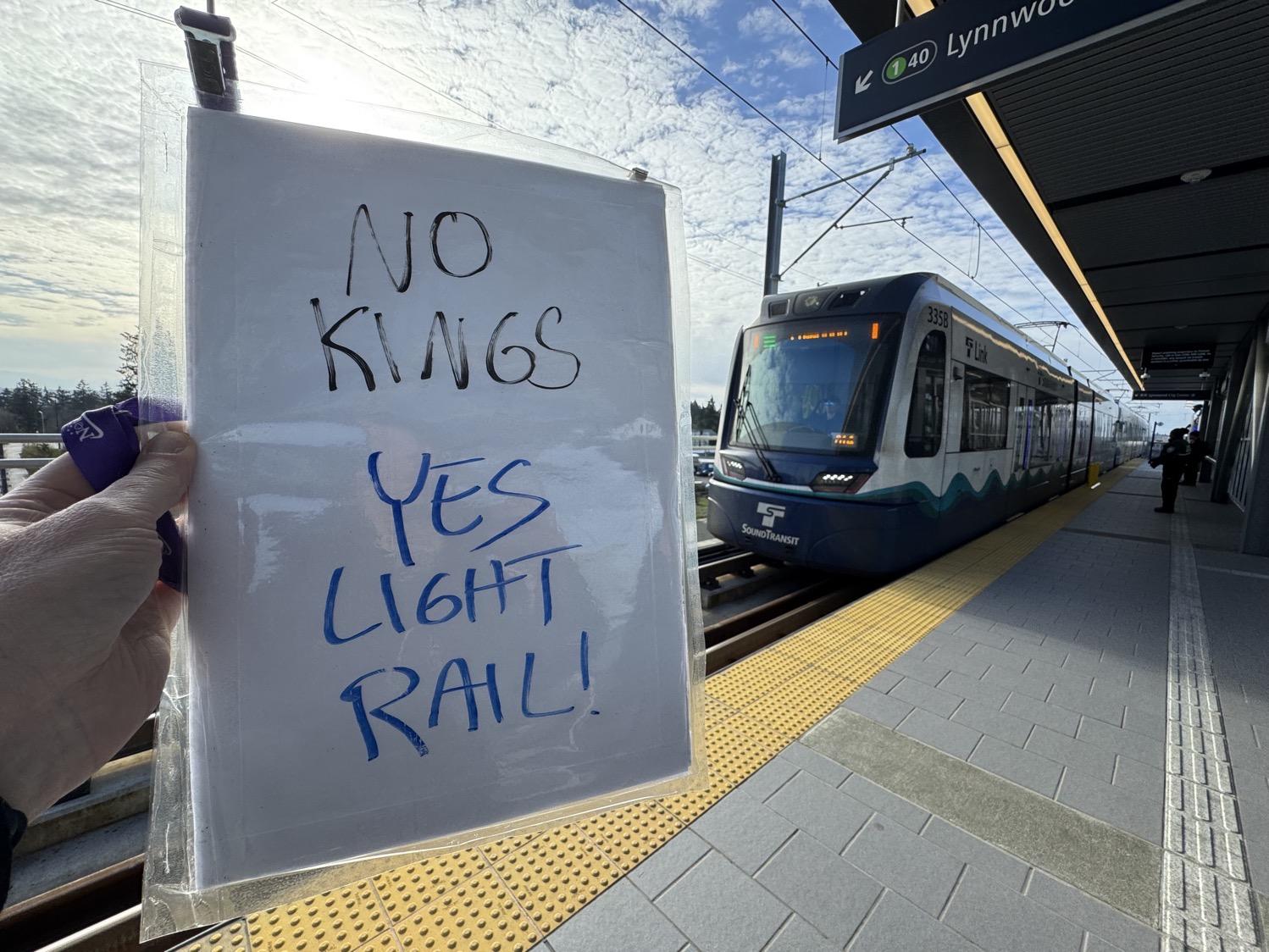
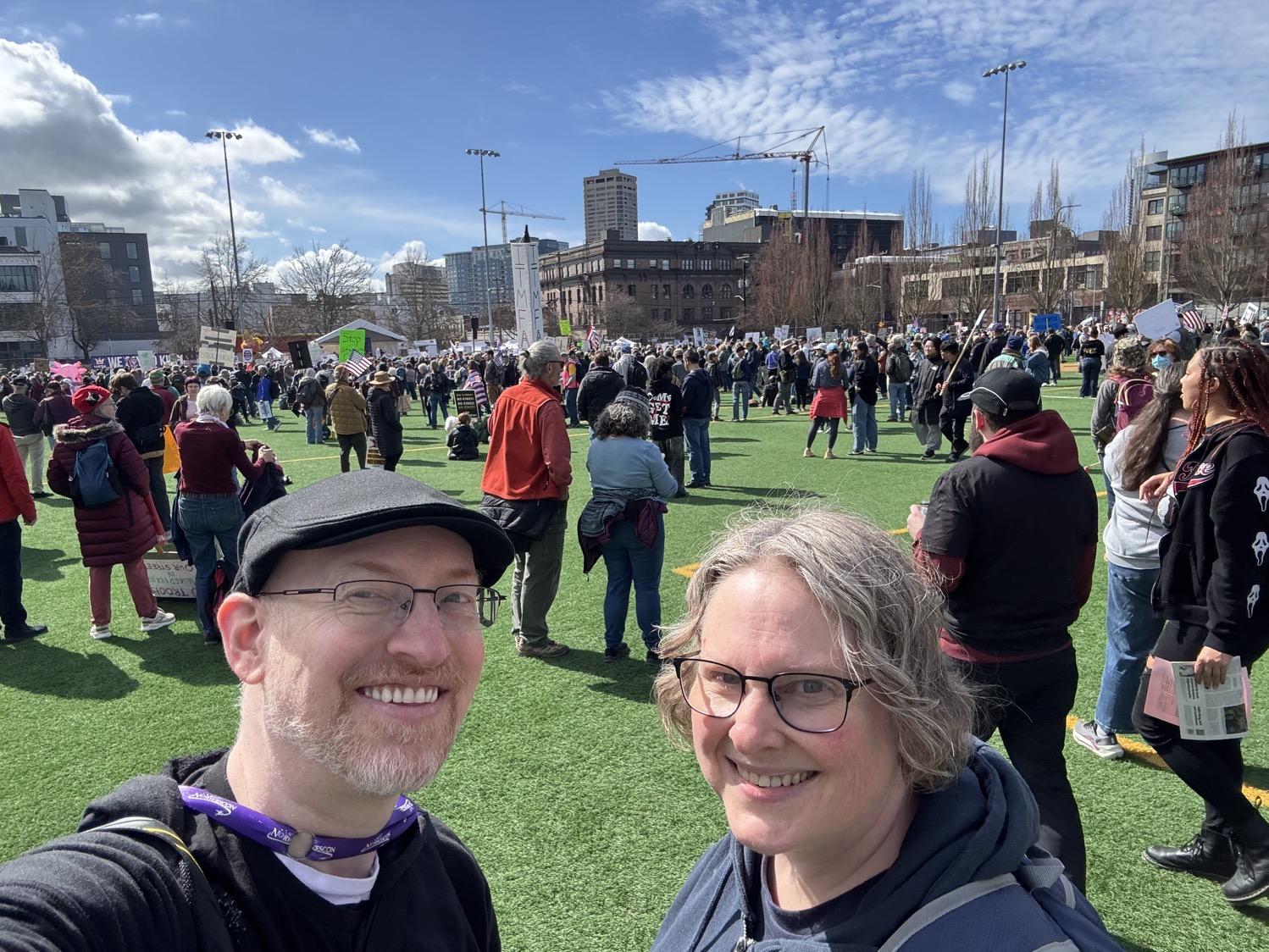
Politically, everything is still a dumpster fire, of course. Saturday was the third No Kings rally and march, which we once again went up to Seattle to participate in. I don’t know how big it actually was (I know they were hoping for 100,000 in Seattle, though I don’t know if an official count has been announced yet), but it definitely felt big. During the march from Capitol Hill to the Seattle Center, we were somewhere in the middle of the pack, and whenever I had a raised view and looked ahead or behind, I couldn’t see either end of the crowd. I took a bunch of pictures, but don’t have them posted yet. Hopefully tonight or tomorrow so I have those up before Norwescon.
📸 Photos
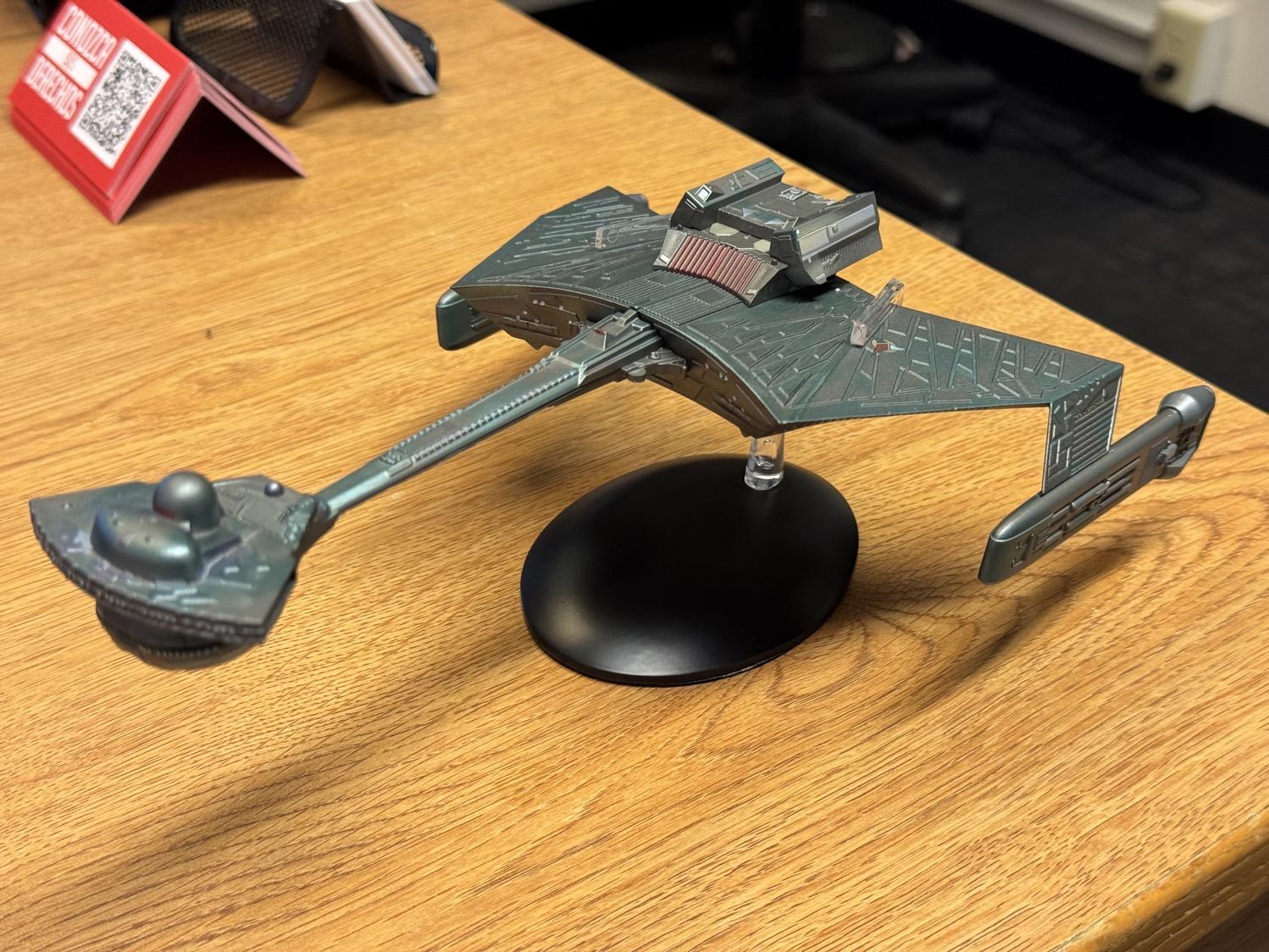
I finally got to add the Klingon K’tinga class battlecruiser to my little fleet of Star Trek model ships on my desktop at work. This is one of my favorite ships from the Trek universe, certainly my favorite non-Federation ship, and was one of the final two models that I’ve been hoping would get re-released. Now down to the last one I’m hoping for, the motion picture Enterprise refit (though I’d settle for the 1701-A, as they’re physically the same, just an updated paint job and new registry number).Since the No Kings rally was on the same day that Sound Transit opened the next bit of Line 2, going across Lake Washington, I made my sign appropriate for both celebrations. We haven’t taken the new Line 2 yet, but we’ll do that eventually.Us at the Cal Anderson park playfield as people gathered for the No Kings rally.
And now, a few week’s worth of collected links. Some may be slightly “old new” by now, but so it goes.
Accessibility
Adrian Roselli: Your Browser Can Already Speak a Page: “Is an “AI” company offering to provide spoken versions of your pages for users? Is an overlay company promising to make your content more accessible by its overlay speaking it? Is some other vendor pitching you on some kind of thing that reads your web pages aloud to users? ¶ You don’t need it. ¶ Or, rather, your users may not need it. Their browser already offers it. At no cost to you. Nor them.”
Amanda Shekarchi at the CBC: When Comicon and other fan conventions focus on accessibility, everyone wins: “Many fan conventions implement accommodations like American Sign Language interpreters, accessible seating at panels and quiet rooms to break from sensory overload. Still, there is a lot of work to be done in terms of making the convention experience fully accessible.”
Entertainment
Eoin Glackin at the Dublin InQuirer: Sixty years on, a Star Trek writer is still creating strange new worlds : “Diane Duane’s early days writing fan fiction have led to a remarkable career as a novelist, comic writer and screen writer.” (Good article, but why is every sentence its own paragraph?)
Charlie Jane Anders: Let Firefly Stay Dead!: “But also, if there is going to be a new show based on one of Joss Whedon’s creations, I think Buffy is a much better choice. Both Buffy and Firefly are chock full of Whedon’s preoccupations and stock characters, but Buffy has more potential to go in a different direction and become properly feminist this time around. Also, I really think it’s time to stop trying to make space westerns a thing.”
History
Jocelyn Timperley at the BBC: The ancient reason there are 60 minutes in an hour: “To understand how we started counting, and still count today, 24 hours in a day, 60 minutes in an hour and 60 seconds in a minute, though, we need to wind the clock back to an era before the dawn of timekeeping. Because it’s the story of one of the earliest number systems that started us off on this track – and explains why this awkward system has long outlived the civilisations who invented it.”
Local
Paul Constant at the Seattle Times: Twice Sold Tales on Capitol Hill offers used books with a side of cats: “The interior of Twice Sold Tales has remained the same, with winding bookcases packed with noteworthy bargains of all kinds — from super-rare art books to paperbacks that will set you back a couple bucks — and all sorts of handwritten signs and other ephemera affixed to the walls. In many ways, wandering the shop feels like exploring a well-thumbed paperback. The shop is staffed with seven cats (who live in the stacks 24/7) and five booksellers (who go home at the end of their shifts).”
Photography
Peter Dench at Amateur Photographer: I took Steve Jobs’ favourite ever portrait – it was all about the preparation: “The resulting portrait shot on film is stark, frontal, almost confrontational in its simplicity. It has become one of the most recognisable images of Jobs ever made. It was used on the cover of Jobs’ biography and Apple’s tribute, with Jobs later calling it his favourite photo. It looks effortless but was all in the preparation.”
Politics
Erin Reed at Erin in the Morning: Kansas Sends Letters To Trans People Demanding The Immediate Surrender Of Drivers Licenses (archive.is snapshot of a Substack original): “As a result of this extreme anti-transgender law, the state of Kansas has seen its status deteriorate to a “Do Not Travel” warning in the EITM Trans Risk Map. Transgender people should exercise extreme caution when traveling through the state, and those already living there should take immediate steps to legally protect themselves in the face of laws that could strip their driving privileges, expose them to criminal penalties, and subject them to thousand-dollar bounties simply for using a restroom. For most transgender people who do not already live in Kansas, the risk is now too great to travel there at all.”
Kelly Jensen at Book Riot: A Nationwide Book Ban Bill Has Been Introduced in the House of Representatives: “H.R. 7661 is an anti-trans bill, and tucked within its provisions are those that ban books for those under 18 that “include sexually oriented material.” This is the same vague language used in numerous states across the U.S. to ban books from public schools and public libraries. This bill includes “lewd” and “lascivious” dancing as prohibited topics or themes. No such books for young readers exist, but facts don’t matter to a regime seeking total and complete control.”
“Staff” at the Kent Reporter: King County blocks construction of ICE detention centers: “Mosqueda said the ordinance is consistent with legislation that has been adopted, or is under consideration by, Tukwila, SeaTac, Port of Seattle, City of Seattle, Baltimore County, Kansas City, Missouri, and other jurisdictions around the country, and ensures that King County’s land use regulations can continue to focus on strengthening public health and community resilience.”
Steve Hunter at the Kent Reporter: Kent City Council passes moratorium on detention centers: “The Kent City Council joined a growing list of King County jurisdictions to adopt a measure to prohibit any new or expansion of jail, corrections or detention facilities in town with expectations that U.S. Immigration and Customs Enforcement (ICE) might be looking to add another center to go with its Tacoma site.”
Karl Bode at TechDirt: 37,000 Fake AI Comments Mysteriously Oppose Washington State’s Effort To Tax The Rich: “Washington State has been exploring the RADICAL SOCIALIST ANTIFA EXTREMIST idea of having the state’s rich actually pay their taxes. That’s not been received particularly well by the extraction class, which has been making empty promises about leaving the state. ¶ Recently the state opened up the public comment system to input, and not too surprisingly it was immediately flooded with upwards of 37,000 fake comments opposing the idea of taxing the rich.”
Aaron Glantz in The Guardian: US veteran charged with ‘conspiracy’ over ICE protest refuses to plead guilty: “The right to protest is ‘supposed to be fundamentally American’, said Bajun Mavalwalla, who walked foot patrols as US army sergeant in the Horn of Panjwai, the birthplace of the Taliban and one of the most dangerous parts of Afghanistan’s Kandahar province. ¶ ‘It’s among the rights that when I joined the military, I thought I was joining to protect,’ he said. ‘You can’t do it violently. You can’t do it in a way that harms other people, but you have a right to stand up for what you believe in.'”
Bret Devereaux: Miscellanea: The War in Iran : “This post is a set of my observations on the current war in Iran and my thoughts on the broader strategic implications. I am not, of course, an expert on the region nor do I have access to any special information, so I am going to treat that all with a high degree of uncertainty. But I am a scholar of military history with a fair bit of training and experience in thinking about strategic problems, ancient and modern; it is this ‘guy that analyzes strategy’ focus that I want to bring to this.”
Technology
Maarten Paulusse at the Eindhoven University of Technology: Are AI-generated summaries suitable for studying and research?: “When dealing with large amounts of text, the process of reading, evaluating, and summarizing can feel daunting. It is understandable to want to outsource this cognitive heavy lifting to a GenAI tool. However, the quality of AI-generated summaries is insufficient for academic use, and they will not provide the coherent, reliable overview you are looking for. Furthermore, by generating a summary instead of writing your own, you miss an essential step in processing, memorizing, and applying information effectively.”
Jon Hicks: My perfect Music app doesn’t exist: I don’t have exactly the same ideal requirements as Jon does, but he captures a lot of the frustration with today’s music options. I’m still (somewhat reluctantly) using Apple’s Music player (for owned, locally stored music most of the time, rather than the Apple Music service), and am making most of my music purchases through Qobuz, as it has the best artist payout.
AJ Dellinger at Gizmodo: Dear Meta Smart Glasses Wearers: You’re Being Watched, Too : “According to a joint investigation published by Swedish newspapers Svenska Dagbladet and Göteborgs-Posten, sensitive and personal footage captured by the devices—including people going to the bathroom, getting dressed, and having sex—is being reviewed by contractors who see all of it uncensored.”
Steve Bonifield at The Verge: Grammarly is using our identities without permission (archive.is snapshot of a paywalled original: “In a statement to The Verge, Alex Gay, vice president of product and corporate marketing at Grammarly parent company Superhuman, commented: ‘The Expert Review agent doesn’t claim endorsement or direct participation from those experts; it provides suggestions inspired by works of experts and points users toward influential voices whose scholarship they can then explore more deeply.'” The feature has since been pulled (and a class action lawsuit filed), but it’s just such egregiously shitty behavior that I didn’t want to drop the link off this roundup.
Mike Masnick at TechDirt: We’re Training Students To Write Worse To Prove They’re Not Robots, And It’s Pushing Them To Use More AI: “The irony of being forced to dumb down an essay about a story warning against the forced suppression of excellence was not lost on me. Or on my kid, who spent a frustrating afternoon removing words and testing sentences one at a time, trying to figure out what invisible tripwire the algorithm had set. The lesson the kid absorbed was clear: write less creatively, use simpler vocabulary, and don’t sound too good, because sounding good is now suspicious.”
Rogi: I Verified My Linkedin Identity. Here’s What I Actually Handed Over.: “Understanding what I actually agreed to took me an entire weekend reading 34 pages of legal documents. ¶ I handed a US company my passport, my face, and the mathematical geometry of my skull. They cross-referenced me against credit agencies and government databases. They’ll use my documents to train their AI. And if the US government comes knocking, they’ll hand it all over — even if it’s stored in Europe, even if I’m European, and possibly without ever telling me. ¶ All for a small blue checkmark on a professional networking site.”
Jeff Johnson: If computers are the future, why are computer users expected to be permanently illiterate?: “The latest front in the war against power users is Artificial Intelligence. The promise of AI appears to be that you’ll never have to learn anything. Don’t know something? Just ask AI for the answer. Can’t do something? Just ask AI to do it. Ignorance is bliss. Laziness is encouraged in the name of efficiency. The prospect that one may have to work and struggle to achieve one’s goals is considered abhorrent. The very notion of self-improvement becomes obsolete. Life under AI is a video game, pure joy… as long as you continue inserting tokens into the machine. Hopefully my video arcade metaphor hasn’t become obsolete too.”
Sam Henri Gold: “This Is Not The Computer For You”: “Nobody starts in the right place. You don’t begin with the correct tool and work sensibly within its constraints until you organically graduate to a more capable one. That is not how obsession works. Obsession works by taking whatever is available and pressing on it until it either breaks or reveals something. The machine’s limits become a map of the territory. You learn what computing actually costs by paying too much of it on hardware that can barely afford it.”
Shubham: The 49MB Web Page: “I went to the New York Times to glimpse at four headlines and was greeted with 422 network requests and 49 megabytes of data. It took two minutes before the page settled. And then you wonder why every sane tech person has an adblocker installed on systems of all their loved ones.”
Stephen Hackett at 512 Pixels: Hide macOS Tahoe’s Menu Icons With This One Simple Tric: “I really dislike Apple’s choice to clutter macOS Tahoe’s menus with icons. It makes menus hard to scan, and a bunch of the icons Apple has chosen make no sense and are inconsistent between system applications. ¶ Steve Troughton-Smith is my hero for finding a Terminal command to disable them.”
Hana Lee Goldin at Card Catalog: Google Has a Secret Reference Desk. Here’s How to Use It.: “The search bar you already have is more capable than that arrangement requires you to know. With the right syntax, it becomes a precision instrument: narrow by domain, by date, by file type, by exact phrase. We can pull up archived pages, surface open file directories, and even find what people said in forums instead of what brands want us to find. None of it requires a new tool or a paid account. The capability has been there the whole time.”